Should Teachers Create a Written Retirement Plan?
A written plan provides clarity and direction. Here’s why it matters.

Learn everything about Market Risk vs Guaranteed Income: Building a Balanced Retirement Portfolio. 60/40 debate updated, role of annuities, sequence of returns risk, bucket strategy.
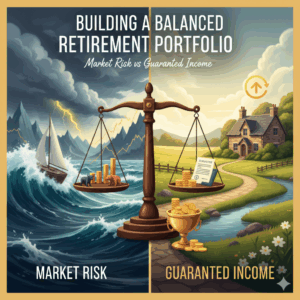
As a licensed financial advisor who’s helped hundreds of pre-retirees navigate the complex world of retirement planning, I’ve witnessed firsthand the anxiety that comes with building a portfolio for your golden years. The traditional 60/40 stock-to-bond allocation that once served as the bedrock of retirement planning is facing unprecedented challenges in today’s economic environment.
With bond yields at historically low levels and market volatility becoming the norm rather than the exception, pre-retirees between 50 and 65 are rightfully questioning whether the old playbook still applies. The answer isn’t simply to abandon time-tested strategies, but rather to evolve them by incorporating both market risk and guaranteed income components into a balanced retirement portfolio.
In this comprehensive guide, we’ll explore how to construct a modern retirement portfolio that addresses sequence of returns risk, leverages the benefits of guaranteed income products like annuities, and implements strategic approaches like the bucket strategy to help ensure your retirement dreams become reality.
Market risk represents the possibility that your investments will decline in value due to economic developments, political events, or changes in market sentiment. While younger investors can typically weather market storms by staying invested for the long term, pre-retirees and retirees face a unique challenge: they may need to withdraw money from their portfolios during market downturns.
One of the most critical concepts every pre-retiree must understand is sequence of returns risk. This refers to the danger of experiencing poor investment returns early in retirement when you’re simultaneously withdrawing funds from your portfolio. Even if your long-term average returns meet expectations, poor performance in the first few years of retirement can permanently damage your portfolio’s ability to sustain your desired lifestyle.
Real-World Example: Consider Sarah, a 62-year-old who retired in 2000 with a $1 million portfolio invested entirely in the S&P 500. Despite the market’s strong long-term performance, the early 2000s bear market combined with her annual $40,000 withdrawals meant her portfolio never recovered to its original value, even after the subsequent bull market. By 2010, she had less than $600,000 remaining.
Today’s market environment presents unique challenges that the traditional 60/40 portfolio wasn’t designed to handle:
Guaranteed income forms the foundation of a secure retirement by providing predictable cash flow regardless of market conditions. This income certainty allows retirees to maintain their standard of living and sleep soundly at night, knowing their essential expenses are covered.
Several vehicles can provide guaranteed income in retirement:
Despite their sometimes controversial reputation, annuities can play a valuable role in balanced retirement portfolios when used appropriately. Modern annuity products have evolved significantly, offering more flexibility and transparency than their predecessors.
Real-World Example: Jim, a 58-year-old engineer, allocated $200,000 of his $800,000 portfolio to a deferred income annuity that will begin paying $1,500 monthly at age 67. This guaranteed income, combined with Social Security, will cover his essential expenses, allowing him to invest the remaining $600,000 more aggressively for potential growth.
Including guaranteed income in your retirement portfolio provides several key advantages:
The traditional 60% stock, 40% bond allocation served investors well for decades, but today’s environment demands a more nuanced approach. Rather than abandoning this foundation entirely, modern portfolio construction should evolve to address current challenges while maintaining core diversification principles.
Several factors have reduced the effectiveness of the classic 60/40 approach:
Contemporary retirement portfolios might include:
The bucket strategy offers an intuitive approach to retirement portfolio management by dividing assets into different “buckets” based on when you’ll need the money and the appropriate risk level for each time horizon.
Bucket 1 – Short-term Needs (0-5 years):
Bucket 2 – Medium-term Needs (5-15 years):
Bucket 3 – Long-term Growth (15+ years):
Real-World Example: Maria, a 60-year-old small business owner, implemented a bucket strategy with her $1.2 million portfolio. Bucket 1 contains $120,000 in cash and short-term investments (one year of expenses). Bucket 2 holds $480,000 in bonds and dividend stocks. Bucket 3 contains $600,000 in growth investments. This structure allows her to avoid selling growth investments during market downturns while maintaining her lifestyle.
Creating an effective balanced retirement portfolio requires careful consideration of your unique circumstances, risk tolerance, and income needs. Here’s a systematic approach to portfolio construction:
Begin by determining the guaranteed income needed to cover essential expenses:
Social Security represents the most valuable guaranteed income source for most retirees. Consider strategies to maximize benefits:
If guaranteed income sources don’t cover essential expenses, consider:
With essential expenses covered, remaining assets can focus on growth and inflation protection:
Effective risk management goes beyond simple diversification. Consider these advanced strategies:
Rather than taking fixed withdrawals regardless of market conditions, consider flexible approaches:
Coordinate withdrawal strategies across different account types:
Healthcare represents one of the largest and most unpredictable retirement expenses:
Building a balanced retirement portfolio is not a one-time event but an ongoing process that requires regular attention and adjustment.
Schedule comprehensive portfolio reviews at least annually to:
Consider partnering with qualified professionals who can provide:
Building a balanced retirement portfolio that effectively manages market risk while providing guaranteed income requires thoughtful planning and ongoing attention. The traditional 60/40 approach, while still relevant, must evolve to address today’s unique challenges of low interest rates, increased volatility, and longer life expectancies.
By incorporating guaranteed income sources, implementing strategies like the bucket approach, and maintaining appropriate diversification across asset classes, you can construct a portfolio designed to weather market storms while providing the income security you need in retirement.
Remember that every individual’s situation is unique, and what works for one person may not be appropriate for another. Consider consulting with a qualified financial advisor who can help you develop a personalized strategy that aligns with your specific goals, risk tolerance, and financial situation.
The key to successful retirement planning is starting with a solid foundation of guaranteed income to cover essential expenses, then building upon that base with growth-oriented investments that can help maintain your purchasing power over time. With careful planning and regular monitoring, you can create a retirement portfolio that provides both security and growth potential for the years ahead.