
Should Teachers Take Lump Sum or Lifetime Income?
Choosing the wrong option can impact your long-term security.

Your investment strategy should evolve in retirement.

Most Texas teachers spend decades building toward a TRS pension — and rightfully so. But the pension is only part of the picture. What you do with your supplemental savings in retirement, and how you structure your investment mix once you stop working, can either protect your income for life or quietly erode it.
Texas teachers can also run a full pension estimate using the Texas Teacher Retirement Calculator to better understand their retirement outlook.
Asset allocation for retired teachers is not the same conversation it was during your accumulation years. The rules of the game change the moment you stop receiving a paycheck. The decisions you make about how to balance growth, income, and risk in retirement can have consequences that are difficult or impossible to reverse.
This guide is written specifically for Texas TRS retirees and near-retirees who want to understand how their investment strategy should evolve — and why getting it wrong costs more than most teachers realize.
For a broader foundation on timing, income options, and benefit decisions, start with the Texas Teacher Retirement Planning Guide.
Most retirement plans look fine on paper. The real problem is that they are never pressure-tested against the actual sequence of events that retirement brings — a bad market in year two, a larger-than-expected healthcare bill, or a Social Security decision that locks in less income than projected. Without stress-testing the plan against real-world conditions, gaps stay hidden until they become costly.
During your working years, a market downturn was an inconvenience. You kept contributing, the market recovered, and your balance climbed back. In retirement, that buffer disappears. You are no longer adding money — you are withdrawing it. A sharp market decline in your first few years of retirement can permanently reduce how long your savings last.
Use the TRS calculator to estimate your pension and identify potential income gaps.
The shift in allocation is not about becoming fearful of growth. It is about recognizing that your relationship with risk has fundamentally changed. Before retirement, you measured risk in terms of volatility and patience. In retirement, you measure it in terms of income reliability and purchasing power over time.
Traditional accumulation thinking points to a simple glide path: as you age, gradually shift from growth-oriented assets toward more stable, income-producing ones. That general principle still applies, but for Texas TRS retirees, the execution requires more precision because the pension itself already changes the equation.
The Texas TRS pension is a defined benefit plan, meaning your monthly benefit is calculated by formula — not by what the market did last year. The pension formula uses a 2.3% multiplier times the average of your five highest annual creditable salaries times your years of credited service to arrive at your annual standard annuity (with an exception for grandfathered members, who use their three highest salaries).
As a concrete example: a teacher with 30 years of service and a final average salary of $60,000 would receive an annual pension of approximately $41,400 — or about $3,450 per month — before any benefit option adjustments or applicable deductions.
(Formula: 30 × 0.023 × $60,000 = $41,400 per year)
That guaranteed monthly income acts as a foundation in your retirement portfolio. It changes how much risk you need to take in your supplemental savings — because a portion of your income floor is already covered regardless of what happens in the market.
A teacher with a pension that covers most or all of their essential monthly expenses can afford to think differently about equity exposure in their 403(b) or other savings than a retiree with no guaranteed income at all. The pension essentially functions like a bond in your overall income picture — providing steady, predictable cash flow. This means some teachers may be able to carry slightly more equity in their investment accounts than conventional rules of thumb suggest, while others may need less growth exposure depending on their total spending needs.
Understanding how to build around that pension base is the foundation of smart retirement income floor planning.
Sequence-of-returns risk is the danger that a sharp market decline in the early years of retirement — when your balance is at its highest and you are beginning to draw from it — causes permanent, compounding damage to how long your money lasts.
Two retirees can experience the exact same average market return over 20 years. If one experiences the poor years first and the good years later, their portfolio can be depleted far sooner than the one who got the good years upfront. The math is unforgiving.
For Texas teachers, the severity of this risk depends heavily on how much of your monthly income comes from TRS versus how much you must withdraw from investment accounts. If your pension covers your essential costs, a market decline in year one hurts your balance but does not threaten your rent payment. If you rely on your 403(b) for a significant portion of daily expenses, the same decline can set off a withdrawal spiral that is hard to recover from.
This is why knowing your exact income gap — the difference between your pension and your total monthly spending — is one of the most important calculations a retiring Texas teacher can make before finalizing any investment allocation.
Effective asset allocation in retirement is not just about reducing stock exposure. It is about aligning different portions of your portfolio to different time horizons and income purposes.
A practical way to think about it:
The exact proportions are not universal. They depend on your TRS pension amount, your expected Social Security benefit (if applicable), your spending level, your healthcare costs, and how long you need your savings to last. These variables are what make generic allocation rules — like “subtract your age from 100 to find your stock percentage” — inadequate for most Texas teachers.
Understanding how long your savings need to last is also part of this calculation. Teachers who retire younger face a longer distribution period and may need to preserve more growth capacity than those who retire later. The relationship between retirement age and portfolio longevity is explored in more depth in how long your retirement savings will last as a teacher.
It is also worth considering whether your timing of retirement — early versus later — changes your income structure in ways that affect the allocation you need. Whether to retire earlier or later has direct implications for how much you will need to draw from supplemental savings before other income sources become available.
Rather than applying a generic allocation rule or simply becoming more conservative because you retired, approach the shift in three deliberate steps.
Step 1: Quantify your income floor. Add up the guaranteed income you will receive each month — TRS pension, Social Security if eligible, and any other guaranteed sources. Subtract your expected monthly expenses. The gap is what your investment portfolio must fill.
Step 2: Match assets to that gap — not to your age. If your pension covers your essential costs, your portfolio gap may be small. In that case, you may not need to be as conservative as a conventional age-based rule would suggest. If your gap is significant, your near-term bucket needs to be larger and better protected.
Step 3: Build sequence-of-returns protection into the structure. Keep enough in low-volatility assets to cover two to three years of income shortfalls so you are not forced to sell equities during a market decline. This is sometimes called a liquidity buffer, and it is one of the most effective structural protections a retiree can build into their plan.
Then stress-test those assumptions. A plan that works in a neutral market environment may not hold up under an extended bear market or an unexpected healthcare expense in your early retirement years. Stress-testing your retirement plan for worst-case scenarios is how you find out whether your structure is actually solid or just optimistic.
Separately, review whether your withdrawal rate from supplemental accounts is sustainable over your expected retirement horizon. Allocation decisions and withdrawal decisions are closely linked — pulling from equities too aggressively in a bad year accelerates portfolio depletion. Understanding safe withdrawal rates for teachers is a necessary complement to any allocation conversation.
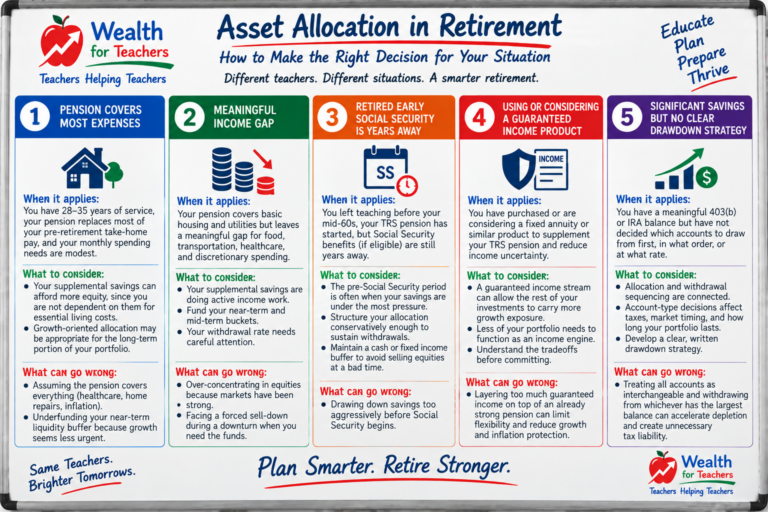
Texas teachers arrive at retirement with very different income profiles, savings balances, and spending needs. The right allocation approach is not the same for everyone. Here are five distinct decision paths you may face.
When it applies: You have 28–35 years of service, your pension replaces most of your pre-retirement take-home pay, and your monthly spending needs are modest.
What to consider: Your supplemental savings can afford to carry more equity than conventional rules suggest, because you are not dependent on them for essential living costs. Growth-oriented allocation may be appropriate for the long-term portion of your portfolio.
What can go wrong: Assuming the pension covers everything when it does not account for healthcare costs, home repairs, or inflation over a 25-year retirement. Underfunding your near-term liquidity buffer because growth seems less urgent can create a squeeze when a large expense hits unexpectedly.
When it applies: Your pension covers basic housing and utilities but leaves a meaningful gap for food, transportation, healthcare, and discretionary spending.
What to consider: Your supplemental savings are doing active income work, not just growing passively. The near-term and mid-term buckets must be adequately funded. Your withdrawal rate from those savings needs careful attention.
What can go wrong: Over-concentrating in equities because markets have been strong, then facing a forced sell-down during a downturn precisely when you need those funds. This is one of the most common and most preventable retirement income mistakes.
When it applies: You left teaching before your mid-60s, your TRS pension has started, but Social Security benefits (if you are eligible) are still years away from beginning.
What to consider: The period before Social Security begins is often when supplemental savings are under the most pressure. Your allocation during this bridge period should be structured conservatively enough to sustain withdrawals without depleting equity positions at a bad time.
What can go wrong: Treating the pre-Social Security period the same as the post-Social Security period and drawing down savings too aggressively before that additional income source activates.
When it applies: You have purchased or are considering a fixed annuity or similar product to supplement your TRS pension and reduce income uncertainty.
What to consider: If a portion of your income is already guaranteed through an annuity, your remaining investment accounts may be able to carry more growth exposure, since less of your portfolio needs to function as an income engine.
What can go wrong: Layering too much guaranteed income on top of an already strong pension can limit your flexibility and leave less capital available for growth and inflation protection over the long term. Understanding the tradeoffs in whether teachers should use guaranteed income products matters before committing.
When it applies: You have accumulated a meaningful 403(b) or IRA balance but have not decided which accounts to draw from first, in what order, or at what rate.
What to consider: Allocation and withdrawal sequencing are connected. Drawing from the wrong account at the wrong time — in terms of tax efficiency and market conditions — can accelerate depletion and create unnecessary tax liability. Account-type decisions interact with your allocation in ways that compound over time.
What can go wrong: Treating all accounts as interchangeable and withdrawing from whichever has the largest balance, without considering tax consequences or market timing, can erode both the portfolio and your after-tax income.
Before finalizing your retirement investment allocation, work through these five diagnostic questions honestly:
Not necessarily. Being too conservative creates its own risk — the risk that your savings do not grow enough to keep pace with inflation over a 20- to 30-year retirement. The goal is appropriate allocation, not maximum conservatism. Your TRS pension already provides a significant fixed-income equivalent. Over-weighting bonds and cash in your investment accounts on top of that may leave your portfolio trailing inflation.
It means you may have more flexibility than someone with no guaranteed income — but aggressive is relative. The key question is how much of your spending needs your pension covers. If your pension leaves a large monthly gap, your investment accounts are doing real income work and need appropriate protection in the near-term bucket. If the gap is small, more growth exposure may be reasonable for the longer-term portion.
Returning to work after TRS retirement has specific rules and can affect your pension payments depending on the type of employment. If returning to work provides additional income that reduces your need to draw from investments, your allocation may be able to carry more growth exposure during that period. The decision to return to work is complex and deserves a separate review of TRS reemployment rules before any action is taken.
If you are eligible for Social Security benefits, they add to your guaranteed income base — similar to the role the TRS pension plays. The Social Security Fairness Act, signed into law on January 5, 2025, repealed the Windfall Elimination Provision (WEP) and Government Pension Offset (GPO), which previously reduced Social Security benefits for many Texas teachers, for benefits payable beginning January 2024. If you were affected by those provisions, your Social Security benefit picture may have changed, and those updated benefit amounts should be factored into your income floor and allocation planning.
At minimum, revisit your allocation when a major life event occurs: retirement itself, a significant health change, the start of Social Security benefits, a change in spending needs, or a major market shift. Allocation is not a one-time decision — it should be reviewed periodically as your income sources, expenses, and time horizon evolve.
One of the most consistent patterns in retirement planning is that teachers discover gaps in their plan after the most consequential decisions have already been locked in. The TRS retirement date is chosen. The benefit option is selected. The 403(b) allocation has not changed in years. Social Security filing has begun. And then — sometimes several years into retirement — it becomes clear that the plan as structured cannot absorb a long market downturn, a major healthcare event, or a spending need that was underestimated during the planning phase.
At that point, the options narrow. Reversing a TRS benefit option selection is not generally possible after retirement. Reconstructing a depleted portfolio takes years, if it is possible at all. Changing course late in retirement is far more difficult and costly than adjusting the plan before those decisions were made final.
This is not a reason to delay retirement — it is a reason to examine the plan carefully before the clock starts. The assumptions that look comfortable in a spreadsheet do not always survive contact with actual retirement conditions: a market down 30% in your first two years, a healthcare bill that exceeds your deductible three years in a row, or a spending pattern that proves higher than estimated. Testing those assumptions before the major decisions are finalized is how teachers protect the retirement they worked decades to reach.
Asset allocation for retired teachers is ultimately about matching your investment structure to the income reality you are actually living — not a theoretical model built on assumptions that may not hold. Your TRS pension is a powerful foundation, but what surrounds it matters enormously. The growth bucket protects you from inflation. The stability bucket protects you from volatility. The liquidity buffer protects you from timing. None of these work in isolation, and none of them work correctly if they are sized to the wrong income picture. Get clear on your numbers, test your assumptions, and build an allocation that reflects where you actually are — not where you were five years ago.
Use the TRS calculator to estimate your pension and identify potential income gaps.