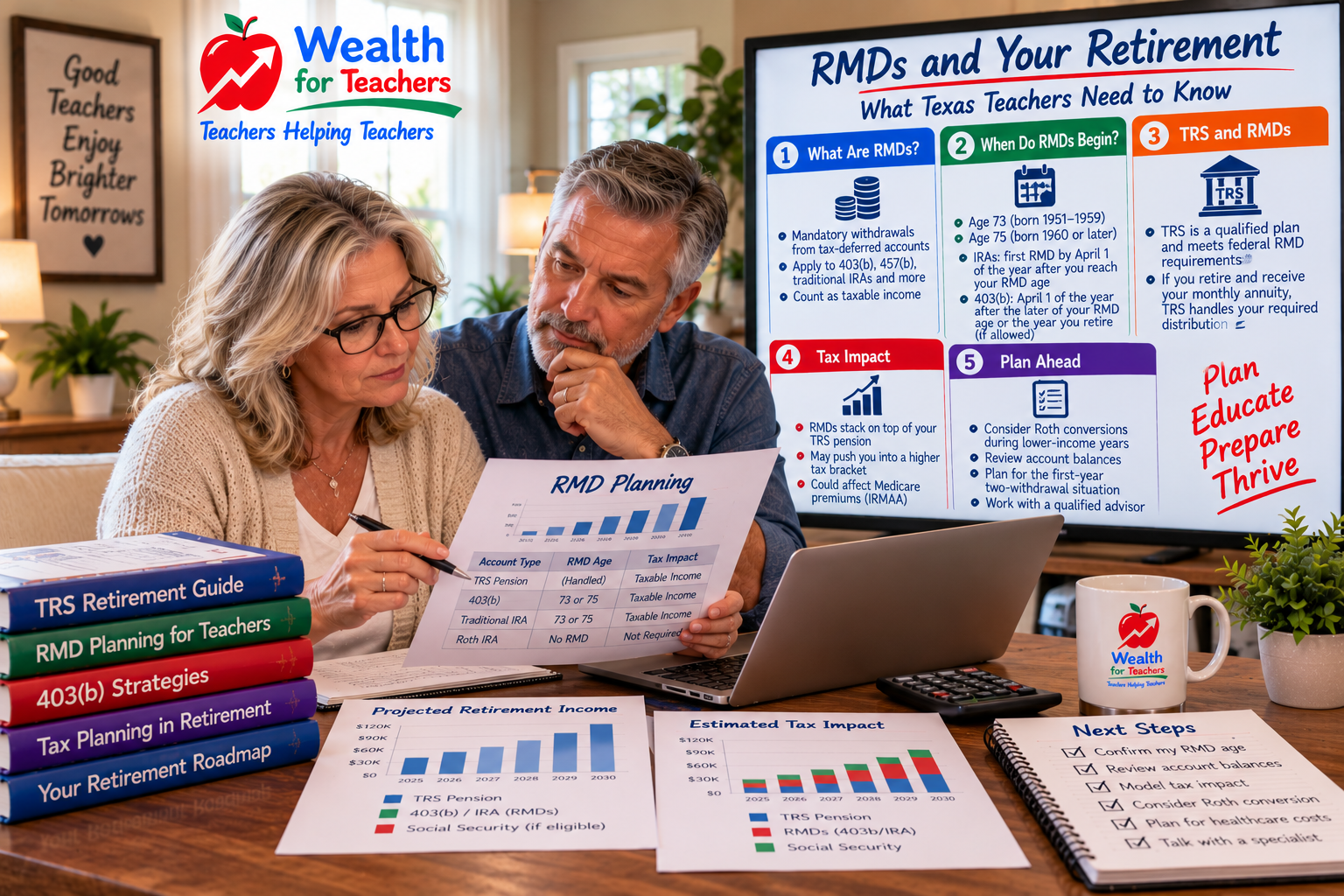
How Required Minimum Distributions Affect Retirement Strategy
Required withdrawals can change your tax and income plan.

Inflation TRS Retirement: How Rising Costs Impact Texas Teacher Pensions Inflation poses one of the biggest long-term threats to your retirement security as a Texas teacher. While your TRS pension provides a foundation for retirement income, understanding how inflation affects your purchasing power over time is crucial for making informed decisions about your financial future. […]

Inflation poses one of the biggest long-term threats to your retirement security as a Texas teacher. While your TRS pension provides a foundation for retirement income, understanding how inflation affects your purchasing power over time is crucial for making informed decisions about your financial future.
Rising costs for housing, healthcare, groceries, and other essentials can significantly erode the value of fixed income sources like your TRS pension. This reality makes inflation planning an essential component of your retirement strategy.
Inflation represents the general increase in prices for goods and services over time. For retirees, this means your money loses purchasing power as years pass. What costs $100 today might cost $130 or more in ten years, depending on inflation rates.
The impact becomes particularly concerning during retirement because you’re typically living on fixed or slowly-growing income sources. Unlike your working years when you might receive annual raises that keep pace with inflation, retirement income often remains static or grows minimally.
Historical data shows that even modest inflation rates compound significantly over long periods. A 3% annual inflation rate means prices double approximately every 23 years. For teachers retiring in their early 60s and living into their 80s or 90s, this represents a substantial erosion of purchasing power.
Healthcare costs present an even greater concern, as they typically inflate faster than general prices. Medical expenses, prescription drugs, and long-term care services often increase at rates exceeding 5% annually, creating additional pressure on retirement budgets.
The Teacher Retirement System of Texas provides cost-of-living adjustments (COLAs) periodically, but these adjustments aren’t automatic or guaranteed. The TRS Board of Trustees must approve COLAs based on the system’s funding status and available resources.
When COLAs are granted, they typically range from 2% to 3% and may not fully offset inflation during periods of higher price increases. The irregular timing and limited scope of these adjustments mean your TRS pension alone may not provide complete inflation protection.
Your TRS pension calculation uses the flat 2.3% multiplier per year of service, applied to your final average salary. This means:
Example only (with stated assumptions): A teacher with 30 years of service and a final average salary of $60,000 would receive:
While this provides a solid foundation, the purchasing power of that $41,400 will decline over time without adequate COLAs or supplemental income sources.
TRS has provided COLAs sporadically over the past two decades. Some periods saw regular adjustments, while others experienced gaps of several years without increases. This unpredictable pattern makes it difficult to count on COLAs for inflation protection.
The funding requirements and legislative approval processes for COLAs mean they often lag behind actual inflation, leaving retirees with reduced purchasing power during the interim periods.
Understanding the mathematical impact of inflation on your retirement income helps illustrate why additional planning is necessary. Even moderate inflation rates create significant long-term effects.
Consider how different inflation scenarios affect a hypothetical $40,000 annual TRS pension over 20 years of retirement:
With 2% annual inflation, your pension’s purchasing power would decline to approximately $26,850 in today’s dollars after 20 years. This represents a 33% reduction in real buying power.
At 3% annual inflation, the same pension would have purchasing power equivalent to about $22,140 in current dollars after two decades—a 45% reduction in real value.
With 4% annual inflation, your pension’s real value would drop to approximately $18,250 after 20 years, representing a 54% loss of purchasing power.
These calculations assume no COLAs during the period. While TRS may provide some adjustments, they historically haven’t fully offset inflation over extended periods.
Creating a diversified retirement income strategy helps combat inflation’s effects. Rather than relying solely on your TRS pension, consider developing multiple income streams that can grow with or ahead of inflation.
Contributing to 403(b) or 457(b) plans available to Texas teachers provides opportunities for inflation-beating growth. These accounts allow your contributions to grow through market investments, potentially outpacing inflation over long periods.
Maximum contribution limits for these plans are substantial, allowing dedicated savers to build significant supplemental retirement wealth. The tax-deferred nature of these accounts also provides current tax benefits.
Traditional and Roth IRAs offer additional retirement savings opportunities beyond employer-sponsored plans. Roth IRAs provide particular benefits for inflation protection since qualified withdrawals are tax-free, eliminating future tax uncertainty.
The ability to invest IRA funds in diverse assets, including stocks, bonds, and real estate investment trusts, provides inflation-hedging opportunities not available through traditional pension systems.
For a full overview if you should, roll your TRS into an IRA when you leave teaching.
Building wealth in regular taxable investment accounts provides flexibility and liquidity that retirement accounts don’t offer. These accounts allow early access to funds without penalties and can hold inflation-hedging investments.
Dividend-growing stocks, real estate investment trusts, and Treasury Inflation-Protected Securities (TIPS) can all play roles in taxable account strategies designed to combat inflation.
Several investment and planning strategies can help protect your retirement purchasing power against inflation’s erosive effects.
Historically, stocks have provided the best long-term protection against inflation. Companies can often raise prices during inflationary periods, maintaining or increasing their real earnings and supporting stock price growth.
Dividend-paying stocks offer particular benefits, as many companies increase dividend payments over time, providing growing income streams that can keep pace with or exceed inflation.
Real estate historically performs well during inflationary periods, as property values and rental income tend to rise with general price levels. Real Estate Investment Trusts (REITs) provide accessible ways to gain real estate exposure without direct property ownership.
REITs often pay substantial dividends and have historically increased these payments over time, providing both current income and inflation protection potential.
TIPS are government bonds specifically designed to protect against inflation. The principal value adjusts with inflation, and interest payments are calculated on the adjusted principal amount.
While TIPS provide direct inflation protection, they typically offer lower returns than stocks over long periods. They work best as part of a diversified strategy rather than standalone solutions.
Including international investments in your portfolio provides exposure to different economic environments and currencies. When U.S. inflation rises, investments in other countries may provide offsetting benefits.
International stocks and bonds can reduce overall portfolio volatility while maintaining inflation-fighting potential through geographic diversification.
Rather than depending entirely on your TRS pension for retirement security, implement a comprehensive approach that addresses inflation risks proactively.
Begin contributing to supplemental retirement accounts as early in your career as possible. Even modest contributions benefit from compound growth over long periods, creating substantial inflation-fighting power.
Automate contributions to remove the temptation to skip payments. Treat retirement savings like any other essential expense that must be paid monthly.
Raise your retirement plan contributions whenever you receive salary increases or cost-of-living adjustments. This strategy helps your savings grow ahead of inflation while maintaining your current lifestyle.
Consider contributing any windfalls, such as tax refunds or bonuses, directly to retirement accounts to accelerate your inflation-protection building.
Create a diversified investment portfolio that includes various asset classes designed to perform well in different economic environments. Don’t concentrate all investments in conservative options that may not keep pace with inflation.
Rebalance your portfolio periodically to maintain appropriate risk levels and ensure your investments align with your retirement timeline and risk tolerance.
Planning for some earned income during early retirement can help bridge the gap between your pension and living expenses while allowing your other investments more time to grow.
Many teachers find fulfillment in substitute teaching, tutoring, or consulting work that provides both income and professional engagement during retirement.
Build flexibility into your retirement spending plans to accommodate changing economic conditions. Having both essential and discretionary spending categories allows you to adjust during high-inflation periods.
Consider maintaining emergency funds specifically for unexpected inflation-related expenses, such as sudden increases in healthcare costs or home maintenance needs.

TRS COLAs aren’t provided on a regular schedule. The Board of Trustees evaluates the system’s funding status and may approve COLAs when financially feasible. Historical patterns show irregular timing, with some periods seeing adjustments every few years and other periods experiencing longer gaps.
Predicting exact real value is impossible due to unknown future inflation rates and COLA decisions. However, you can model different scenarios using historical inflation averages to understand potential purchasing power erosion and plan accordingly.
This depends on your mortgage interest rate, tax situation, and retirement timeline. Generally, if your mortgage rate is low and you have many years until retirement, prioritizing retirement savings often provides better long-term inflation protection through investment growth potential.
TRS manages investments professionally, but individual members don’t control specific investment choices within the pension system. Your inflation protection comes from supplemental retirement accounts like 403(b) or 457(b) plans where you can choose inflation-hedging investments.
Financial experts typically recommend replacing 70-80% of your pre-retirement income. Since TRS may provide 60-70% for career teachers, you’ll likely need supplemental savings to bridge the gap and provide inflation protection. The exact amount depends on your lifestyle goals and expected healthcare costs.
High inflation periods create significant challenges for pension systems. While TRS would likely work to provide COLAs during such periods, the adjustments might not fully offset rapid price increases. This scenario emphasizes the importance of having inflation-hedging investments outside the TRS system.
Working additional years can help in multiple ways: your final average salary increases with inflation-adjusted raises, you gain additional years of service (increasing your pension multiplier), and you have more time to build supplemental savings. However, personal factors like health and family circumstances also matter.
Yes, you can invest any portion of your monthly TRS pension that exceeds your immediate living expenses. Many retirees use this strategy to continue building wealth and fighting inflation even after leaving the workforce.
Get Your Free TRS Retirement Calculations
About the Author: LG Canales spent 16 years as a Texas public school teacher before transitioning to financial services. He specializes in helping educators maximize their TRS benefits and build comprehensive retirement strategies. As founder of Outside The Box Financial Group and the Wealth for Teachers division, LG combines his teaching experience with financial expertise to serve the unique needs of Texas educators.