
How to Build a Retirement Plan That Adapts Over Time
Retirement plans should evolve as life changes.

Spending patterns change after retirement. Learn how to manage it.

Most Texas teachers spend decades carefully building toward retirement. They track their TRS service credit, estimate their pension, and count down the years until they qualify under the Rule of 80 or reach age 65. Then retirement arrives — and the spending decisions begin almost immediately.
Texas teachers can also run a full pension estimate using the Texas Teacher Retirement Calculator to better understand their retirement outlook.
What surprises many teachers is how quickly a retirement spending strategy that looked solid on paper begins to show cracks under real-world conditions. A pension that seemed generous during the planning phase may feel tighter once healthcare costs, tax obligations, and irregular expenses collide in the same budget. The early retirement years — roughly the first three to five years — are when most of the critical adjustments happen, and they are also when the costliest mistakes get made.
This guide is built for Texas teachers navigating that transition. It explains the specific spending risks that surface in early retirement, how to structure a practical retirement spending strategy around your TRS pension, and what to do when your income and expenses don’t line up the way you expected.
For a broader foundation, start with the Texas Teacher Retirement Planning Guide, which covers the full retirement planning picture from TRS eligibility through income management.
A retirement plan that has never been tested against real spending behavior is not really a plan — it is a projection. Most teachers enter retirement with an income estimate and a general sense of what they expect to spend. What they do not have is a stress-tested model that accounts for irregular expenses, tax drag, healthcare transitions, and the behavioral tendency to spend more in the first few years of retirement than in any other phase.
Use the TRS calculator to estimate your pension and identify potential income gaps.
The gap between the projected plan and the actual experience is where retirement spending strategies break down. Understanding that gap — and building a plan that anticipates it — is the core of sound retirement income management for Texas teachers.
Early retirement is not a single financial event. It is a series of overlapping transitions, each with its own spending pressure. Texas teachers face several risks that are specific to their situation.
The first few years of retirement are often the most active — and the most expensive. Travel, home projects, and lifestyle upgrades that were deferred during working years tend to cluster in this phase. Many teachers significantly underestimate how much they will spend in years one through three, which can draw down savings accounts earlier than planned and create pressure later when flexibility is more limited.
Teachers who retire before age 65 face a gap between their retirement date and Medicare eligibility. Texas TRS retirees may be eligible for TRS-Care, but eligibility requirements matter here. Understanding how taxes change after retirement is closely connected to this — healthcare premiums paid out of pocket can affect your effective tax rate and your overall spending plan in ways that are easy to underestimate during the planning phase.
Monthly pension income creates a predictable base, but retirement spending is rarely predictable month to month. Vehicle replacements, home repairs, family support, and medical expenses don’t arrive on a schedule. Teachers who build a monthly budget without a separate reserve for irregular and lumpy expenses often find themselves pulling from long-term savings to cover what should be a short-term cost.
Texas teachers with supplemental savings in a 403(b) or other account face sequence of returns risk — the possibility that early investment losses force them to sell assets at depressed prices before their portfolio has time to recover. If a teacher retires and begins drawing from savings during a market downturn in years one or two, the long-term impact can significantly exceed the short-term loss. This is a risk that a pension-only strategy does not fully address.
Pension income, Social Security income, and distributions from tax-deferred savings accounts are each taxed differently. Many teachers assume their taxes will be lower in retirement and are surprised when required minimum distributions from pre-tax accounts push them into a higher bracket. Understanding how required minimum distributions affect your retirement strategy is critical to avoiding avoidable tax exposure in the middle and later years of retirement.
Your TRS pension is a fixed, lifetime monthly payment calculated using a straightforward formula:
Annual Pension = (Years of Service × 2.3%) × Average of Highest Annual Salaries
To put this in concrete terms: a teacher with 30 years of service and a final average salary of $60,000 would receive an annual pension of $41,400, or roughly $3,450 per month before taxes. That is a meaningful and reliable income floor — but it is not the same as a flexible budget.
Because TRS pension income is fixed, your spending strategy has to be built around that number with discipline. Unlike a salary, you cannot earn more in a difficult month. If irregular expenses arise — and they will — the pension does not expand to meet them. This is exactly why Texas teachers need a retirement spending strategy that goes beyond simply knowing the monthly payment amount.
The pension tier you fall under also affects your final average salary calculation. Depending on when you joined TRS and which tier applies to you, your annuity may be based on your three highest annual salaries or your five highest annual salaries. That distinction can move the needle on your pension amount — and by extension, your baseline spending capacity — more than many teachers realize.
If you are weighing the option to take a Partial Lump Sum at retirement rather than receiving only the monthly annuity, that decision affects your long-term income floor in a meaningful way. The article on lump sum vs. lifetime pension income for teachers covers the tradeoffs in detail.
For years, Texas teachers who also qualified for Social Security benefits faced significant reductions from the Windfall Elimination Provision (WEP) and the Government Pension Offset (GPO). That has changed. The Social Security Fairness Act of 2023 repealed both WEP and GPO — provisions that reduced Social Security benefits when someone received a pension based on work not covered by Social Security — and the law applies to benefits payable for months after December 2023.
Starting in January 2024, Social Security benefits are no longer reduced or eliminated for those who receive a retirement or disability pension from work not covered by Social Security, due to the Social Security Fairness Act of 2023, signed into law on January 5, 2025.
What this means practically: Texas teachers who qualify for Social Security based on prior covered employment may now be eligible for higher Social Security payments than they previously received or anticipated. If Social Security was not previously included in your retirement spending plan because of WEP or GPO reductions, it may be worth revisiting those assumptions. Additional income — even modest amounts — can significantly change the flexibility of your early retirement spending strategy.
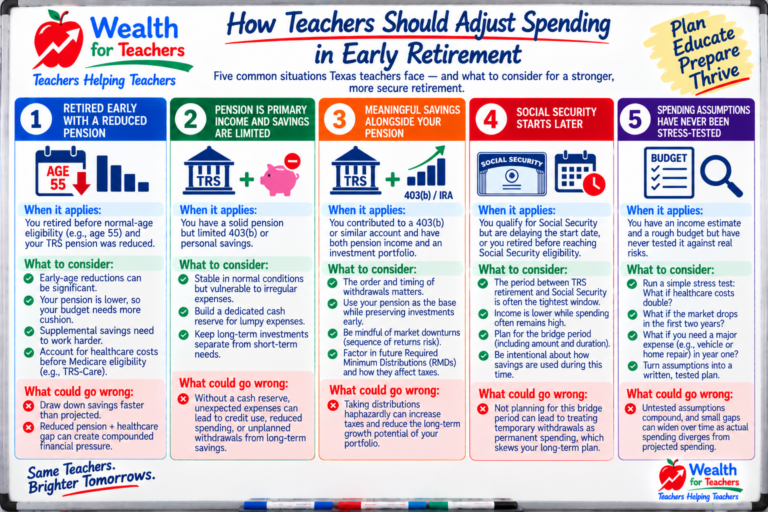
Not every Texas teacher faces the same set of spending decisions in early retirement. The right approach depends on where you are in the transition and what variables are most likely to affect your income and expenses.
When it applies: You retired before meeting normal-age eligibility — for example, at age 55 with enough service but without satisfying the Rule of 80 for your tier.
What to consider: An early-age reduction can be substantial. Depending on your tier and age at retirement, TRS may reduce your standard annuity significantly. A reduced pension as your income floor means less room for spending variation. Your supplemental savings need to work harder and your budget needs more built-in cushion.
What can go wrong: Teachers who retire early and assume the spending plan will “adjust itself” tend to draw down savings faster than projected. The reduced pension, combined with a healthcare coverage gap before Medicare eligibility, creates compounded financial pressure.
When it applies: You have a solid pension but limited 403(b) or personal savings to supplement income.
What to consider: A pension-heavy, savings-light retirement is stable in normal conditions but fragile under irregular expense pressure. Building a cash reserve specifically for lumpy expenses — separate from any investment account — is the most important structural adjustment a teacher in this position can make.
What can go wrong: Without a dedicated cash reserve, every unexpected expense forces a choice between credit, reduced spending in other areas, or drawing from long-term savings in a way that was not planned.
When it applies: You contributed consistently to a 403(b) or similar account and are entering retirement with both pension income and an investment portfolio.
What to consider: The sequencing of withdrawals matters. Drawing from tax-deferred savings in early retirement — particularly during a market downturn — can permanently impair the portfolio’s ability to recover. A coordinated withdrawal strategy that uses the pension as the base while preserving invested assets early is often more effective. Understanding the timing and amount of future required minimum distributions is part of this planning. RMD strategy for teachers directly affects how and when you draw on these accounts.
What can go wrong: Taking distributions haphazardly, without a sequencing plan, increases both tax exposure and long-term depletion risk.
When it applies: You qualify for Social Security benefits but are delaying the start date, or you retired before reaching Social Security eligibility age.
What to consider: The period between your TRS retirement date and your Social Security start date is often the tightest spending window. Your income is lowest, your activity level (and spending) is often highest, and the temptation to draw from savings to bridge the gap is real. Planning specifically for this bridge period — including the amount and duration — is an important part of a complete retirement spending strategy.
What can go wrong: Not accounting for the bridge period causes teachers to treat temporary savings withdrawals as permanent spending, which skews the long-term plan.
When it applies: You have an income estimate and a rough monthly budget, but you have never modeled what happens if healthcare costs rise, the market drops, or an unexpected expense of significant size occurs in years one or two.
What to consider: A plan that has not been tested is not a plan. Running a simple stress test — what happens to my budget if my out-of-pocket healthcare costs double, or if I need to replace a vehicle in year one — reveals structural vulnerabilities that are far easier to address before retirement than after. Creating a written retirement plan is the first step toward turning assumptions into tested projections.
What can go wrong: Untested assumptions compound. Small gaps in the original estimate widen over time as actual spending diverges from projected spending.
Rather than building a retirement spending plan around a single monthly income number, Texas teachers benefit from a layered approach:
If you are unsure whether your current income and spending assumptions hold up under scrutiny, working with someone who specializes in TRS retirement decisions can help. The article on whether teachers should hire a retirement specialist explains what to look for and when outside expertise adds the most value.
Before making any final retirement spending decisions, work through these diagnostic questions honestly. Each gap you identify represents a planning risk worth addressing before it becomes a real-world problem.
Texas TRS has specific rules about returning to work for a TRS-covered employer after retirement. Those rules include required break-in-service periods and surcharge implications for both the retiree and the employer. The details depend on your retirement tier and the type of position. Reviewing TRS guidelines directly before accepting post-retirement employment is important because the rules have changed over time and the wrong decision can affect your pension payments.
TRS does not provide an automatic cost-of-living adjustment. Whether you receive any increase depends on legislative action. This is one of the strongest reasons to build a supplemental savings strategy that can grow over time and absorb the real cost of inflation, rather than relying entirely on a fixed pension payment.
TRS-Care is the health benefit program for eligible TRS retirees. Eligibility is not automatic — it depends on meeting specific service credit and age-plus-service requirements at the time of retirement. Teachers who do not meet the TRS-Care eligibility threshold face independent healthcare costs until Medicare begins at age 65, which can be a significant spending variable in early retirement.
Under the Social Security Fairness Act of 2023, WEP and GPO were repealed for benefits payable beginning January 2024. Texas teachers who also qualify for Social Security based on covered employment are no longer subject to the reductions those provisions imposed. If you previously planned around reduced Social Security income, your assumptions may now be outdated and worth revisiting.
A budget tracks monthly income and expenses. A retirement spending strategy goes further — it accounts for irregular costs, income bridge periods, tax implications, sequence of returns risk, and long-term asset preservation. Texas teachers with a pension, supplemental savings, and a future Social Security payment need a coordinated spending strategy, not just a spreadsheet.
One of the most consistent — and avoidable — patterns in teacher retirement is this: the most consequential decisions get made before the planning work is complete. Teachers choose a retirement date, select a pension option, decide whether to take a lump sum, and determine when to claim Social Security — often before they have fully modeled the downstream spending implications of each choice.
By the time the gaps become visible — a healthcare cost that wasn’t anticipated, a tax bill that was larger than expected, a savings account drawn down faster than projected — several of those decisions are already locked in. A pension option, once selected and finalized, generally cannot be changed. A lump sum, once taken, cannot be converted back into monthly income. A Social Security claim date, once activated, establishes a permanent benefit level.
This is not an argument for paralysis. It is an argument for testing your assumptions before the decisions are irreversible. Running your spending plan against realistic scenarios — higher healthcare costs, a down market in year two, an unexpected irregular expense — reveals vulnerabilities while there is still time to address them. The earlier that work happens, the more options remain available.
Understanding where your plan is solid and where it carries unexamined risk is the foundation of every sound retirement spending strategy for Texas teachers. The decisions you make in the first few years of retirement set the trajectory for decades that follow — and that trajectory is far easier to correct before it starts than after it is already in motion.
Use the TRS calculator to estimate your pension and identify potential income gaps.