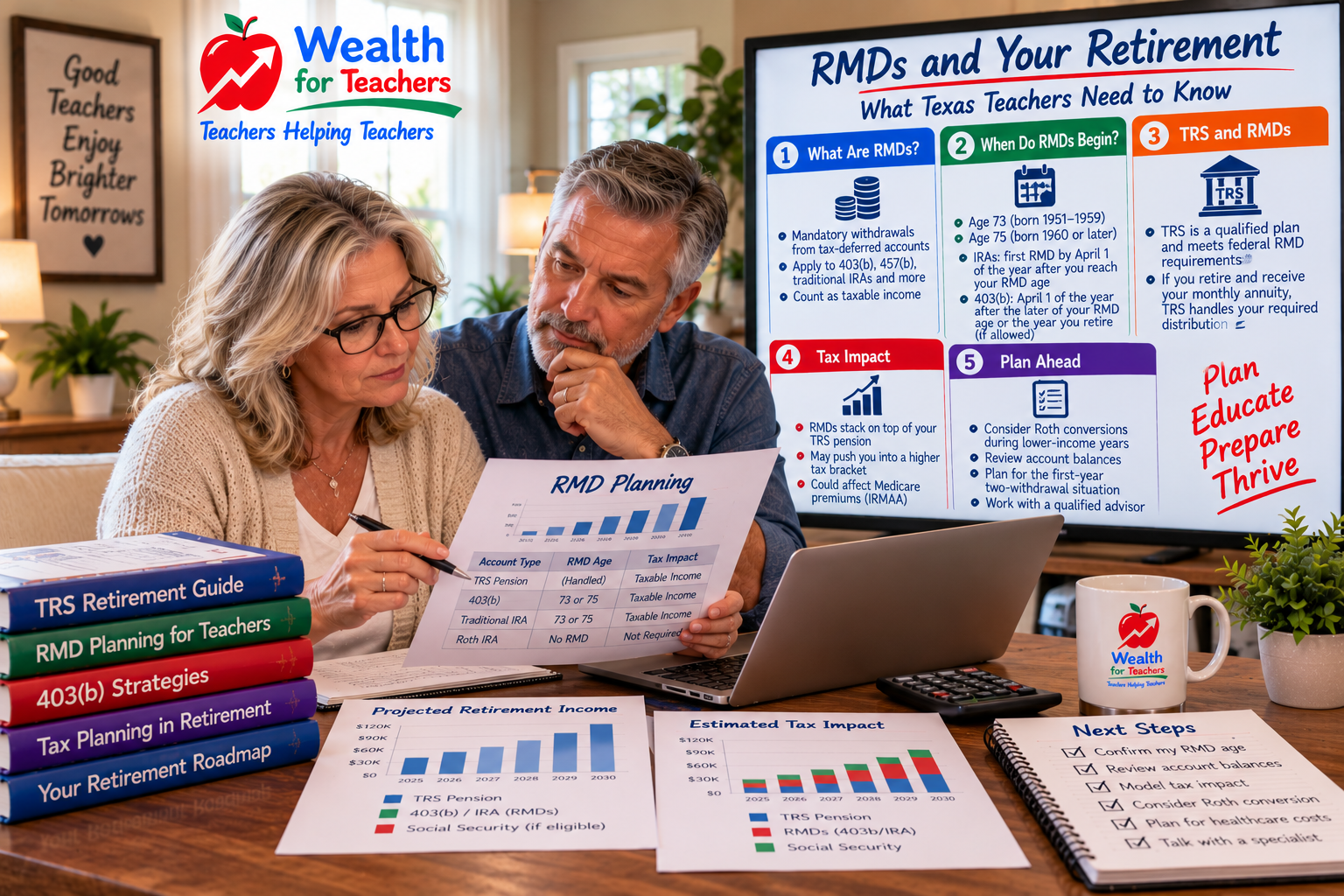
How Required Minimum Distributions Affect Retirement Strategy
Required withdrawals can change your tax and income plan.

TRS sick leave conversion for Texas teachers who want to maximize retirement benefits Texas teachers spend decades building their retirement security through TRS, but many don’t realize they’re sitting on a valuable asset that could boost their final pension calculation. Your unused sick leave represents more than just missed days off—it’s potential service credit that […]

Texas teachers spend decades building their retirement security through TRS, but many don’t realize they’re sitting on a valuable asset that could boost their final pension calculation. Your unused sick leave represents more than just missed days off—it’s potential service credit that can directly increase your monthly retirement check.
When you understand how sick leave conversion works within the Teacher Retirement System of Texas, you can make strategic decisions that add thousands of dollars to your lifetime retirement income. The key is knowing the rules, timing your conversion correctly, and avoiding common mistakes that cost teachers money.
Texas Teacher Retirement System (TRS): Complete guide for educators
The Teacher Retirement System of Texas allows eligible members to convert unused sick leave into additional service credit, which directly increases your years of creditable service for retirement calculation purposes. This conversion happens at retirement and can add valuable time to your service record.
Get Your Free TRS Calculations:
Here’s how the conversion formula works:
This additional service credit gets added to your total years of service, which is one of the key factors in calculating your monthly retirement benefit. Since TRS uses a formula that multiplies your years of service by your average salary and a multiplier percentage, even a small increase in service time can compound into significant additional monthly income.
The conversion only applies to sick leave you’ve actually accumulated and haven’t used. It doesn’t include personal days, vacation time, or other types of leave. Only legitimate sick leave days that remain unused in your account at retirement qualify for this benefit.
Not every Texas teacher can convert sick leave into service credit. TRS has specific eligibility requirements that you must meet to qualify for this benefit.
The sick leave conversion is only available when you retire directly from a TRS-covered position. If you leave TRS employment and later return to work in a non-TRS position, you may lose the ability to convert your accumulated sick leave.
Teachers who take a break from education and work in private sector jobs before returning to teaching need to be particularly careful about maintaining their eligibility. The conversion benefit is designed for educators who complete their careers in TRS-covered positions.
Your school district or employer must have accurate records of your sick leave balance. Discrepancies in sick leave records can delay or prevent conversion, so it’s important to monitor your leave balances throughout your career and address any errors promptly.
Some districts have better record-keeping systems than others. If you’ve worked for multiple districts during your career, make sure all your sick leave has been properly transferred and recorded with your current employer.
Understanding exactly how much additional service credit you’ll receive requires looking at your specific sick leave balance and running the conversion calculation. The math is straightforward, but the impact on your retirement benefit requires more detailed analysis.
Here are some examples of how different sick leave balances convert to service credit:
While these fractions of a year might seem small, they can add up to meaningful increases in your monthly retirement benefit when multiplied by your average salary and TRS multiplier.
Your TRS retirement benefit uses the formula: Average Salary × Years of Service × 2.3% (or applicable multiplier). When sick leave conversion adds to your years of service, it increases this calculation proportionally.
For example, if your average salary is $60,000 and you convert 200 days of sick leave (adding 0.055 years of service), your monthly benefit increases by about $7.59 per month. Over a 20-year retirement, that’s approximately $1,822 in additional lifetime benefits.
Teachers with higher salaries or more sick leave to convert will see proportionally larger increases. The key is that this additional benefit continues for your entire retirement, making the total value much greater than it initially appears.
The timing of your sick leave conversion is automatic—it happens when you file for retirement with TRS. However, understanding when to retire to maximize this benefit requires strategic thinking about your overall retirement planning.
Since you can only convert unused sick leave, teachers approaching retirement need to balance using sick days for health needs while preserving enough days to maximize conversion benefits. This becomes particularly important in your final years of teaching.
Some teachers make the mistake of “saving” all their sick leave for conversion without considering their actual health needs. Remember that sick leave exists primarily to protect your income when you’re ill, not just as a retirement enhancement tool.
Teachers eligible for the TRS Rule of 80: should consider how sick leave conversion affects their total service credit. Additional service credit from conversion might help some teachers reach full benefit eligibility sooner or increase their benefit calculation even under early retirement scenarios.
However, the conversion benefit is relatively small compared to working additional years if you’re close to a milestone like 30 years of service. Running detailed calculations can help determine whether early retirement with sick leave conversion or working longer provides better financial outcomes.
The additional service credit from sick leave conversion doesn’t count toward TRS health insurance eligibility requirements. If you need additional years to qualify for TRS health insurance in retirement, you’ll need actual years of service, not converted service credit.
Converting your sick leave happens as part of your retirement application process with TRS. Understanding the steps helps ensure everything goes smoothly and you receive full credit for your accumulated leave.
When you file your retirement application with TRS, the system automatically calculates your sick leave conversion based on the employment data your district provides. You don’t need to file separate paperwork for the conversion—it’s built into the retirement process.
Your final employer must certify your sick leave balance as part of your retirement paperwork. This is why accurate records throughout your career are so important. Any disputes about sick leave balances need to be resolved before your retirement can be finalized.
Your retirement benefit calculation will include any additional service credit from sick leave conversion. This shows up in your official service credit total and affects your monthly benefit amount from your first retirement check.
TRS provides detailed benefit statements that show how your retirement was calculated, including any service credit from sick leave conversion. Review this documentation carefully to ensure accuracy.
The financial impact of sick leave conversion extends beyond just the immediate increase in monthly benefits. Understanding all the ways this conversion affects your retirement helps you make informed decisions about your end-of-career planning.
The most direct impact is the increase in your monthly TRS retirement benefit. Even small increases compound over time, and since TRS benefits include annual cost-of-living adjustments, the additional benefit grows throughout your retirement.
Teachers with 25+ years of service and high final average salaries see the most significant dollar impact from sick leave conversion. However, even teachers with shorter careers or lower salaries benefit from this additional security.
If you elect survivor benefits for a spouse or beneficiary, the increase in your monthly benefit also increases the potential survivor benefit. This provides additional financial security for your loved ones beyond your lifetime.
The conversion doesn’t affect your ability to choose different survivor benefit options, but it does increase the base benefit amount that survivor benefits are calculated from.
Sick leave conversion only affects your TRS retirement benefit calculation. It doesn’t impact Social Security benefits, 403(b) or 457 plan distributions, or other retirement income sources you may have.
The additional service credit also doesn’t count toward eligibility for other TRS benefits like disability retirement or certain health insurance requirements. It’s purely a retirement benefit enhancement.
Texas teachers often make preventable errors that reduce or eliminate their ability to benefit from sick leave conversion. Being aware of these pitfalls helps you maximize this valuable retirement enhancement.
The most common problem is inaccurate or incomplete sick leave records. Teachers who change districts, take leaves of absence, or have employment gaps sometimes find their sick leave balances aren’t properly tracked.
Keep your own records of sick leave earned and used throughout your career. If you notice discrepancies, address them immediately rather than waiting until retirement.
Some teachers use all their accumulated sick leave in their final years, thinking it’s “use it or lose it.” While sick leave should be used when you’re genuinely ill, completely depleting your balance eliminates the conversion opportunity.
Balance your health needs with the potential retirement benefit. You don’t need to hoard sick days, but maintaining some balance provides both security and retirement enhancement.
Teachers sometimes assume they can convert sick leave even if they don’t retire directly from TRS-covered employment. The conversion benefit is only available when you retire from active TRS membership.
If you’re considering leaving education before retirement age, understand that you may forfeit the ability to convert accumulated sick leave. Factor this into your career planning decisions.
While sick leave conversion provides valuable additional benefits, some teachers overestimate its impact on their retirement security. The conversion should be viewed as a nice bonus rather than a primary retirement planning strategy.
Focus on maximizing your TRS contributions, building additional savings through 403(b) and 457 plans, and planning for healthcare costs in retirement. Sick leave conversion supplements these efforts but doesn’t replace them.
Rather than relying solely on sick leave conversion to enhance your retirement, focus on comprehensive strategies that provide more significant long-term benefits. Smart teachers take a holistic approach to retirement planning that maximizes all available opportunities.
Working additional years provides much more retirement benefit than converting sick leave. If you’re close to a significant milestone like 30 years of service or age 65, consider whether continuing to work makes more financial sense than early retirement with sick leave conversion.
Each additional year of actual service typically increases your retirement benefit far more than the maximum sick leave conversion. Run the numbers to see which option provides better lifetime income.
Use tax-advantaged retirement accounts available to Texas teachers to build additional retirement security. Contributing to 403(b) and 457 plans throughout your career provides much larger retirement benefits than sick leave conversion.
Even small monthly contributions to these accounts can grow to significant sums over a teaching career. The key is starting early and contributing consistently.
Healthcare represents one of the largest expenses in retirement for many teachers. Understanding your options for health insurance in retirement and planning for medical costs provides more security than small increases in monthly pension benefits.
Research TRS health insurance options and consider health savings accounts or other strategies to manage medical expenses in retirement.
Keep detailed records of all your TRS-related employment, including sick leave balances, salary history, and service credit. Accurate records ensure you receive full credit for all benefits you’ve earned.
Create a personal file with copies of all important documents, including annual benefit statements, employment contracts, and leave balances. This documentation becomes invaluable when you’re ready to retire.

Yes, sick leave conversion is available regardless of which TRS retirement option you qualify for. Whether you retire under the Rule of 80, at normal retirement age, or through other eligibility paths, you can convert unused sick leave if you meet the basic requirements and retire directly from TRS-covered employment.
Unfortunately, sick leave conversion benefits are only available to living members who actually retire from TRS. If you die while actively employed, your beneficiaries cannot convert your unused sick leave into additional benefits. However, they may be eligible for other TRS survivor benefits based on your service and contributions.
No, sick leave conversion only affects your TRS retirement benefit calculation. It has no impact on Social Security benefits, which are calculated based on your actual earnings and work history. The additional TRS service credit from conversion doesn’t count as additional Social Security work credits.
You can convert sick leave from your final TRS-covered employer, but rules about transferring sick leave between districts vary. Some districts allow teachers to transfer accumulated sick leave when they change jobs, while others don’t. Check with your current HR department about their sick leave transfer policies and ensure all your eligible leave is properly recorded.
The conversion happens automatically when you file for retirement, so there’s no separate deadline. However, you must retire directly from TRS-covered employment to be eligible. If you leave teaching and don’t file for retirement immediately, you may lose the opportunity to convert your sick leave.
Sick leave conversion doesn’t affect your final paycheck from your employer. You won’t receive cash payment for converted sick leave—instead, it becomes additional service credit that increases your monthly TRS retirement benefit. Some districts may have separate policies about paying out unused leave, but that’s different from the TRS conversion benefit.
Address sick leave record discrepancies immediately with your HR department. You may need to provide documentation like old pay stubs, attendance records, or previous employment verification to correct errors. Resolve these issues before filing for retirement, as TRS uses the official records your employer provides for conversion calculations.
While TRS has a 40-year maximum for benefit calculation purposes under certain circumstances, the small amount of service credit from sick leave conversion rarely affects this limit. The maximum conversion is only about 0.082 years (30 days), which wouldn’t typically push teachers over benefit calculation limits. However, if you’re approaching maximum service limits, consult with TRS directly about your specific situation.
Understanding sick leave conversion is just one piece of comprehensive retirement planning for Texas teachers. Get personalized guidance on optimizing your TRS benefits, building additional savings, and planning for a secure retirement.
TRS sick leave conversion provides Texas teachers with a valuable opportunity to enhance their retirement benefits using unused sick days they’ve accumulated throughout their careers. While the benefit may seem modest compared to your overall retirement planning needs, it represents free additional income that continues throughout your retirement.
The key to maximizing this benefit lies in understanding the rules, maintaining accurate records, and making informed decisions about when to use sick leave versus preserving it for conversion. Remember that this conversion is just one component of comprehensive retirement planning—focus on building strong TRS service credit, contributing to supplemental retirement accounts, and preparing for healthcare costs in retirement.
By taking a holistic approach to retirement planning and understanding all the benefits available through TRS, you can build the financial security you deserve after a career dedicated to educating Texas students. Every small advantage, including sick leave conversion, contributes to your overall retirement success.
For more detailed information about TRS sick leave policies and conversion procedures, visit the official Teacher Retirement Guide or contact TRS directly with specific questions about your situation.
About the Author: LG Canales spent 16 years as a Texas public school teacher before transitioning to financial services. He specializes in helping educators maximize their TRS benefits and build comprehensive retirement strategies. As founder of Outside The Box Financial Group and the Wealth for Teachers division, LG combines his teaching experience with financial expertise to serve the unique needs of Texas educators.