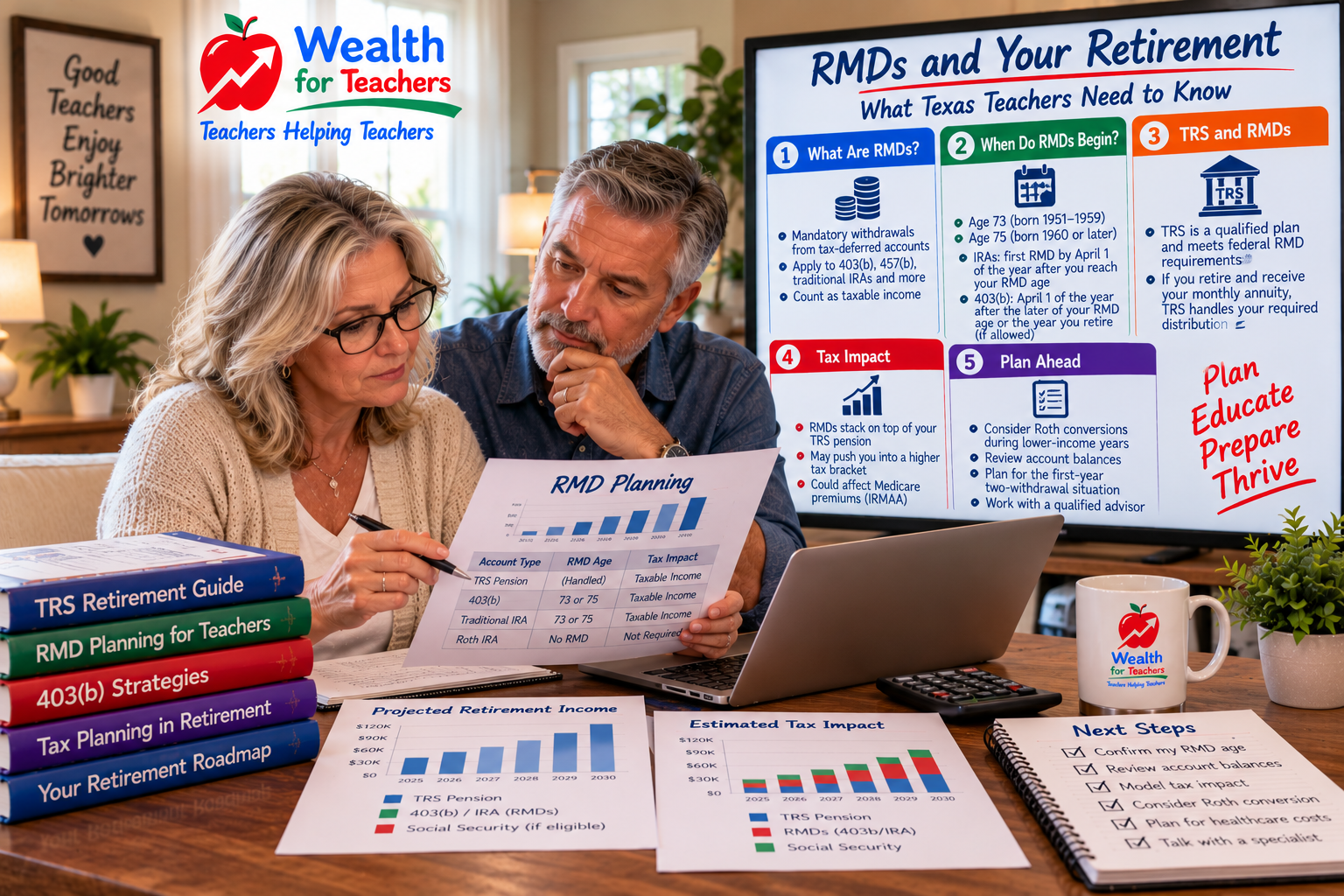
How Required Minimum Distributions Affect Retirement Strategy
Required withdrawals can change your tax and income plan.

Teacher Retirement Planning Timeline: When to Start Planning Your TRS Exit Strategy As a dedicated educator, you’ve spent years shaping young minds and building your career. But when should you start thinking about your teacher retirement planning timeline? The answer might surprise you: it’s never too early, and for many teachers, it’s already later than […]

As a dedicated educator, you’ve spent years shaping young minds and building your career. But when should you start thinking about your teacher retirement planning timeline? The answer might surprise you: it’s never too early, and for many teachers, it’s already later than ideal.
Whether you’re a first-year teacher wondering about your pension or a veteran educator with decades of service, understanding the optimal timing for retirement planning can make the difference between a comfortable retirement and financial stress in your golden years. Texas teachers face unique challenges with TRS benefits, Social Security considerations, and the rising costs of healthcare that require careful, strategic planning.
The ideal time to begin your teacher retirement planning timeline is within your first five years of teaching. This might seem overwhelming when you’re focused on classroom management, lesson planning, and establishing yourself professionally, but early planning provides the most powerful advantage: time.
Starting early allows you to:
However, if you’re reading this and thinking “I wish I had started earlier,” don’t despair. Teachers at any career stage can benefit from strategic retirement planning. The key is starting now and making the most of the time you have remaining.
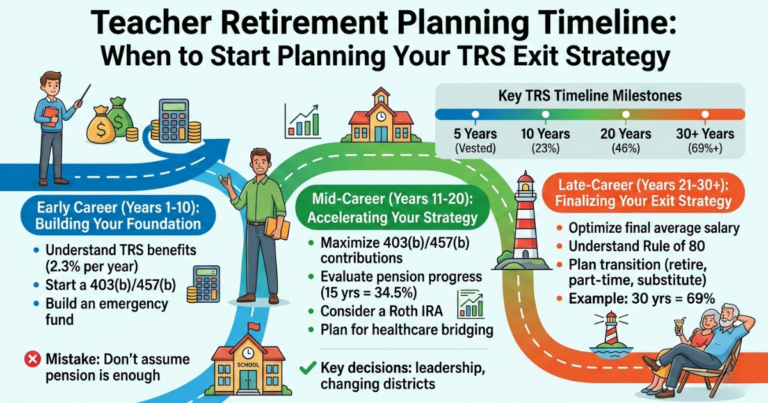
During your first decade of teaching, your retirement planning timeline should focus on understanding the basics and establishing good habits. This is when you have the most time to benefit from compound growth, but it’s also when your salary is typically at its lowest.
Understand Your TRS Benefits: Learn how your pension accumulates. In Texas, you earn a flat 2.3% multiplier for each year of service. After 10 years, you’d have earned 23% of your final average salary as an annual pension benefit.
Example calculation for a teacher with 10 years of service:
Start a 403(b) or 457(b): Even contributing $50-100 per month can grow significantly over 20-30 years. Many teachers overlook these supplemental retirement accounts, but they’re crucial for building wealth beyond your pension.
Build an Emergency Fund: Before focusing heavily on retirement investments, ensure you have 3-6 months of expenses saved. Teaching income can be unpredictable, especially for newer teachers who might face budget cuts or position changes.
Don’t assume your pension will be enough. While TRS provides valuable benefits, most teachers need additional savings to maintain their lifestyle in retirement. Also, avoid job-hopping without considering the impact on your service credit and vesting periods.
This is often the most critical phase of your teacher retirement planning timeline. You’re likely earning more than when you started, but you still have 10-15 years to build substantial wealth outside your pension.
Maximize Retirement Contributions: If you haven’t already, increase your 403(b) or 457(b) contributions. Consider contributing enough to reach the annual limit if your budget allows. For teachers in their 40s, this is your prime wealth-building decade.
Evaluate Your Pension Progress: With 15 years of service, you’d have earned 34.5% of your final average salary (15 years × 2.3%). Start projecting what your final average salary might be and whether your combined pension and savings will meet your retirement goals.
Consider a Roth IRA: Many teachers benefit from Roth IRA contributions, especially if you expect to be in a similar or higher tax bracket in retirement. The tax-free growth can provide valuable flexibility in retirement.
Plan for Healthcare: Start researching healthcare options for early retirees. If you plan to retire before 65 (when Medicare begins), you’ll need to bridge the gap with private insurance or COBRA.
Mid-career is when many teachers consider leadership roles, changing districts, or even leaving education temporarily. Each decision impacts your retirement timeline. Moving to administration might increase your final average salary but could affect your years of service calculation if you leave the classroom.
Teachers in their final decade of service face the most complex retirement planning decisions. Your teacher retirement planning timeline now shifts from accumulation to preservation and distribution strategy.
Optimize Your Final Average Salary: Your TRS pension is based on your highest consecutive five years of salary. Consider how additional responsibilities, summer school, or coaching stipends might impact this calculation.
Understand the Rule of 80: Texas teachers can retire without penalty once their age plus years of service equal 80, with at least five years of service. This might allow you to retire earlier than traditional retirement age while receiving full benefits.
Plan Your Transition: Decide whether you’ll retire completely, work part-time, or pursue substitute teaching. Each option has different implications for your TRS benefits and supplemental income needs.
Example for a teacher ready to retire:
The Teacher Retirement System of Texas operates on a straightforward formula that makes planning easier once you understand the basics. Unlike some pension systems, TRS uses a consistent 2.3% multiplier for each year of service, regardless of when you earned those years. You may also want to understand the differences between TRS Tier 1 vs Tier 2 vs Tier 3.
5 Years: You become vested and eligible for a pension at retirement age. Your benefit would be 11.5% of your final average salary (5 years × 2.3%).
10 Years: You’ve earned 23% of your final average salary as an annual pension. This is when many teachers start seeing TRS as a meaningful part of their retirement security.
20 Years: At 46% of your final average salary, your pension becomes substantial. Many teachers with 20 years of service find they’re about halfway to a comfortable retirement income from TRS alone.
30+ Years: Teachers with three decades of service earn 69% or more of their final average salary, providing a strong foundation for retirement. However, this still typically needs to be supplemented with personal savings.
Understanding when you can access your TRS benefits is crucial for your timeline. You can retire with full benefits at:
Every teacher’s retirement timeline looks different based on when they started teaching, career interruptions, and personal financial goals. Here are three common scenarios:
Sarah started teaching at 22 and plans to retire at 52 with 30 years of service. Her scenario:
Mike started teaching at 35 after a corporate career. His timeline:
Lisa wants to retire at 55 with 25 years of service but doesn’t meet Rule of 80:
While your TRS pension provides valuable retirement security, most teachers need additional savings to maintain their pre-retirement lifestyle. Your teacher retirement planning timeline should include strategies for building wealth outside the pension system.
These employer-sponsored retirement plans are available to most teachers and offer significant tax advantages. The key is starting early and contributing consistently. Even modest contributions can grow substantially over a teaching career.
Consider this example: A teacher contributing $200 per month to a 403(b) for 30 years, earning an average 7% return, would accumulate approximately $245,000. This provides significant additional retirement income beyond the TRS pension.
Many teachers benefit from Roth IRA contributions because:
If your district offers a high-deductible health plan with HSA eligibility, this can be a powerful retirement tool. HSAs offer triple tax benefits and can be used for any expense (not just medical) after age 65 without penalty.
A: Yes, but there are restrictions. You can work up to 1,000 hours per year for a TRS-covered employer without affecting your pension. If you exceed this limit, your pension payments may be suspended. Working for non-TRS employers generally doesn’t affect your pension.
A: If you’re vested (5+ years of service), you can leave your money in TRS and receive a pension when you reach retirement age. You can also withdraw your contributions plus interest, but you’ll forfeit the state’s contribution and any future pension benefits.
A: Texas teachers don’t pay into Social Security on their teaching income, so TRS is your primary retirement benefit. However, you might be eligible for Social Security from other employment. Be aware of the Windfall Elimination Provision, which can reduce Social Security benefits for pension recipients.
A: Purchasing service credit can be beneficial if it helps you reach Rule of 80 or significantly increases your pension. Calculate the cost versus the lifetime benefit increase. Generally, it’s most valuable when it allows you to retire earlier without penalties.
A: This depends on your individual situation, but many teachers find that retiring when they meet Rule of 80 provides the best balance of pension benefits and years to enjoy retirement. However, working a few additional years can significantly increase your final average salary and pension benefit.
A: Most financial experts recommend replacing 70-80% of your pre-retirement income. If your TRS pension provides 60-70% of your final salary, you’ll need additional savings to bridge the gap. A good target is saving 10-15% of your income in supplemental retirement accounts.
A: TRS pensions receive cost-of-living adjustments (COLAs) when the system’s funding allows and the legislature approves them. However, these adjustments aren’t guaranteed and may not keep pace with inflation. This is another reason to build supplemental retirement savings.
A: Your designated beneficiary can receive your TRS contributions plus interest. If you die after retirement, your survivor may be eligible for continued pension payments, depending on the retirement option you selected.
Instead of waiting until you’re close to retirement to start serious planning, take action now regardless of your career stage. Here’s what successful teacher retirees do differently:
Don’t wait for the “perfect” time to begin your retirement planning timeline. Even if you can only contribute $25 per month to a 403(b), start now. You can always increase contributions later as your income grows.
Instead of relying solely on what colleagues say about TRS benefits, read official TRS publications, attend retirement planning workshops, and consider working with a financial advisor who specializes in teacher retirement planning.
Rather than assuming your TRS pension will be sufficient, calculate your actual retirement income needs. Factor in healthcare costs, inflation, and your desired lifestyle. Most teachers need to save independently to maintain their standard of living.
Instead of assuming you’ll teach for exactly 30 years, plan for various scenarios. What if you want to retire early? What if health issues force early retirement? What if pension benefits change? Having contingency plans provides security and options.
Rather than coasting through your final years of teaching, consider how to optimize your final average salary. Take on additional responsibilities, pursue advanced degrees with salary increases, or coach sports if the stipends count toward your retirement calculation.
Instead of stopping work abruptly, plan a gradual transition to retirement. Consider substitute teaching, educational consulting, or part-time positions that provide income while allowing you to start enjoying retirement gradually.
Your teacher retirement planning timeline is unique to your situation, but starting early and planning strategically will give you the best chance of achieving the retirement you’ve earned through your dedicated service to education. Take the first step today, and your future self will thank you.
About the Author: LG Canales spent 16 years as a Texas public school teacher before transitioning to financial services. He specializes in helping educators maximize their TRS benefits and build comprehensive retirement strategies. As founder of Outside The Box Financial Group and the Wealth for Teachers division, LG combines his teaching experience with financial expertise to serve the unique needs of Texas educators.