Early TRS Retirement: Understanding Your Options as a Texas Teacher
Thinking about leaving the classroom before you reach full retirement eligibility? You’re not alone. Many Texas teachers consider stepping away from their careers early for various reasons – burnout, family obligations, health concerns, or simply wanting to pursue other opportunities while they’re still young enough to enjoy them.
The decision to retire early from the Teacher Retirement System of Texas (TRS) is complex and comes with significant financial implications. Unlike some career fields where early retirement might mean accessing a full pension with minor reductions, TRS has specific rules and penalties that can dramatically impact your monthly benefits for the rest of your life.
This guide will help you understand exactly what early retirement means within the TRS system, the financial costs involved, and alternative strategies that might better serve your long-term financial security.
Teacher Retirement Planning
Table of Contents
What Qualifies as Early TRS Retirement
In the TRS system, early retirement occurs when you choose to begin receiving your pension benefits before meeting the standard retirement requirements. The normal retirement scenarios for Texas teachers are:
- Age 65 with at least 5 years of service credit
- Age 60 with at least 5 years of service credit
- Any age when your age plus years of service equals 80 (the Rule of 80)
If you don’t meet any of these criteria but have at least 5 years of service credit, you can still choose to retire early. However, this decision comes with permanent reductions to your monthly pension that will affect you for the entire duration of your retirement.
The earliest you can begin receiving TRS retirement benefits is age 55, provided you have at least 5 years of creditable service. Retiring between ages 55-59 without meeting the Rule of 80 is considered early retirement and triggers actuarial reductions.
Service Credit Requirements
Regardless of when you choose to retire, you must have accumulated at least 5 years of creditable service with TRS. This service doesn’t have to be consecutive, but it must total at least 5 full years. Partial years count toward this requirement based on the actual days worked during the school year.
The Financial Impact of Early Retirement
The financial consequences of early TRS retirement are substantial and permanent. Unlike temporary penalties that might be lifted at a certain age, the reductions applied to your pension for early retirement last for your entire lifetime.
Actuarial Reduction Rates
TRS applies actuarial reductions based on how early you retire before age 60. These reductions are calculated to account for the longer period over which you’ll receive benefits. The reduction rates are:
- 6% per year for each year you retire before age 60
- Applied monthly, which equals 0.5% per month
- Calculated based on your exact age at retirement
For example, if you retire at age 55, you’ll face a 30% reduction in your monthly pension (5 years × 6% = 30%). This means you’ll receive only 70% of what your full pension would have been.
Long-term Financial Impact
The cumulative effect of these reductions over a retirement that could span 30-40 years is enormous. Consider a teacher who would have received $3,000 per month at full retirement but chooses to retire at 55. With the 30% reduction, they’ll receive $2,100 per month instead.
Over 30 years, this represents a loss of $324,000 in pension income ($900 per month × 12 months × 30 years). This doesn’t account for annual cost-of-living adjustments, which would make the actual loss even greater.
How Early Retirement Affects Your Pension Calculations
Understanding how TRS calculates your pension is crucial for making an informed decision about early retirement. The basic formula remains the same whether you retire early or at full retirement age, but the early retirement reductions are applied after the base calculation.
The TRS Pension Formula
TRS uses a straightforward formula with a flat 2.3% multiplier for each year of service:
Annual Pension = (Years of Service × 0.023) × Final Average Salary
Let’s walk through an example calculation:
Example (assumptions stated for illustration):
- Years of Service: 20 years
- Final Average Salary: $65,000
- Retirement Age: 55
Step 1: Calculate Base Benefit Percentage
Benefit % = 20 years × 2.3% = 46%
Step 2: Calculate Full Retirement Pension
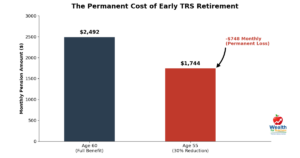
Annual Pension = $65,000 × 46% = $29,900 per year ($2,492 per month)
Step 3: Apply Early Retirement Reduction
Retiring at 55 means 5 years before age 60: 5 × 6% = 30% reduction
Reduced Annual Pension = $29,900 × (100% – 30%) = $20,930 per year ($1,744 per month)
This teacher loses $748 per month ($8,970 annually) by retiring early, and this reduction is permanent.
Understanding the Rule of 80
The Rule of 80 is often misunderstood by teachers considering early retirement. This rule allows you to retire without actuarial reductions when your age plus years of service equals or exceeds 80. However, it’s not necessarily “early” retirement in the traditional sense.
How the Rule of 80 Works
To qualify for unreduced benefits under the Rule of 80, you need:
- Combined age and service credit totaling at least 80
- Minimum age of 55
- At least 5 years of creditable service
For example, a teacher who is 58 years old with 22 years of service meets the Rule of 80 (58 + 22 = 80) and can retire with full benefits. However, a 45-year-old teacher with 35 years of service, despite having more than 80 combined, must wait until age 55 to retire.
Strategic Planning for the Rule of 80
If you’re close to meeting the Rule of 80, it often makes financial sense to continue working rather than retire early with reductions. Even one additional year of service can make a dramatic difference in your lifetime pension income.
Consider purchasing additional service credit if you’re close to the Rule of 80. TRS allows members to purchase credit for various types of service, including military service, out-of-state teaching, or leave without pay. This purchased service counts toward both your years of service calculation and the Rule of 80.
Health Insurance Considerations
One of the most significant challenges of early retirement is maintaining health insurance coverage. TRS provides retiree health insurance, but the eligibility requirements and costs vary significantly based on when you retire.
TRS-Care Eligibility
To be eligible for TRS-Care (the retiree health insurance program), you must:
- Be receiving a monthly TRS pension
- Have at least 10 years of creditable service
- Meet certain age and service requirements
If you retire early without meeting the Rule of 80, you may face higher premiums for TRS-Care coverage. Additionally, if you’re under age 65, you’ll need to maintain this coverage until you’re eligible for Medicare.
COBRA and Alternative Options
Some teachers consider using COBRA continuation coverage from their active employment, but this is typically only available for 18-36 months. After COBRA expires, you’ll need to find alternative coverage, which can be expensive for individuals not yet eligible for Medicare.
Marketplace insurance plans under the Affordable Care Act might be an option, but premiums can be substantial, especially if your reduced pension income affects your eligibility for subsidies.
Social Security and Medicare Implications
Early retirement from TRS doesn’t affect your eventual eligibility for Social Security or Medicare, but it does impact your financial planning for these programs.
Social Security Considerations
Most Texas teachers don’t pay into Social Security on their teacher salary, so they won’t receive Social Security benefits based on their teaching career. However, if you’ve worked in other jobs that paid Social Security taxes, you might be eligible for benefits.
Be aware of the Windfall Elimination Provision (WEP), which can reduce Social Security benefits for people who also receive pensions from employment where they didn’t pay Social Security taxes. This includes TRS pensions.
Medicare Planning
You become eligible for Medicare at age 65, regardless of when you retire. If you retire early from TRS, you’ll need to bridge the gap between your retirement and Medicare eligibility with other health insurance options.
Planning for Medicare premiums is important, as these will be ongoing costs throughout your retirement. Medicare Part B premiums are based on your income, so your pension amount will affect these costs.
Common Questions Texas Teachers Ask
Can I return to work after taking early retirement from TRS?
Yes, but there are strict limitations. If you retire and later return to TRS-covered employment, you’ll face restrictions on your earnings and may have to suspend your pension payments. The rules are complex and vary based on how long you’ve been retired and the type of position you take.
What happens to my TRS contributions if I retire early?
Your contributions remain yours regardless of when you retire, as long as you have at least 5 years of service. These contributions, plus interest, are factored into your pension calculation. You cannot withdraw your contributions once you begin receiving monthly pension payments.
Can I roll my TRS account to an IRA if I retire early?
No, TRS is a defined benefit pension plan, not a defined contribution plan like a 401(k). You cannot roll your TRS pension to an IRA. However, if you have a 403(b) or 457(b) account from your school district, those accounts can typically be rolled over.
How does early retirement affect my beneficiary benefits?
Early retirement reductions generally don’t affect the death benefits available to your beneficiaries. However, the reduced monthly amount you receive will impact any survivor benefits that are calculated as a percentage of your pension.
Can I purchase additional service credit to avoid early retirement penalties?
Purchasing service credit can help you meet the Rule of 80 or reach other retirement milestones sooner. However, you cannot purchase service credit specifically to avoid early retirement reductions if you’re already below the minimum retirement age.
What if I have both TRS and Social Security from other jobs?
Having both doesn’t prevent early retirement from TRS, but be aware of the Windfall Elimination Provision and Government Pension Offset, which can reduce your Social Security benefits. These federal rules affect many public employees who have pensions from non-Social Security covered employment.
Should I take a lump sum instead of monthly payments if I retire early?
TRS doesn’t offer lump-sum distributions for service retirement. You’ll receive monthly payments for life once you begin your pension. The only exception is if your calculated monthly benefit is extremely small, in which case TRS might offer a small lump sum instead.
How do I calculate the exact reduction for my early retirement?
The reduction is 6% per year (0.5% per month) for each month you retire before age 60. TRS calculates this precisely based on your exact retirement date and birthdate. You can request a retirement estimate from TRS for your specific situation.
What to Do Instead of Early Retirement
Before making the decision to retire early from TRS, consider these alternative strategies that might better serve your financial future while still addressing your desire to change your current situation.
Take a Leave of Absence
If burnout or stress is driving your desire to retire early, consider taking a sabbatical or unpaid leave of absence. This gives you time to recharge without permanently reducing your pension benefits. Many school districts offer sabbatical programs for experienced teachers.
During a leave of absence, you can:
- Maintain your position and benefits
- Return refreshed and reenergized
- Continue building service credit toward retirement
- Avoid the permanent financial penalties of early retirement
Transfer to a Different Role
Consider moving to a different position within education that might be less stressful or better suited to your current life stage. Options might include:
- Instructional coaching or curriculum development
- Administrative roles
- Adult education or community college teaching
- Educational consulting
- Part-time teaching positions
These positions often still qualify for TRS participation, allowing you to continue building your pension without the stress of a traditional classroom.
Plan a Phased Retirement
Work with your district to create a phased retirement plan. Some districts allow experienced teachers to reduce their workload gradually while maintaining benefits. This might involve:
- Job sharing arrangements
- Teaching part-time
- Mentoring new teachers
- Special project assignments
Focus on Financial Independence
Instead of retiring early with reduced benefits, focus on building wealth outside of TRS that will allow you to retire comfortably when you reach full retirement eligibility. This approach involves:
- Maximizing contributions to 403(b) and 457(b) plans
- Building emergency savings
- Investing in taxable accounts
- Reducing debt and living expenses
- Potentially working summer jobs or side hustles
Calculate Your “Coast” Number
Determine the minimum amount you need to save now that will grow to support your retirement needs. This “coast” number represents the point where you could stop saving entirely and still have adequate retirement funds by age 65.
Once you reach this number, you might feel more comfortable making career changes or taking lower-stress positions, knowing your retirement security is already established.
Consider Geographic Arbitrage
If your desire for early retirement is driven by financial stress, consider moving to an area with a lower cost of living while continuing to teach. Your TRS benefits are portable within Texas, and moving to a less expensive area can dramatically improve your quality of life without sacrificing your pension benefits.
Explore Alternative Revenue Streams
Develop income sources outside of teaching that could eventually replace your teaching salary. This might involve:
- Online course creation
- Educational consulting
- Tutoring or test prep services
- Writing educational materials
- Summer camp or enrichment program work
Building these revenue streams while still teaching allows you to transition gradually and maintains your TRS benefits until you reach full retirement eligibility.
Get Professional Financial Guidance
Before making any major decisions about early retirement, consult with a financial advisor who understands TRS and teacher-specific financial planning. They can help you model different scenarios and understand the long-term implications of your choices.
A good financial advisor can also help you optimize your 403(b) and other retirement savings, potentially creating enough wealth outside of TRS to make early retirement financially viable without taking the pension reductions.
The decision to pursue early retirement from TRS is one of the most significant financial choices you’ll make in your career. While the desire to leave teaching early is understandable, the permanent financial consequences require careful consideration. In most cases, finding alternative solutions that allow you to reach full retirement eligibility will serve your long-term financial security much better than accepting the substantial penalties that come with early retirement.
Take time to explore all your options, run the numbers carefully, and consider seeking professional guidance before making this irreversible decision. Your future self will thank you for the careful planning you do today.
Avoid Costly Teacher Retirement Mistakes
Get Your Free Guide: 10 Money Mistakes Teachers Make
Get Your Free Guide →
About the Author: LG Canales spent 16 years as a Texas public school teacher before transitioning to financial services. He specializes in helping educators maximize their TRS benefits and build comprehensive retirement strategies. As founder of Outside The Box Financial Group and the Wealth for Teachers division, LG combines his teaching experience with financial expertise to serve the unique needs of Texas educators.