
How Teachers Can Maintain Financial Confidence in Retirement
Confidence comes from clarity and planning—not guesswork.

Living longer can create financial pressure if not planned for.

Most Texas teachers spend decades building toward retirement. They track their TRS service credit, estimate their pension, and choose a retirement date. What many do not plan for is what happens if that retirement lasts 25, 30, or even 35 years.
Texas teachers can also run a full pension estimate using the Texas Teacher Retirement Calculator to better understand their retirement outlook.
Longevity planning for teachers is not just about living a long life. It is about making sure your income, savings, and health coverage hold up across a retirement that could span more years than your entire teaching career.
Living longer can create serious financial pressure if your plan was built only around early retirement years. A pension that felt sufficient at 62 may feel very different at 82, especially if healthcare costs have climbed, savings have been drawn down, or inflation has quietly eroded your purchasing power.
This guide explains the specific longevity scenarios Texas TRS retirees face, the income planning decisions that matter most, and what can go wrong when these risks are not addressed before retirement begins. For a broader foundation, see the Texas Teacher Retirement Planning Guide.
Most retirement plans are designed around projections — a projected pension amount, a projected savings balance, a projected life expectancy. The problem is that projections rarely get tested against real-world conditions before the most important decisions are already locked in. Once a Texas teacher submits a retirement application and selects an annuity option, many of those choices cannot be reversed. That is precisely why longevity scenarios need to be stress-tested before retirement begins, not discovered after.
Use the TRS calculator to estimate your pension and identify potential income gaps.
Longevity risk is the possibility that you outlive your money. For Texas teachers, this risk has specific structural features that make it different from what most private-sector retirees face.
Texas teachers in TRS do not participate in Social Security through their TRS-covered employment. This means your TRS pension carries a heavier load as a source of guaranteed lifetime income. If that pension does not grow over time — and TRS does not provide automatic cost-of-living adjustments — a fixed monthly payment becomes less powerful with every passing year of inflation.
Teachers also tend to retire earlier than many other professionals. Some qualify under the Rule of 80, meaning a teacher who starts at 22 and accumulates 30 years of service credit could retire in their early 50s, depending on their membership tier. A retirement that begins at 52 and extends to age 85 is a 33-year retirement. That is a long time for a fixed income stream to hold its value.
Additionally, teachers often carry modest personal savings outside of TRS because salary levels in public education have historically limited discretionary saving. That combination — early retirement age, a fixed pension, limited outside savings, and no automatic cost-of-living adjustment — is what makes longevity planning for teachers a genuinely distinct challenge.
TRS actuarial data provides a useful baseline. Based on TRS experience data, the static life expectancy for a 65-year-old female TRS retiree is approximately 22.6 years, and for a male, approximately 20.2 years. That means a 65-year-old female retiree should plan for income needs into her late 80s — at a minimum.
But averages are not guarantees. Half of all retirees live longer than the average. Mortality rates are assumed to decline each year in the future, so that life expectancies for each annual cohort of retirees will be slightly higher than the previous year — meaning a teacher reaching retirement age today faces a longer expected lifespan than a teacher who retired a decade ago.
Because of continuous mortality improvement, life expectancies for today’s younger active members are expected to be materially longer than those of today’s retirees.
What does this mean practically? A teacher who retires at 58 should build a plan that realistically stretches to age 90 or beyond. Planning to age 85 and running short at 88 is not a planning success — it is a planning failure that arrives too late to fix.
The Texas TRS pension is calculated using a flat 2.3% multiplier per year of service, applied to your final average salary. The formula is:
Annual Pension = Years of Service × 0.023 × Final Average Salary
As a concrete example: a teacher with 30 years of service and a final average salary of $60,000 would receive an annual pension of $41,400, or about $3,450 per month. That is a meaningful income. But it is a fixed income. If inflation averages even 2.5% per year over a 25-year retirement, the purchasing power of that $3,450 monthly payment falls significantly over time. By year 25, the same payment buys considerably less than it did on day one.
TRS does not automatically adjust benefits for inflation. Supplemental payments have been issued in some prior years but are not guaranteed and depend on legislative action. This means teachers who rely exclusively on their TRS pension without building a supplemental income strategy face a real purchasing-power gap in later retirement years.
This is not a reason to panic — it is a reason to plan. Savings held in a 403(b), 457(b), or other account can serve as an inflation buffer, providing additional distributions in years when fixed pension income falls short of actual costs.
Understanding how to adjust spending in early retirement years is one of the most important steps in managing this gap. Spending less aggressively in early retirement preserves more savings for later years when fixed income feels the most pressure.
Many Texas teachers worked in Social Security-covered jobs before or alongside their teaching careers. If you paid into Social Security, you may be eligible for benefits — and those benefits now come without the reductions that previously applied to pension recipients.
On January 5, 2025, the Social Security Fairness Act of 2023 was signed into law, repealing the Windfall Elimination Provision (WEP) and Government Pension Offset (GPO) — both of which previously reduced Social Security benefits for those who received a pension based on work not covered by Social Security. The law applies to benefits payable for months after December 2023.
This is a significant change for Texas teachers who qualify for Social Security. If you were previously told that your Social Security benefit would be reduced or eliminated because of your TRS pension, that calculation has changed. Starting in January 2024, Social Security benefits are no longer reduced or eliminated for those who receive a retirement pension from work not covered by Social Security.
From a longevity planning standpoint, Social Security’s value increases dramatically the longer you live. Delaying Social Security benefits — if you qualify — increases your monthly payment permanently. That higher payment, once started, continues for life and adjusts annually for inflation through Social Security’s cost-of-living adjustment. For a teacher who retires early on TRS, delaying Social Security until 67 or 70 may provide a meaningfully higher lifetime income stream and help reduce the longevity gap created by TRS’s fixed pension, depending on your individual health, cash-flow needs, and other circumstances. The right claiming age varies by person and is not the same for everyone.
Healthcare costs are among the most unpredictable variables in a long retirement. TRS-Care provides health coverage for eligible retired Texas educators, but premiums, deductibles, and coverage options can change. What you pay for coverage at 62 may look very different at 75.
Medicare becomes available at age 65, which creates an important transition point for teachers who retire before that age. If you retire at 58, you need to bridge health coverage for seven years before Medicare eligibility. That gap has real costs that need to be built into your plan.
Beyond premiums and deductibles, later-stage retirement often involves long-term care needs — assisted living, in-home care, or skilled nursing — that are not covered by Medicare in any substantial way. A longevity plan that does not account for potential long-term care expenses is an incomplete one. Even a few years of care needs can consume savings that were intended to last decades.
Rather than building a plan around average outcomes, build one that holds up under unfavorable scenarios. Here are the key adjustments that matter most for Texas teachers:
An adaptive retirement plan that is reviewed and adjusted periodically is far more likely to hold up over a long retirement than a static plan built once and never revisited.
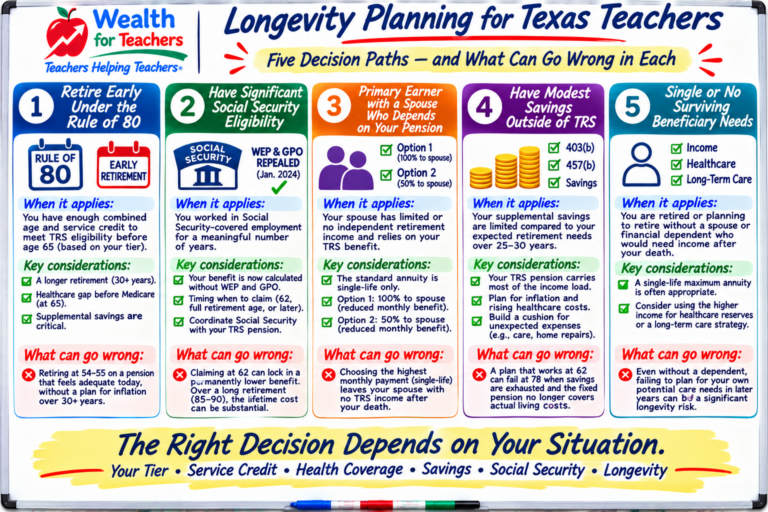
Longevity risk does not look the same for every Texas teacher. Your retirement age, years of service, spousal situation, outside savings, and Social Security eligibility all shape what a sound income plan looks like for you specifically. Here are five decision paths teachers commonly face:
When it applies: You have enough combined age and service credit to meet TRS eligibility well before age 65, based on your membership tier.
What to consider: An early retirement start date means your fixed pension must cover a longer period. You will also face a healthcare gap before Medicare eligibility at 65 and a potential Social Security gap if you delay benefits. Your supplemental savings take on greater importance.
What can go wrong: Retiring at 54 or 55 on a TRS pension that feels adequate in year one, without a formal plan for inflation erosion over 30+ years, is one of the most common longevity planning mistakes Texas teachers make.
When it applies: You worked in Social Security-covered employment for a meaningful number of years before or during your teaching career.
What to consider: With WEP and GPO repealed for benefits payable beginning January 2024, your Social Security benefit is now calculated without those reductions. Timing when you claim Social Security — and how it coordinates with your TRS pension — is now a more valuable planning lever than it was before the law changed. The right claiming age depends on your individual circumstances.
What can go wrong: Filing for Social Security at 62 to get income sooner may lock in a permanently lower benefit. If you live to 85 or 90, the cumulative lifetime cost of claiming early can be substantial. However, claiming earlier may be appropriate depending on your health, cash-flow needs, and other factors.
When it applies: Your spouse has limited or no independent retirement income and relies on your TRS benefit continuing after your death.
What to consider: The standard TRS annuity is a single-life benefit. TRS Option Two provides a reduced annuity paid throughout your lifetime; upon your death, your designated beneficiary receives one half of the reduced annuity throughout their life. Option One provides 100% of the reduced annuity to your beneficiary for their lifetime. The reduction in your monthly payment is real, but so is the protection it provides.
What can go wrong: Selecting the highest monthly payment under a single-life option to maximize current income leaves a surviving spouse with no TRS income at all. This is an irreversible election once your retirement begins.
When it applies: Your 403(b), 457(b), or personal savings are limited compared to your expected retirement income needs over 25–30 years.
What to consider: With little supplemental savings, your TRS pension carries nearly all the income weight. This makes the inflation erosion problem more acute. It also means healthcare cost spikes, home repairs, or care needs in later years have fewer resources to absorb them.
What can go wrong: A plan that works on paper at age 62 can fail structurally at age 78 when savings are exhausted and the fixed pension no longer covers actual living costs.
When it applies: You are retired or planning to retire without a spouse or financial dependent who would need income to continue after your death.
What to consider: A single-life maximum annuity is often appropriate in this situation, since survivor protections serve no functional purpose for you. Directing the difference in savings toward healthcare reserves or a long-term care strategy may be more valuable.
What can go wrong: Even without a dependent spouse, failing to plan for your own potential care needs in later years is a longevity risk. Assuming you will not need long-term care is a planning assumption that can be very costly if wrong.
TRS does not provide an automatic annual cost-of-living adjustment to retirement benefits. Supplemental payments have been granted in some prior years based on legislative action, but they are not guaranteed. This is why building a supplemental income source outside of TRS is important for a long retirement.
Your TRS pension is a lifetime annuity — it continues for as long as you live, regardless of age. The longevity risk is not that your pension stops; it is that inflation steadily reduces what that fixed monthly payment can buy over time.
If you paid into Social Security through covered employment, you may be eligible for benefits. Previously, for benefits payable for December 2023 and earlier, payments were reduced through WEP and GPO. For benefits payable for January 2024 and later, WEP and GPO no longer apply. Your eligibility and benefit amount depend on your specific earnings history.
This depends entirely on your household situation. If a spouse or dependent relies on your TRS income and would struggle without it, a survivor option provides critical protection. If you are single with no dependents, the standard annuity may make more sense. This is one of the most consequential decisions at retirement and cannot be undone after your first payment is issued.
There is no single correct number, because the answer depends on your pension amount, retirement age, healthcare situation, Social Security eligibility, and spending needs. A useful starting point is to identify the gap between what your fixed pension covers and what your projected expenses — including healthcare and inflation — will require in years 15, 20, and 25 of retirement. That gap is what supplemental savings must fill.
Use these questions to identify gaps in your current longevity plan:
One of the most significant risks in longevity planning is not any single bad decision — it is the timing of when gaps are discovered. Many Texas teachers do not uncover flaws in their retirement income plan until after they have retired, selected an annuity option, or made Social Security claiming decisions that cannot be reversed. By that point, the available adjustments are limited.
A fixed pension that feels adequate at retirement may reveal its limitations only in year 15 or 20, when the combination of inflation erosion, rising healthcare costs, and a depleted savings buffer creates pressure that the original plan never anticipated. The plan looked reasonable under the assumptions used to build it. It simply was not tested against realistic long-range scenarios before it was finalized.
This is why longevity scenarios — not just average-case projections — deserve attention before retirement begins. Testing a plan against an extended time horizon, a higher inflation rate, or an earlier-than-expected healthcare need does not require certainty about the future. It requires the discipline to ask what happens if things do not go as planned, and to make sure the answer is acceptable before the most important decisions are locked in. A written retirement plan that explicitly addresses these scenarios gives you something concrete to review, adjust, and rely on over time.
Teachers who invest time in maintaining financial confidence through retirement tend to do so because they did the planning work upfront — not because everything went exactly as expected, but because their plan had enough flexibility built in to absorb what did not.
Longevity is not a problem to solve on the day you retire. It is a planning dimension that deserves the same rigor and attention as your TRS pension calculation, your annuity election, and every other major retirement decision you will make. The teachers who navigate long retirements most successfully are those who planned for one.
Use the TRS calculator to estimate your pension and identify potential income gaps.