

Why Most Texas Teachers’ Retirement Plans Break Down — and How to Build One That Holds
A retirement plan that works perfectly on paper can fall apart the moment real life intervenes. A health scare at 58, a district reduction in force at 61, a spouse’s job change, or an unexpected inheritance — any of these can shift the math in ways a static plan never anticipated. For Texas teachers, that risk is amplified because TRS retirement decisions carry long-term consequences that are difficult to reverse once made.
Texas teachers can also run a full pension estimate using the Texas Teacher Retirement Calculator to better understand their retirement outlook.
Adaptive retirement planning for teachers is the practice of building a strategy that can bend without breaking — one designed from the start to absorb change, test assumptions, and respond to new information rather than treating retirement as a single finish line event.
This guide explains what that looks like in practice, why timing and sequencing matter inside the TRS system, and how to recognize the gaps in your current plan before they become expensive mistakes.
For a broader foundation, start with the Texas Teacher Retirement Planning Guide before diving into the adjustment strategies below.
Most retirement plans are built once and revisited only when something goes wrong. That single-draft approach is the most common reason teachers reach their intended retirement date and discover that key assumptions — about income, health coverage, Social Security, or spending — no longer hold. A plan that was never stress-tested under real-world conditions is not a plan. It is a starting estimate.
Why TRS Decisions Demand Flexibility
Texas TRS is a defined-benefit pension, which means the monthly income it produces is predictable — but the timing, eligibility path, and benefit options you choose at retirement are not easily undone.
Run Your Free Texas Teacher Retirement Analysis
Use the TRS calculator to estimate your pension and identify potential income gaps.
The pension formula is straightforward: your annual benefit equals your years of service multiplied by 2.3%, multiplied by your final average salary. A teacher with 28 years of service and a final average salary of $62,000 would receive approximately $39,928 per year, or roughly $3,327 per month before any optional benefit elections.
What is not straightforward is everything surrounding that number: which benefit payment option you select, when you retire relative to your tier’s eligibility rules, whether you qualify for TRS-Care, and how other income sources interact with your pension. Each of those decisions compounds over time, and each has a window that eventually closes.
Understanding the safest retirement strategy for Texas teachers begins with recognizing which decisions are reversible and which are not — because adaptive planning only works when you know where the hard stops are.
The Variables That Change — Even When You Don’t Plan for Them
An adaptive retirement plan accounts for the fact that several key inputs are moving. Here are the categories that shift most often for Texas teachers:
- Service credit accumulation. A leave of absence, a district change, or a move out of state can all affect the number of years TRS credits toward your benefit and eligibility. Service credit purchased later carries different costs and deadlines.
- Final average salary trajectory. A salary freeze, a step reduction in the final years of employment, or a voluntary move to a lower-paying position near retirement can reduce your calculated benefit more than most teachers expect. TRS caps how much compensation can increase in the final years before retirement, which limits last-minute salary-boost strategies.
- Health coverage continuity. TRS-Care eligibility depends on reaching at least 10 years of service credit and satisfying specific age and service thresholds. Retiring even slightly early can disqualify a teacher from this coverage until Medicare eligibility begins — a gap that requires a funded bridge plan.
- Supplemental savings balances.403(b) contributions, TSA balances, and personal savings often grow unevenly across a career. Market timing, contribution pauses, and early withdrawals leave many teachers with less supplemental income than projected.
- Spousal and household income changes. A partner’s job loss, disability, or early retirement can shift when a Texas teacher needs to draw on TRS income, compressing or extending the planning window without warning.
None of these variables are exotic. All of them show up regularly in the retirement timelines of Texas teachers who assumed their original plan would hold.
Social Security and TRS: A Moving Target
Social Security has historically been a complicated layer of the Texas teacher retirement picture because many Texas educators do not pay into Social Security through their school employment. That created a planning assumption — widely repeated for decades — that TRS retirees’ Social Security benefits would be permanently reduced.
That assumption is now outdated. The Social Security Fairness Act of 2023 repealed the Windfall Elimination Provision (WEP) and Government Pension Offset (GPO), both of which could reduce Social Security benefits when someone received a pension based on work not covered by Social Security. The law applies to benefits payable for months after December 2023.
This matters for adaptive planning because it changes the income projection for any Texas teacher who has Social Security credits from prior private-sector work, a spouse’s benefit, or a survivor’s benefit. Plans built before this change may be significantly understating available Social Security income — or may have already been revised upward for teachers who have since received retroactive adjustments.
If your written retirement plan still reflects old WEP or GPO assumptions, that plan needs to be recalculated. Reviewing your written retirement plan is the right starting point for confirming whether your Social Security projections reflect current law.
How to Make the Right Decision for Your Situation
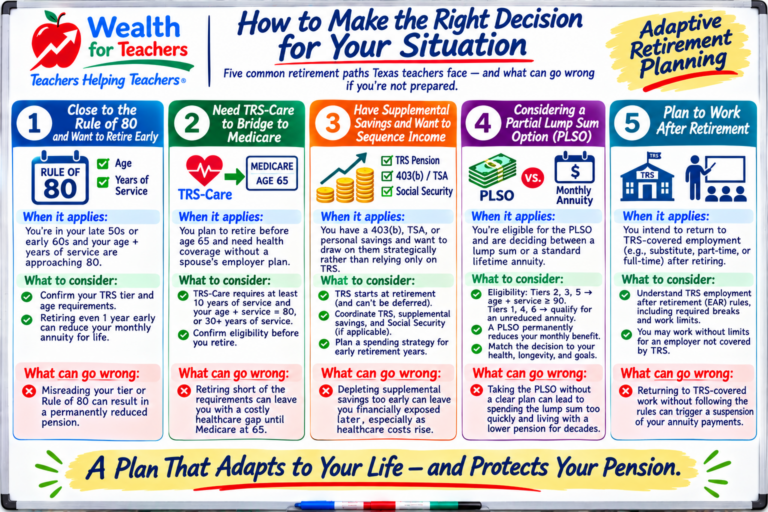
Adaptive retirement planning is not a generic checklist. Different teachers face fundamentally different decision trees based on their tier, their service credit, their health coverage needs, and their supplemental savings. Here are five common paths and what can go wrong in each.
Path 1: The Teacher Close to the Rule of 80 Who Wants to Retire Early
When it applies: You are in your late 50s or early 60s, your age and years of service are approaching 80, and you are ready to stop teaching before the traditional end-of-career timeline.
What to consider: Your TRS membership tier determines whether early retirement triggers a benefit reduction and what the minimum age requirement is for your tier. Retiring even one year short of your tier’s normal-age threshold can reduce your monthly annuity permanently.
What can go wrong: Teachers who miscalculate their tier or misread the Rule of 80 threshold sometimes retire expecting a full annuity and receive a reduced one. That reduction does not correct itself over time — it is built into every future payment for life.
Path 2: The Teacher Who Needs TRS-Care to Bridge to Medicare
When it applies: You plan to retire before age 65 and need health coverage that does not come from a spouse’s employer plan.
What to consider: TRS-Care requires at least 10 years of service credit in TRS, and your age plus years of service credit must equal 80 or more, or you must have 30 or more years of service credit. Retiring short of these thresholds eliminates TRS-Care access until — or unless — you return to TRS-covered employment.
What can go wrong: A teacher who retires at 57 with 22 years of service and no TRS-Care access, and no spousal coverage, faces a potential multi-year gap in affordable health coverage. Without a funded bridge plan, this forces either a return to work or a significant drain on retirement savings.
Path 3: The Teacher With Supplemental Savings Who Wants to Sequence Income
When it applies: You have a 403(b), a TSA, or personal savings, and you want to draw on those accounts strategically rather than starting TRS income immediately at retirement.
What to consider: TRS pension income begins at retirement and cannot be deferred like a 401(k). The question is how supplemental savings interact with your pension and when Social Security, if applicable, should begin. Adjusting your spending strategy in early retirement depends heavily on how well these income layers are sequenced.
What can go wrong: Depleting supplemental savings too early to cover early retirement spending, before Social Security or other income sources begin, leaves teachers financially exposed in their mid-to-late 70s when care costs tend to increase.
Path 4: The Teacher Considering a Partial Lump Sum Option at Retirement
When it applies: You are eligible for TRS’s Partial Lump Sum Option (PLSO), and you are weighing it against a standard lifetime annuity.
What to consider: PLSO eligibility depends on your membership tier. For non-grandfathered members (Tiers 2, 3, and 5), eligibility requires that your age and years of service total at least 90. For grandfathered members (Tiers 1, 4, and 6), eligibility requires only that you qualify for an unreduced service retirement annuity. In all cases, taking a PLSO permanently reduces your monthly annuity. Whether that trade is appropriate depends on your health, longevity expectations, other assets, and whether you have a specific use for the lump sum. Understanding the lump sum versus lifetime income trade-off is a decision that cannot be reversed after it is made.
What can go wrong: Teachers who take the PLSO without a clear plan for the lump sum often spend it faster than projected, then live for decades on a permanently reduced annuity.
Path 5: The Teacher Who Plans to Work After Retirement
When it applies: You intend to return to TRS-covered employment — in a substitute, part-time, or full-time capacity — after retiring.
What to consider: TRS has specific rules that govern employment after retirement (commonly called EAR), including required breaks in service and limits on the type and duration of work before annuity payments are affected. Service retirees may work without limits for an employer not covered by TRS without losing any monthly annuity payments. Work for a TRS-covered employer is subject to stricter rules.
What can go wrong: Returning to TRS-covered employment without understanding the applicable restrictions can trigger a suspension of annuity payments — an outcome that surprises many teachers who assumed part-time classroom work after retirement was unrestricted.
What to Do Instead
Rather than building one plan and hoping circumstances cooperate, an adaptive approach structures retirement around a series of decision checkpoints. Here is what that looks like in practice:
- Run a formal plan review every two to three years, not just in the final year before retirement. Salary changes, service credit additions, legislative changes, and household income shifts all affect the plan.
- Build a separate bridge plan for health coverage. Do not assume TRS-Care is available until you have confirmed it against your specific tier and service credit total. If a gap exists, quantify it in dollars and fund it specifically.
- Update Social Security projections to reflect current law. If your plan was built before the Social Security Fairness Act repealed WEP and GPO for benefits payable beginning January 2024, your income projections may be too conservative.
- Test the plan under adverse scenarios. What happens if you retire two years earlier than planned? What happens if your final-year salary is lower than projected? What happens if a spouse predeceases you? A plan that cannot answer those questions has not been tested.
- Treat required minimum distributions as a planning input, not an afterthought. How required minimum distributions affect your retirement strategy matters if you carry a significant 403(b) or IRA balance, because RMDs can affect your tax bracket and interaction with other income sources.
Quick Self-Check Before You Move Forward
Use these five questions to identify gaps in your current plan before a decision window closes:
- Do you know your TRS membership tier and exactly which Rule of 80 threshold and minimum age applies to you for normal-age retirement versus early-age retirement with a reduction?
- Have you confirmed TRS-Care eligibility based on your actual projected service credit at your intended retirement date — not an estimate?
- Does your Social Security projection reflect current law, meaning it does not apply WEP or GPO reductions that were repealed for benefits payable beginning January 2024?
- Do you have a written, funded plan for health coverage during any gap between your TRS retirement date and Medicare eligibility at age 65?
- Has your plan been stress-tested against at least two adverse scenarios — such as retiring earlier than planned or experiencing a final-year salary lower than projected?
If any of these questions produce uncertainty, that uncertainty is the most important thing to address before making irreversible elections.
Why Gaps Often Surface After Decisions Are Made
One of the most consequential dynamics in Texas teacher retirement planning is how often critical gaps are discovered only after permanent decisions have already been locked in. A teacher who files a retirement application, selects a benefit payment option, and separates from employment has closed most of the major decision windows. TRS benefit elections, once finalized, are not revisited.
This is not a hypothetical risk. It shows up in the form of teachers who discover they do not qualify for TRS-Care the month after their retirement is processed. It shows up in annuity payment options chosen without fully understanding the survivor benefit implications. It shows up in supplemental savings accounts drawn down too early because the overall income plan was never coordinated across all sources.
The purpose of testing assumptions before a retirement date — not in the final weeks, but in the years preceding it — is to create enough time to course-correct. A teacher who discovers a health coverage gap at 54 has years to address it. The same teacher who discovers that gap at 61, three months before their planned retirement date, has far fewer options and far less time to build an alternative.
Adaptive retirement planning for teachers is fundamentally about building a strategy with enough flexibility to absorb what you cannot predict, while removing uncertainty from the decisions you can control.
Common Questions Texas Teachers Ask
Can I change my TRS benefit payment option after retirement?
In most cases, no. TRS benefit payment elections — including the standard annuity and any optional survivor benefit choices — are finalized at retirement. There are limited exceptions for specific qualifying events, but the general rule is that the option you elect is the option you keep. This makes the pre-retirement period the only meaningful window for evaluating these choices.
What happens to my TRS pension if I leave teaching before retirement eligibility?
If you leave TRS-covered employment before meeting retirement eligibility requirements, you have a few options. You can leave your contributions in TRS and maintain your account, which continues to earn interest and preserves future retirement eligibility if you return to TRS-covered employment. Alternatively, you can take a refund of your member contributions, but doing so means forfeiting future retirement benefits if you have at least five years of service credit.
Does the Social Security Fairness Act affect Texas TRS retirees who never paid into Social Security through their school job?
It depends on whether you have Social Security credits from other employment, a spouse’s record, or a survivor’s benefit. The Act eliminated WEP and GPO reductions for benefits payable beginning January 2024. If you have Social Security credits through other work or qualify through a spouse, your projected benefit may now be higher than previously estimated. Teachers who never paid into Social Security and have no other qualifying work history are generally not affected.
How does the TRS-Care requirement affect when I retire?
For many teachers, TRS-Care eligibility is a binding constraint on when retirement is financially viable before age 65. If you retire and do not meet the 10-year service credit minimum and the applicable age-plus-service threshold, you are not eligible for TRS-Care. That forces you to find alternative health coverage — often at significantly higher cost — until Medicare begins. Building a realistic cost estimate for that scenario is a core element of any adaptive plan.
Should I purchase additional TRS service credit to improve my retirement outcome?
Purchasing service credit can be worth considering if it allows you to reach a retirement eligibility threshold sooner or increases your benefit meaningfully, but the cost is actuarial — meaning TRS prices it to be cost-neutral over a typical retirement period. The calculation depends on your remaining years of work, the cost of purchase, and how much the additional credit improves your monthly annuity. Decisions about purchasing service credit also carry firm deadlines tied to your retirement application date, so this is not a decision to defer to the last moment. Understanding the full scope of the retirement transition includes recognizing how service credit decisions fit into the broader timeline.
Retirement planning for Texas teachers works best when the plan is treated as a living document — one that is revisited as service credit accumulates, life circumstances shift, and policy changes alter the income landscape. The teachers who navigate TRS decisions most successfully are not necessarily the ones who planned earliest. They are the ones who kept testing their assumptions and adjusting before the windows closed.