The Hidden Tax Trap in Your Retirement Accounts — and Why Texas Teachers Often Miss It
Most Texas teachers spend their careers focused on earning a TRS pension. That pension is the centerpiece. But many also accumulate savings in supplemental accounts — a 403(b), a traditional IRA, or both — and give relatively little thought to what happens to those accounts after they retire.
Texas teachers can also run a full pension estimate using the Texas Teacher Retirement Calculator to better understand their retirement outlook.
That changes the moment the IRS forces the issue.
Required minimum distributions, or RMDs, are mandatory withdrawals the federal government requires from most tax-deferred retirement accounts. They do not ask whether you need the money. They do not care that your TRS pension already covers your expenses. When you reach the applicable age, the withdrawals must begin — and they count as taxable income.
For Texas teachers, the intersection of RMD strategy and a lifetime pension creates planning decisions that are easy to mishandle and difficult to reverse. Understanding how RMDs work, when they start, and how to coordinate them with your TRS benefit is one of the most consequential decisions you will make in retirement. A well-built Texas Teacher Retirement Planning Guide addresses this coordination directly — because most teachers don’t discover the problem until the withdrawals have already begun.
This article walks through the core decisions every Texas teacher with supplemental retirement savings needs to make.
Most retirement plans — even thoughtful ones — are built around accumulation. They answer the question of how to save. Very few are pressure-tested against the reality of what mandatory withdrawals, pension income, and a shifting tax situation actually look like together in the same year. That gap is where costly surprises live.
Run Your Free Texas Teacher Retirement Analysis
Use the TRS calculator to estimate your pension and identify potential income gaps.
What Are RMDs and Why Do They Matter for Teachers?
Required minimum distributions are the minimum amounts you must withdraw from your retirement accounts each year. They apply to funds that were contributed pre-tax and allowed to grow tax-deferred. The government eventually demands its share — through annual mandatory withdrawals that are included in your taxable income for the year.
The RMD rules apply to all employer-sponsored retirement plans, including 403(b) plans and 457(b) plans, as well as traditional IRAs and IRA-based plans such as SEPs, SARSEPs, and SIMPLE IRAs.
For Texas teachers, this is particularly relevant because many educators supplement their TRS pension with a 403(b) account through their school district. Those accounts are subject to RMD rules. When withdrawals begin, they add to income that already includes a monthly pension — and that combination can push a teacher into a higher tax bracket than anticipated.
When RMDs Must Begin
The SECURE 2.0 Act changed the starting age for RMDs. The applicable RMD age depends on your birth year: age 73 for those born between 1951 and 1959, and age 75 for those born in 1960 or later.
The specific deadline for your first withdrawal depends on the account type:
- For IRAs, you must take your first RMD by April 1 of the year following the year in which you reach your applicable RMD age, even if you’re still employed.
- For defined contribution plans such as a 403(b), the required beginning date is April 1 of the year following the later of the year you reach your applicable RMD age or the year you retire, if allowed by your plan.
That distinction matters. A teacher who is still working at their applicable RMD age may be able to delay RMDs from an active 403(b) until they actually retire — but not from a traditional IRA. IRS rules require you to take RMDs from traditional IRAs, SEP, SIMPLE, and SARSEP IRA plans beginning at your applicable RMD age, even if you’re still employed.
There is a timing trap in the first year. For the first year following the year you reach your applicable RMD age, you will generally have two required distribution dates: a withdrawal on April 1 of the following year and an additional withdrawal by December 31 of that same year. Taking two distributions in one calendar year can significantly increase your taxable income for that year. Many teachers are not prepared for this.
Missing an RMD is costly. If the distributions to you in any year are less than the RMD for that year, the amount not withdrawn is subject to a 25% excise tax, with a reduced penalty of 10% if corrected within two years.
How Texas TRS Handles Required Distributions
The Texas Teacher Retirement System is a qualified retirement plan under federal tax law and must comply with federal minimum distribution requirements. As a qualified retirement plan under federal tax law, TRS must comply with minimum distribution requirements of Section 401(a)(9) of the Internal Revenue Code, and federal regulations require that TRS members must begin to receive benefits by a required beginning date.
For most Texas teachers, this is less complicated than it sounds. If you retire from TRS and begin receiving your monthly annuity on schedule, the pension payments themselves generally satisfy the RMD requirement for the TRS plan. The pension is a defined benefit — not an account balance — so TRS administers the required beginning date on your behalf as part of the standard retirement process.
The more pressing RMD decisions for Texas teachers typically involve their supplemental accounts: 403(b) plans, traditional IRAs, or other tax-deferred savings accumulated outside of TRS. Those require active tracking and deliberate planning.
It is worth noting that RMDs cannot be rolled over and are included in your income for the year amounts were distributed. This means you cannot simply move an RMD into another tax-deferred account to defer the tax. Once the distribution is required, it is taxable.
The Tax Impact: When RMDs Stack on Top of Your Pension
This is the core planning problem for Texas teachers with supplemental savings.
Consider a teacher who retires with 30 years of service and a final average salary of $65,000. Using the Texas TRS formula — Annual Pension = (Years of Service × 0.023) × Final Average Salary — the calculation would be: 30 × 0.023 × $65,000 = $44,850 per year in pension income.
Now add an RMD from a 403(b) account with a $200,000 balance. Depending on the applicable IRS life expectancy factor for that teacher’s age, the required withdrawal could easily be $8,000 to $10,000 or more. Combined with the pension, total taxable income rises substantially — potentially affecting the tax bracket, Medicare premium calculations, and the taxability of any Social Security benefit the teacher may eventually receive.
The problem compounds over time. After the first RMD, you must take subsequent RMDs by December 31 of each year. Each year the calculation resets based on the prior December 31 account balance, meaning the amounts shift annually.
For a deeper look at how the overall tax picture changes after you leave the classroom, see how taxes change after teachers retire — particularly the interaction between pension income, taxable withdrawals, and bracket thresholds.
The Roth Exception Teachers Often Overlook
Not all retirement accounts carry RMD requirements during the account owner’s lifetime. You’re not required to take withdrawals from Roth IRAs or from designated Roth accounts in a 401(k) or 403(b) plan while the account owner is alive.
This distinction has significant strategic value. A teacher who converts pre-tax 403(b) or IRA funds into a Roth account before RMDs begin — during years when taxable income is lower — may be able to reduce future mandatory withdrawals, lower the long-term tax burden, and leave a more tax-efficient legacy for beneficiaries. However, the conversion itself is a taxable event in the year it occurs, and timing matters. This strategy requires careful modeling against current and projected income — it is not universally beneficial.
Withdrawals from traditional accounts are included in taxable income except for any part that was already taxed (your basis) or that can be received tax-free, such as qualified distributions from designated Roth accounts.
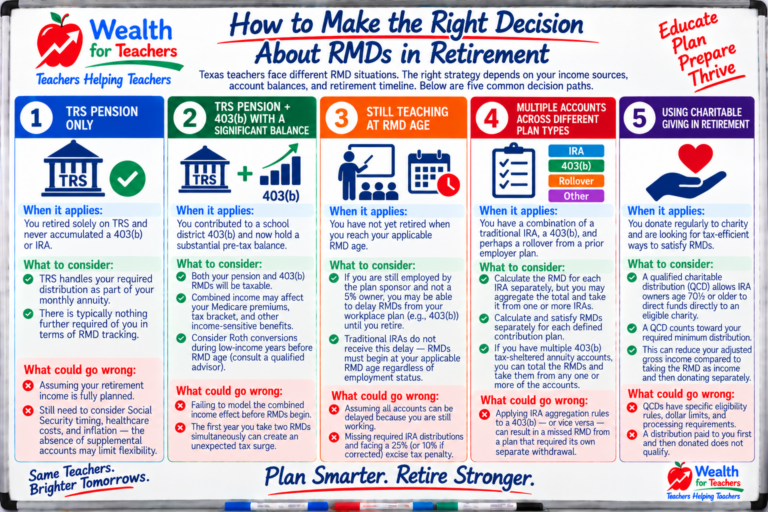
How to Make the Right Decision for Your Situation
Texas teachers approaching RMD age face meaningfully different situations depending on their income sources, account balances, and retirement timeline. Below are five decision paths that illustrate the most common scenarios.
Path 1: You Have a TRS Pension and No Supplemental Savings
When it applies: You retired solely on TRS and never accumulated a 403(b) or IRA.
What to consider: TRS handles your required distribution as part of your monthly annuity. There is typically nothing further required of you in terms of RMD tracking.
What could go wrong: Some teachers assume this means retirement income is fully planned. It does not address Social Security timing, healthcare costs, or inflation adjustments. The absence of supplemental accounts is not automatically a clean situation — it may limit flexibility.
Path 2: You Have a TRS Pension and a 403(b) With a Significant Balance
When it applies: You contributed to a school district 403(b) throughout your career and now hold a substantial pre-tax balance.
What to consider: Your pension income and future 403(b) RMDs will both be taxable. The combined total may affect your Medicare premium tier, your tax bracket, and other income-sensitive benefits. The first year you take two RMDs simultaneously can be especially impactful.
What could go wrong: Failing to model the combined income effect before RMDs begin means you may face an avoidable tax surge in the first year. Starting Roth conversions of the 403(b) during low-income years before your applicable RMD age may reduce the RMD burden — but only if executed with current-year income clearly in view. Consult with a qualified advisor before converting. See also the discussion of shifting investments before retirement, which addresses how account structure decisions made before you retire affect your income options afterward.
Path 3: You Are Still Teaching at Your Applicable RMD Age
When it applies: You have not yet retired from your school district when you reach your applicable RMD age.
What to consider: If you’re still employed by the plan sponsor and not a 5% owner of the employer, your plan may allow you to delay taking RMDs from that workplace retirement plan until you retire. A traditional IRA, however, does not receive this delay — RMDs from an IRA begin at your applicable RMD age regardless of employment status.
What could go wrong: A teacher who assumes all accounts can be delayed because they are still working may miss required IRA distributions and face the excise tax penalty. Verify what your specific plan document allows — plan terms govern.
Path 4: You Have Multiple Accounts Across Different Plan Types
When it applies: You have a combination of a traditional IRA, a 403(b), and perhaps a rollover from a prior employer plan.
What to consider: RMD aggregation rules differ by account type. If you have more than one IRA, you must calculate the RMD for each IRA separately each year. However, you may aggregate your RMD amounts for all your IRAs and withdraw the total from one IRA or a portion from each of your IRAs. If you have more than one defined contribution plan, you must calculate and satisfy your RMDs separately for each plan. An exception applies if you have more than one 403(b) tax-sheltered annuity account, in which case you can total the RMDs and take them from any one or more of the accounts.
What could go wrong: Applying IRA aggregation rules to a 403(b) — or vice versa — can result in a missed RMD from a plan that required its own separate withdrawal.
Path 5: You Plan to Use Charitable Giving in Retirement
When it applies: You donate regularly to charity and are looking for tax-efficient ways to satisfy RMDs.
What to consider: A qualified charitable distribution (QCD) allows IRA owners who are at least age 70½ to direct IRA funds directly to an eligible charity. A qualified charitable distribution counts toward your required minimum distribution. This can reduce your adjusted gross income compared to taking the RMD as income and then donating separately.
What could go wrong: QCDs have specific eligibility rules, dollar limits, and requirements about how the distribution must be processed. A distribution paid to you first and then donated does not qualify. This strategy requires precise execution.
What to Do Instead
The most common mistake Texas teachers make is waiting until RMDs begin to think about them. By then, the account balance is set, the income picture is fixed, and the only remaining variable is how to manage withdrawals year to year.
A more effective approach:
- Identify all tax-deferred accounts five to ten years before your applicable RMD age. Know what you have, where it is, and what the RMD obligation will look like based on projected balances.
- Model combined income early. Project what your TRS pension plus future RMDs will produce as taxable income. Identify which tax brackets you will occupy and whether that affects Medicare or other benefits.
- Evaluate Roth conversion windows carefully. The years between retirement from teaching and the start of RMDs can represent a lower-income period — a potential window for strategic Roth conversions. This requires careful analysis of your specific income, bracket, and timeline.
- Avoid the double-distribution trap in year one. If delaying your first RMD to April 1 of the following year means taking two distributions in the same calendar year, that may not be the optimal choice for your tax situation. Model both options before deciding.
- Keep your plan documented and updated. As tax law changes and account balances shift, the RMD strategy that was right five years ago may no longer apply. A written retirement plan that includes an explicit RMD section gives you a framework to revisit and adjust as circumstances evolve.
Teachers who discover these issues mid-stream often face avoidable consequences — not from ignorance, but from planning around the pension while leaving supplemental accounts unexamined. Understanding why retirement income plans fail when income actually begins can help you identify gaps before they become costly.
Quick Self-Check Before You Move Forward
Use these questions to identify gaps in your current retirement plan before RMDs become an active issue.
- Do you know the current balance of every tax-deferred account you own — including any 403(b), rollover IRA, or traditional IRA — and have you estimated what RMDs from those accounts will look like at your applicable RMD age?
- Have you projected what your total taxable income will look like when your TRS pension and RMDs are received in the same year — including any Social Security benefit you may be entitled to?
- Do you know whether your 403(b) plan allows you to delay RMDs if you are still employed at your applicable RMD age — and have you confirmed how that rule interacts with any traditional IRA you also hold?
- Have you considered whether Roth conversion during lower-income years before your applicable RMD age is worth modeling — and do you know what the tax cost of conversion would be in your specific situation?
- Is your retirement income plan written down and updated, with a clear section addressing how and when supplemental account withdrawals will be taken relative to your TRS pension?
If any of these questions revealed uncertainty, that uncertainty is worth resolving before withdrawals are forced by law rather than chosen strategically.
Common Questions Texas Teachers Ask
Does my TRS pension count as an RMD?
For most retired TRS members receiving a standard monthly annuity, the pension payments satisfy the required minimum distribution requirement for the TRS defined benefit plan. You do not separately calculate an RMD amount for TRS the way you would for an IRA. However, supplemental accounts like a 403(b) or traditional IRA are separate — and those require their own RMD calculations.
What if I don’t need the RMD money?
The withdrawal is still required. You can withdraw more than the minimum required amount, but you cannot skip the withdrawal altogether to avoid taxation. If you do not need the income, you may direct it toward reinvestment in a taxable brokerage account, use it for a qualified charitable distribution from an IRA, or apply it toward other financial goals — but the tax on the distribution generally cannot be avoided.
Can I roll an RMD into another retirement account?
No. RMDs cannot be rolled over into another tax-deferred account. Attempting to do so would result in an excess contribution. The distribution must be received as income for that tax year.
How is my RMD amount calculated?
The required minimum distribution for any year is the account balance as of the end of the immediately preceding calendar year divided by a distribution period from the IRS’s Uniform Lifetime Table. Your account custodian is generally required to report the RMD amount to you or offer to calculate it — but verifying the calculation yourself is wise, particularly if you hold multiple accounts.
Should I work with a retirement specialist on my RMD strategy?
For teachers with substantial supplemental savings alongside a TRS pension, the answer is often yes. The interaction between a defined benefit pension, tax-deferred accounts, and potentially Social Security creates a layered income picture that benefits from coordinated planning. Understanding when and why to hire a retirement specialist can help you decide whether professional guidance makes sense for your situation.
Why Teachers Often Discover Gaps Too Late
One of the most consistent patterns in teacher retirement planning is that significant gaps only become visible under real-world conditions — after the pension is locked in, after the retirement date is set, and often after the first withdrawal is already underway.
The assumptions that seemed reasonable during accumulation — “I’ll figure out the 403(b) when I get there,” or “the RMDs won’t be that much” — become harder to correct once income has begun. The choice of retirement date, the pension payment option selected, and the sequence of withdrawals from supplemental accounts are all interconnected. A decision made early in retirement can narrow the options available later.
This is why RMD strategy is not a question to defer. The most effective plans are built before the forced timeline begins — when there is still time to restructure accounts, evaluate Roth conversions, model combined income, and make deliberate choices rather than reactive ones. Teachers who treat their supplemental accounts as an afterthought to the TRS pension often discover, too late, that those accounts carry their own set of rules that do not wait for a convenient moment.
The decision of whether to take a lump sum or lifetime income from a pension is one such early decision that interacts directly with how supplemental accounts and RMDs are managed. Getting that foundational choice right — and understanding its downstream effects — is part of what makes comprehensive retirement planning different from simply knowing what your monthly check will be.
A retirement plan that accounts for mandatory withdrawals, tax bracket management, and the specific structure of Texas TRS is one that has been tested against reality — not just built on accumulation-phase assumptions. That kind of plan doesn’t happen by default. It requires deliberate construction, and it requires starting before the rules force your hand.