
The Investment Shift That Can Make or Break a Texas Teacher’s Retirement
Most Texas teachers spend decades focused on earning their TRS pension. Then, five to ten years before retirement, a critical question surfaces: should you shift your investments before you stop working?
Texas teachers can also run a full pension estimate using the Texas Teacher Retirement Calculator to better understand their retirement outlook.
It is the right question. But the timing, the degree of change, and the reasoning behind it are where most teachers get into trouble. Deciding how to shift investments for retirement as a teacher is not a generic financial planning exercise. It is a decision with real pension-level consequences that depends on your TRS benefit formula, your supplemental savings in a 403(b) or 457 plan, your expected income gap, and how long you need those savings to last.
This guide walks through what a pre-retirement investment shift actually means for a Texas teacher, when it makes sense, and how to avoid the most common and costly mistakes.
For a broader foundation, start with the Texas Teacher Retirement Planning Guide before working through the allocation decisions below.
Most retirement plans that look solid on paper fail under real-world pressure. A market drop in the first two years of retirement, an unexpected health expense, or an income gap between your pension and your actual cost of living can quickly expose weaknesses that were never stress-tested. A plan that was never challenged before retirement day is not truly a plan — it is an assumption.
What “Shifting Investments” Actually Means for Texas Teachers
Shifting investments before retirement generally means moving a portion of your portfolio away from growth-oriented assets — primarily stocks — and toward more stable, income-producing assets such as bonds, fixed income funds, or cash equivalents. The goal is to reduce the damage a market downturn can do to your savings right before or right after you stop working.
Run Your Free Texas Teacher Retirement Analysis
Use the TRS calculator to estimate your pension and identify potential income gaps.
For Texas teachers, this shift applies almost exclusively to supplemental accounts: a 403(b), a 457(b), a Roth IRA, or other personal savings. Your TRS pension itself is not an investment account you control. The TRS fund is managed by the TRS Investment Management Division, and your benefit is determined by a formula, not by market performance in your individual account.
This distinction matters enormously. The shift-investments decision for a Texas teacher is not about protecting the pension — it is about protecting the supplemental savings that fill whatever income gap the pension does not cover.
Your TRS Pension Changes the Math Entirely
Texas TRS uses a straightforward benefit formula:
Annual Pension = Years of Service × 2.3% × Final Average Salary
Consider a teacher with 30 years of service and a final average salary of $62,000. Her annual pension would be:
30 × 0.023 × $62,000 = $42,780 per year, or roughly $3,565 per month.
If her estimated monthly expenses in retirement are $4,500, she has an income gap of approximately $935 per month — or about $11,220 per year. That gap is what her 403(b) or other savings must cover.
This framing changes the investment shift decision completely. A teacher with a small gap and strong pension coverage needs her supplemental savings to last and keep pace with inflation, but she does not need to take aggressive growth risk either. A teacher with a large gap or fewer years of service faces a different set of trade-offs.
Building a retirement income floor as a teacher begins with knowing exactly how large that gap is — and how long your savings need to cover it.
It is also worth noting that TRS pensions are not automatically adjusted for inflation. There are no automatic annual increases to your annuity once you have retired. This means your supplemental savings may need to grow in real terms over time, which has direct implications for how aggressively or conservatively you should invest them.
When Should Texas Teachers Start Shifting?
There is no universal answer, but a practical framework exists. The years immediately before and immediately after retirement are often called the “sequence of returns danger zone.” A significant market loss during this window can permanently reduce how long your savings last — even if the market recovers years later.
For most teachers, a gradual shift beginning five to ten years before retirement is a reasonable starting point. However, the appropriate pace and depth of that shift depends on several factors specific to your situation:
- Size of your income gap: The larger the gap between your TRS pension and your monthly expenses, the more your supplemental savings have to work — and the more carefully you need to protect them near retirement.
- Account balance relative to your gap: A teacher with $400,000 saved to cover a $500/month gap has more room to stay invested in growth assets than one with $80,000 saved to cover a $1,200/month gap.
- Expected retirement length: Retirement longevity is a serious risk for teachers who often retire in their late 50s and may spend 30 or more years in retirement. A shift that is too conservative too early can leave a teacher financially exposed in her 80s.
- Other income sources: Social Security eligibility, a spouse’s income, or part-time work can reduce your dependence on investment withdrawals and affect how much risk you need to take.
How to Make the Right Decision for Your Situation
Texas teachers approach the pre-retirement investment shift from very different financial positions. Below are five decision paths that reflect the most common situations.
Path 1: Strong Pension, Small Supplemental Balance
When it applies: Your TRS pension covers 85–100% of your expected expenses. Your 403(b) or IRA balance is relatively modest.
What to consider: Since your pension handles most of your income needs, your supplemental savings can serve as an inflation buffer and emergency reserve. You may be able to keep a moderate growth allocation longer than you think.
What can go wrong: Shifting entirely to conservative assets too early can result in savings that lose purchasing power over a 25–30 year retirement, leaving you financially strained in later years when healthcare costs often rise. Inflation’s effect on a fixed TRS pension compounds this risk over time.
Path 2: Moderate Pension, Significant Income Gap
When it applies: Your pension covers 60–75% of your retirement expenses. Your supplemental savings must cover a meaningful monthly shortfall.
What to consider: This is the scenario where sequence-of-returns risk is most dangerous. A portfolio drop of 25–30% in year one of retirement can force you to sell assets at a loss to cover living expenses, accelerating depletion.
What can go wrong: Moving too slowly to a more stable allocation leaves your gap-covering savings exposed. Moving too aggressively toward fixed income early could underfund a 30-year income need. A bucketed or tiered approach — keeping one to two years of gap income in stable assets while allowing longer-term funds to stay invested in growth — is one structure worth evaluating with a qualified planner.
Path 3: Early Career Teacher Planning Ahead
When it applies: You have 15 or more years until retirement but want to understand how the pre-retirement shift works now.
What to consider: This is the time to prioritize building supplemental savings, not shifting them. Understand the TRS benefit formula, estimate your projected pension, and identify your likely income gap so you know your savings target.
What can go wrong: Shifting to conservative investments decades too early is one of the most expensive mistakes a teacher can make. Time and compounding growth are the most powerful tools available to an early-career teacher.
Path 4: Teacher Within Two to Three Years of Retirement
When it applies: You are close to your retirement eligibility date and have not yet reviewed your allocation.
What to consider: This window is critical. Review your current allocation immediately. If you are still heavily invested in equities, determine how much you need accessible and stable within the next 24–36 months and begin repositioning those funds deliberately.
What can go wrong: Waiting until after you retire to make this shift means you are already exposed to sequence-of-returns risk. A market downturn during your first year of drawing from savings can cause permanent, irreversible harm to your income plan. Understanding safe withdrawal rates for teachers before you retire is essential.
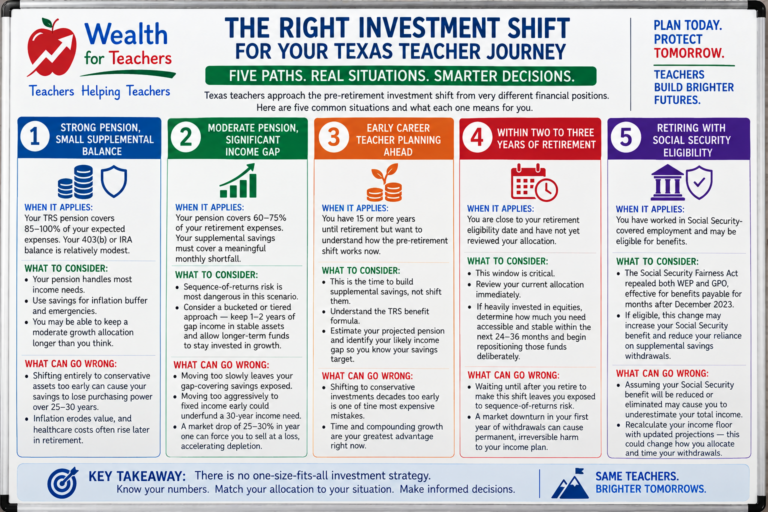
Path 5: Teacher Retiring With Social Security Eligibility
When it applies: You have worked in Social Security-covered employment at some point in your career and may be eligible for benefits.
What to consider: The Social Security Fairness Act repealed both WEP and GPO, which previously could reduce Social Security benefits when someone received a pension based on work not covered by Social Security — effective for benefits payable for months after December 2023. If you are eligible for Social Security, this change affects your income planning and may reduce your dependence on supplemental savings withdrawals.
What can go wrong: Teachers who previously assumed Social Security would be significantly reduced — or eliminated — by their TRS pension may be underestimating their total retirement income. Recalculating your income floor with updated Social Security projections could change how you allocate and time your savings withdrawals. See also: should Texas teachers delay Social Security benefits?
What to Do Instead of a Generic Glide Path
Generic target-date funds and one-size-fits-all glide paths are designed for workers whose entire retirement income comes from their investment portfolio. That is not the situation for most Texas teachers.
Because your TRS pension already functions as a stable, lifetime income source, your supplemental savings have a different role. Here is a more practical approach:
- Calculate your actual income gap first. Do not make allocation decisions until you know exactly how much income your pension will provide and how much your savings must supplement each year.
- Match your asset allocation to your gap size and timeline. The larger and longer-lasting your gap, the more you need your savings to both protect against near-term losses and grow over time.
- Do not conflate the pension with your overall risk tolerance. Having a pension does not mean your 403(b) should be in pure equities at age 58. It means you have a known income foundation — but your supplemental assets still need careful stewardship.
- Consider a segment or bucket structure. Keep one to two years of supplemental income needs in stable, low-volatility assets. Allow longer-horizon funds to remain in a diversified growth-oriented allocation. Replenish the near-term bucket periodically.
- Review your allocation annually as retirement approaches. The shift is not a one-time event. It should be a gradual, deliberate process reviewed and adjusted each year.
For teachers who are thinking through what happens after the shift — once retirement begins — how asset allocation changes for teachers in retirement covers the next phase of this decision.
A Note on Social Security for Texas Teachers
Approximately 96% of public school employees do not pay into the Social Security system. However, some Texas teachers have Social Security-covered earnings from prior careers, summer employment, or part-time work outside the school system.
If you fall into that group, the repeal of WEP and GPO under the Social Security Fairness Act — signed into law on January 5, 2025, and effective for benefits payable beginning January 2024 — may meaningfully increase your projected Social Security benefit. Only people who receive a pension based on work not covered by Social Security may see benefit increases. This is worth verifying directly with the Social Security Administration if you believe you may qualify.
Quick Self-Check Before You Move Forward
Before making any changes to your supplemental investment accounts, answer these five questions honestly:
- Do you know your exact projected TRS pension amount? If you cannot state this number with confidence, your allocation decisions are built on an incomplete foundation.
- Have you calculated your monthly income gap? Subtract your projected TRS pension from your estimated monthly retirement expenses. That number drives every supplemental savings and allocation decision.
- Do you know how many years your current savings need to last? A teacher retiring at 57 with a life expectancy into her late 80s may need her savings to last 30 or more years — a detail that dramatically changes the appropriate allocation.
- Have you stress-tested your plan against a 20–30% market loss in year one of retirement? If not, you do not yet know whether your current plan survives real-world conditions.
- Have you reviewed your Social Security eligibility since the Social Security Fairness Act took effect? If you have any Social Security-covered work history, your projections may need to be updated.
Most Teachers Don’t Find the Gaps Until It’s Too Late
The most dangerous retirement planning mistakes are invisible ones. A teacher can spend years contributing faithfully to a 403(b), maintain a reasonable asset allocation, and still retire into a plan that fails — not because of negligence, but because the assumptions were never tested against reality.
The gaps most teachers discover too late include: an income gap larger than expected because final salary calculations came in lower than projected, a 403(b) balance depleted faster than anticipated because withdrawals were not calibrated to a specific shortfall, or a sequence-of-returns loss in the first two years that permanently reduced how long savings would last.
By the time these gaps surface, options narrow. The time to find and close them is before the retirement date — not after.
Common Questions Texas Teachers Ask
Should I move everything to bonds before I retire?
Probably not. A full shift to bonds or cash may feel safe, but it can leave your savings without enough growth to cover a 25–30 year retirement. The goal is to reduce your exposure to near-term market volatility while preserving long-term purchasing power — not to eliminate growth entirely.
Does my TRS pension affect how I should invest my 403(b)?
Yes, significantly. Because your TRS pension provides a defined, lifetime income stream, your 403(b) does not need to function as your primary income source in most cases. It needs to cover your income gap — the difference between your pension and your actual expenses. That gap, not your total savings balance, should drive your allocation decisions.
What if I retire early and have fewer years of service?
Fewer years of service means a lower TRS pension and a larger income gap to fill from savings. This typically requires a more careful balance between protecting near-term funds and allowing longer-horizon savings to grow. Early retirees also face longer retirement periods, which makes both inflation risk and longevity risk more significant.
Can I change my TRS investment elections?
Your TRS pension benefit is determined by a formula, not individual investment elections. The TRS fund is managed at the institutional level. However, if you participate in a supplemental 403(b) or 457(b) plan through your employer, you typically do have investment options and can adjust your allocation within those plans.
How does the Social Security Fairness Act affect my retirement income planning?
If you have Social Security-covered earnings from any prior work, WEP and GPO no longer reduce your benefit for months beginning January 2024. This could increase your projected Social Security income, which in turn may reduce how much of your supplemental savings you need to draw on each year. It is worth verifying your current Social Security estimate through the Social Security Administration if you have any covered earnings history.
Get Your TRS Analysis
Knowing your TRS pension formula is a starting point. Understanding how your supplemental savings, income gap, Social Security eligibility, and investment allocation fit together into a plan that actually holds up — that requires a complete picture.
Do not make your pre-retirement investment shift based on a generic template designed for someone with a very different financial situation.
Get Your TRS Analysis and find out where your retirement plan stands — before it is too late to adjust it.