
The Real Risk Texas Teachers Face: Outliving a Retirement Income That Was Never Stress-Tested
Retirement longevity is the one variable most Texas teachers forget to plan for. You spend decades planning when to retire. You calculate your TRS pension, estimate your monthly budget, and figure out what life will look like in year one. What most teachers never seriously account for is what happens in year fifteen, year twenty, or year twenty-five.
Texas teachers can also run a full pension estimate using the Texas Teacher Retirement Calculator to better understand their retirement outlook.
That is the core problem with retirement longevity for teachers. A pension that looks comfortable the day you leave campus can lose significant purchasing power over a long retirement — especially when there are no automatic increases to your annuity once you have retired, and your TRS pension is not automatically adjusted for inflation.
This is not a scare tactic. It is a structural feature of the TRS plan that every Texas teacher needs to understand before making final retirement decisions. The longer you live, the harder your income has to work — and the more damage a gap between your pension and your real expenses can do.
For a comprehensive overview of how TRS retirement planning fits together, start with the Texas Teacher Retirement Planning Guide.
Most retirement plans fail not because they were built on bad intentions, but because they were never tested against real-world conditions. A pension estimate, a ballpark savings figure, and a rough monthly budget are not a retirement plan. They are a starting point — and a dangerously optimistic one if longevity risk is left out of the equation.
How Long Does a Texas Teacher’s Retirement Actually Last?
Many Texas teachers retire in their late 50s or early 60s. If you retire at 60 and live to 85 — a realistic expectation for an educated professional — your retirement lasts 25 years. Live to 88 or 90, and that number grows to nearly three decades.
Run Your Free Texas Teacher Retirement Analysis
Use the TRS calculator to estimate your pension and identify potential income gaps.
TRS’s own actuarial data includes life expectancy projections for retired members who reach age 65, and life expectancy is expected to increase over time. That trajectory matters because it means the assumptions baked into your retirement plan today may underestimate how long your money needs to last.
A 25- to 30-year retirement is not an edge case. It is a realistic planning horizon for a significant number of Texas teachers — and it demands a level of income sustainability that a single pension check may not provide on its own.
What the TRS Pension Covers Over Time — and What It Doesn’t
The TRS pension plan is a defined benefit plan, meaning retirement benefits are determined using a formula established by Texas law — not member contributions. The formula is straightforward:
Annual Pension = Years of Service × 2.3% × Final Average Salary
That formula produces a fixed monthly benefit paid for life. The word “life” is important — upon retirement, you receive a monthly annuity for life. That longevity protection is one of TRS’s genuine strengths. You cannot outlive the pension itself.
But “for life” is not the same as “sufficient for life.” The challenge is that the modesty of TRS’s benefit is due primarily to the lack of an automatic cost-of-living increase, and the benefit value reflects the loss of purchasing power over time.
In plain terms: your pension check in year one of retirement and your pension check in year twenty are the same dollar amount — but year twenty’s check buys meaningfully less. That gap is where retirement longevity risk lives for Texas teachers.
Understanding exactly how inflation compounds against a fixed pension is one of the most important analyses a Texas teacher can do before finalizing their retirement date. The details of that erosion are covered in depth in this article on how inflation really impacts a TRS pension over time.
The Three Threats That Erode Income in a Long Retirement
1. Inflation Without a COLA
A fixed pension and rising prices are a slow-motion income problem. Even modest annual inflation, compounded over 20 to 25 years, can substantially reduce what your monthly pension actually buys. Groceries, utilities, property taxes, and everyday expenses do not stay flat — but your TRS benefit does.
2. Healthcare Cost Escalation
Healthcare spending typically increases as retirees age, and it tends to rise faster than general inflation. For Texas teachers who retire before Medicare eligibility at age 65, there is a gap period where coverage options through TRS-Care require careful evaluation. Even after Medicare begins, supplemental premiums, out-of-pocket costs, and long-term care expenses can represent a significant and growing budget line. This is why understanding how healthcare costs impact Texas teacher retirement deserves its own planning analysis.
3. Sequence of Returns Risk on Personal Savings
Most Texas teachers supplement their TRS pension with savings in a 403(b), 457, or IRA. Personal savings such as a 403(b), 457, or IRA play an important part in financial security and can supplement a TRS pension at retirement. But how and when you draw down those savings matters enormously. Withdrawing too aggressively — or drawing from an account that has just experienced a market decline — can deplete supplemental savings far earlier than projected. For a structured look at how to draw down savings without accelerating depletion, see this guide on safe withdrawal rates for teachers.
Social Security and Texas Teachers: What Has Changed
Approximately 96% of Texas public school employees do not pay into the Social Security system. That means most Texas teachers are not building a Social Security benefit during their classroom careers. However, many teachers have prior work history in Social Security-covered employment — and for those teachers, a significant rule change now affects retirement income planning.
On January 5, 2025, the President signed into law the Social Security Fairness Act of 2023, which repeals the Windfall Elimination Provision (WEP) and Government Pension Offset (GPO) — both of which could reduce Social Security benefits when someone received a pension based on work not covered by Social Security. The law applies with respect to benefits payable for months after December 2023.
For Texas teachers who qualify for Social Security through prior work, this change can meaningfully affect total retirement income. The question of whether and when to claim those benefits, especially in the context of a long retirement, is worth dedicated analysis. See this article on whether teachers should delay Social Security benefits for a full breakdown.
If you have not yet checked whether you are eligible for Social Security based on prior covered employment, contact the Social Security Administration directly to get an accurate estimate.
A Concrete Example: Running the Numbers Over 25 Years
Consider a teacher who retires with 28 years of service and a final average salary of $62,000.
Using the Texas TRS formula:
28 × 0.023 × $62,000 = $39,928 per year, or approximately $3,327 per month
In year one, $3,327 per month may be workable — especially if the teacher has modest personal savings to supplement it. But apply even a conservative average annual inflation rate to everyday expenses over 25 years, and that same check buys materially less by the time the teacher reaches her mid-80s. If she has depleted her 403(b) by year twelve and has no Social Security benefit, the last decade of retirement becomes a serious income sustainability problem.
This is not a hypothetical edge case. For many TRS members, the only source of lifetime income in retirement is TRS itself. That makes the longevity math especially consequential for Texas teachers who haven’t built robust supplemental savings.
Income gaps that emerge mid-retirement are harder to close than those identified before retirement. The biggest income gap risks teachers face in retirement covers the specific patterns that most often catch Texas teachers off guard.
Common Questions Texas Teachers Ask
Does TRS ever increase my pension after I retire?
TRS does not provide automatic annual cost-of-living adjustments. The Texas Legislature has occasionally approved one-time supplemental payments or ad hoc increases, but these are not guaranteed and should not be counted on in long-range planning.
What if I retire early — does that hurt my longevity outlook?
Retiring early has two compounding effects: your monthly benefit is lower (fewer years of service in the formula), and you have more years ahead of you to fund. Both increase the risk that your income falls short in the later stages of retirement.
How does my 403(b) fit into longevity planning?
Your 403(b) is a supplement, not a replacement, for TRS income. It gives you flexibility and a buffer, but how you draw from it matters as much as how much is in it. Withdrawing too fast in the early years of retirement leaves you exposed if you live longer than expected.
If I have Social Security from a previous job, will it still be reduced by my TRS pension?
No. The Windfall Elimination Provision and Government Pension Offset — both of which could reduce Social Security benefits for TRS retirees — were repealed effective for benefits payable beginning January 2024. If you have Social Security-covered work history, contact the SSA to understand your current benefit eligibility.
How much of my pre-retirement income does TRS replace?
Experts say you will need 80–90% of your pre-retirement income to maintain your current standard of living. Whether TRS alone reaches that threshold depends heavily on your years of service, salary history, and how long your retirement lasts.
How to Make the Right Decision for Your Situation
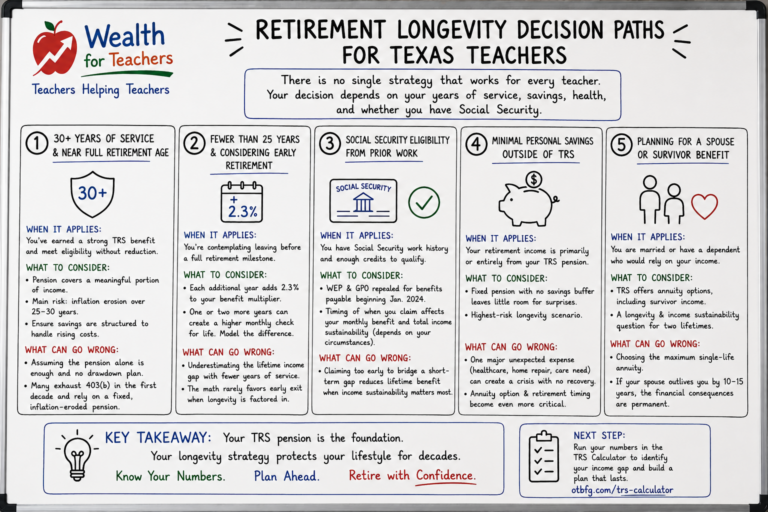
There is no single retirement longevity strategy that works for every Texas teacher. Your decision depends on your years of service, your savings, your health expectations, and whether you have access to Social Security. Here are five decision paths that reflect the real scenarios Texas teachers face.
Path 1: You Have 30+ Years of Service and Are Near Full Retirement Age
When it applies: You’ve earned a relatively strong TRS benefit and meet TRS eligibility requirements for normal retirement without reduction.
What to consider: Your pension covers a meaningful portion of your pre-retirement income. The primary longevity risk is inflation erosion over a 25–30 year horizon. Focus on whether your personal savings are structured to absorb rising costs without being depleted too early.
What can go wrong: Assuming the pension alone is enough and neglecting to build a drawdown strategy for supplemental savings. Without a plan, many teachers exhaust their 403(b) in the first decade and are left with a fixed, inflation-eroded pension for the second and third decades.
Path 2: You Have Fewer Than 25 Years of Service and Are Considering Early Retirement
When it applies: You’re contemplating leaving before reaching a full retirement milestone.
What to consider: Each additional year of service adds 2.3% to your benefit multiplier. One or two more years of teaching can produce a meaningfully higher monthly check for the rest of your life. Model the difference before deciding.
What can go wrong: Underestimating how large the lifetime income gap is when you retire with a smaller benefit and a longer retirement ahead. The math rarely favors early exit when longevity is factored in.
Path 3: You Have Social Security Eligibility from Prior Work
When it applies: You worked in Social Security-covered employment before or alongside your teaching career and have earned enough credits to qualify.
What to consider: With WEP and GPO repealed for benefits payable beginning January 2024, your Social Security benefit may be higher than previously estimated. The timing of when you claim Social Security affects how much you receive monthly and can have a direct impact on how long your total income remains sustainable — though the right claiming age depends on your individual circumstances, including health, other income sources, and financial needs.
What can go wrong: Claiming Social Security too early to bridge a short-term income gap, reducing your lifetime benefit at exactly the stage of retirement when income sustainability matters most.
Path 4: You Have Minimal Personal Savings Outside of TRS
When it applies: Your retirement income picture is primarily or entirely dependent on your TRS monthly annuity.
What to consider: A fixed pension without a supplemental savings buffer leaves little room for unexpected expenses — a major healthcare event, home repair, or extended care need. This is the highest-risk longevity scenario for Texas teachers.
What can go wrong: One unexpected large expense in the middle of retirement can create a financial crisis with no recovery mechanism. If this is your situation, the timing and annuity option you choose at retirement become even more critical.
Path 5: You Are Planning for a Spouse or Survivor Benefit
When it applies: You are married or have a dependent who would rely on your income after your death.
What to consider: TRS offers different annuity options, including those that provide survivor income. A higher monthly benefit for yourself may leave a spouse with nothing if you predecease them. This is a longevity and income sustainability question for two lifetimes, not one.
What can go wrong: Choosing the maximum single-life annuity without accounting for your spouse’s income needs. If your spouse outlives you by 10 to 15 years, the financial consequences of that annuity choice are permanent.
What to Do Instead
Rather than assuming your retirement income will hold, stress-test it. Here is what that looks like in practice:
- Model multiple retirement ages. Run your TRS benefit calculation at your current projected retirement date and two to three years later. The lifetime income difference is often larger than expected.
- Project expenses forward, not backward. Don’t anchor your budget to what you spend today. Healthcare, housing, and everyday costs will likely be higher in the later years of retirement.
- Build a supplemental savings withdrawal strategy. Determine how much you can draw from your 403(b) or IRA each year without running out before age 85 or 90. Review safe withdrawal rate research specific to your situation.
- Account for the inflation gap explicitly. Your TRS pension is fixed. Your expenses are not. Every year of retirement, that gap widens slightly. Plan for it rather than hoping it stays small.
- Consider Social Security timing carefully if you qualify. Delaying Social Security increases the monthly benefit you receive, which can matter in the later years of a long retirement — but the right claiming age depends on your individual health, income needs, and financial circumstances.
Quick Self-Check Before You Move Forward
Before you finalize any retirement decision, answer these five questions honestly. They will surface the gaps in your current plan.
- Have you modeled your TRS monthly benefit at your specific years of service — and compared it against your projected monthly expenses? If those two numbers haven’t been set side by side, your plan has a critical blind spot.
- Do you know how long your personal savings (403(b), 457, IRA) will last if you draw from them at your current planned rate? Most teachers who haven’t run this number are surprised by the result.
- Have you factored in healthcare costs before Medicare eligibility at age 65? If you plan to retire before 65, the coverage gap and cost exposure are significant and frequently underestimated. Note that if you have qualifying coverage through a current employer’s group health plan, different Medicare enrollment rules may apply — confirm your specific situation with Medicare or a benefits counselor.
- If you have prior Social Security-covered work history, have you checked your current benefit estimate with the SSA? With WEP and GPO repealed for benefits payable beginning January 2024, your eligible benefit may be different from what you previously assumed.
- Have you chosen a TRS annuity option and stress-tested what happens to your spouse or household if you predecease them? This decision is irreversible at the time of retirement and affects income sustainability for potentially two lifetimes.
Why Most Teachers Discover Gaps Too Late
The most common pattern in Texas teacher retirement planning is not recklessness — it is incompleteness. Teachers review their TRS benefit estimate, feel confident about the monthly number, and stop there. The gaps that surface five, ten, or fifteen years into retirement — eroded purchasing power, depleted savings, unexpected healthcare expenses — were almost always visible in advance. They just weren’t looked for.
By the time those gaps become financial pressure, the options to correct them are significantly narrower. You can’t go back and add years of service. You can’t undo an annuity election. You can’t recover savings that were drawn down too fast during the first decade of retirement.
The window to make the decisions that protect retirement longevity is before retirement, not after. And that window closes permanently the moment the paperwork is submitted.
If downsizing is part of how you plan to manage expenses in retirement, that decision also deserves careful analysis before it becomes a constraint rather than a choice. This guide on whether to downsize in retirement as a teacher walks through the key factors.
Get Your TRS Analysis
Retirement longevity planning for Texas teachers is not a generic financial exercise. It requires understanding your specific TRS tier, benefit calculation, personal savings structure, Social Security eligibility, and healthcare exposure — and then stress-testing those variables against a retirement that may last 25 to 30 years.
If you haven’t run those numbers in a coordinated way, now is the time to do it — before a retirement decision becomes permanent.