
Why the Wrong Safe Withdrawal Rate Can Drain a Texas Teacher’s Savings Too Soon
Your TRS pension is the anchor of your retirement income. But for most Texas teachers, it does not cover everything — and the savings you’ve built in a 403(b), IRA, or other account will need to last decades. How much you withdraw each year from those savings is one of the most consequential decisions you will make in retirement.
Texas teachers can also run a full pension estimate using the Texas Teacher Retirement Calculator to better understand their retirement outlook.
The concept of a safe withdrawal rate for teachers sits at the intersection of pension income, personal savings, healthcare costs, and longevity risk. Get it right and your money outlasts you. Get it wrong and you face a gap that no amount of cutting back can fully close.
This guide explains exactly how withdrawal rates work, why standard rules of thumb often miss the mark for Texas teachers, and how to build a withdrawal strategy that accounts for the specific structure of a TRS pension.
For a broader overview of how all the pieces fit together, start with the Texas Teacher Retirement Planning Guide.
Why Most Retirement Plans Fail Under Real-World Conditions
Most retirement income plans look solid on paper. The problem is that they are built on assumptions — average returns, stable spending, predictable healthcare costs — that rarely survive contact with an actual retirement. A market downturn in the first three years. A healthcare expense that wasn’t modeled. A pension that loses purchasing power quietly over time. Any one of these can turn a plan that “should work” into one that doesn’t.
Run Your Free Texas Teacher Retirement Analysis
Use the TRS calculator to estimate your pension and identify potential income gaps.
A plan that has never been stress-tested is not a plan. It is a guess dressed up in spreadsheet format.
The 4% Rule Explained
The 4% rule is the most widely cited withdrawal rate guideline in retirement planning. It comes from research showing that a retiree who withdraws 4% of their portfolio in year one — then adjusts that dollar amount for inflation each subsequent year — historically had a strong probability of not running out of money over a 30-year retirement, based on portfolios invested in a mix of stocks and bonds.
For example: A teacher with $400,000 in a 403(b) would withdraw $16,000 in the first year. Each year after, that amount adjusts with inflation.
That’s the concept. But the rule was designed for someone whose entire retirement income comes from a portfolio. That’s not the situation Texas teachers face.
Where the 4% Rule Falls Short for Teachers
- It assumes your portfolio is your primary income source — not a supplement to a pension.
- It was designed around a 30-year time horizon. Teachers who retire at 55 or 58 may need to plan for 35 or 40 years.
- It doesn’t account for the absence of automatic inflation protection in the TRS pension.
- It doesn’t incorporate the timing of Social Security benefits, which affects how much you need from savings in early retirement years.
How Your TRS Pension Changes the Math
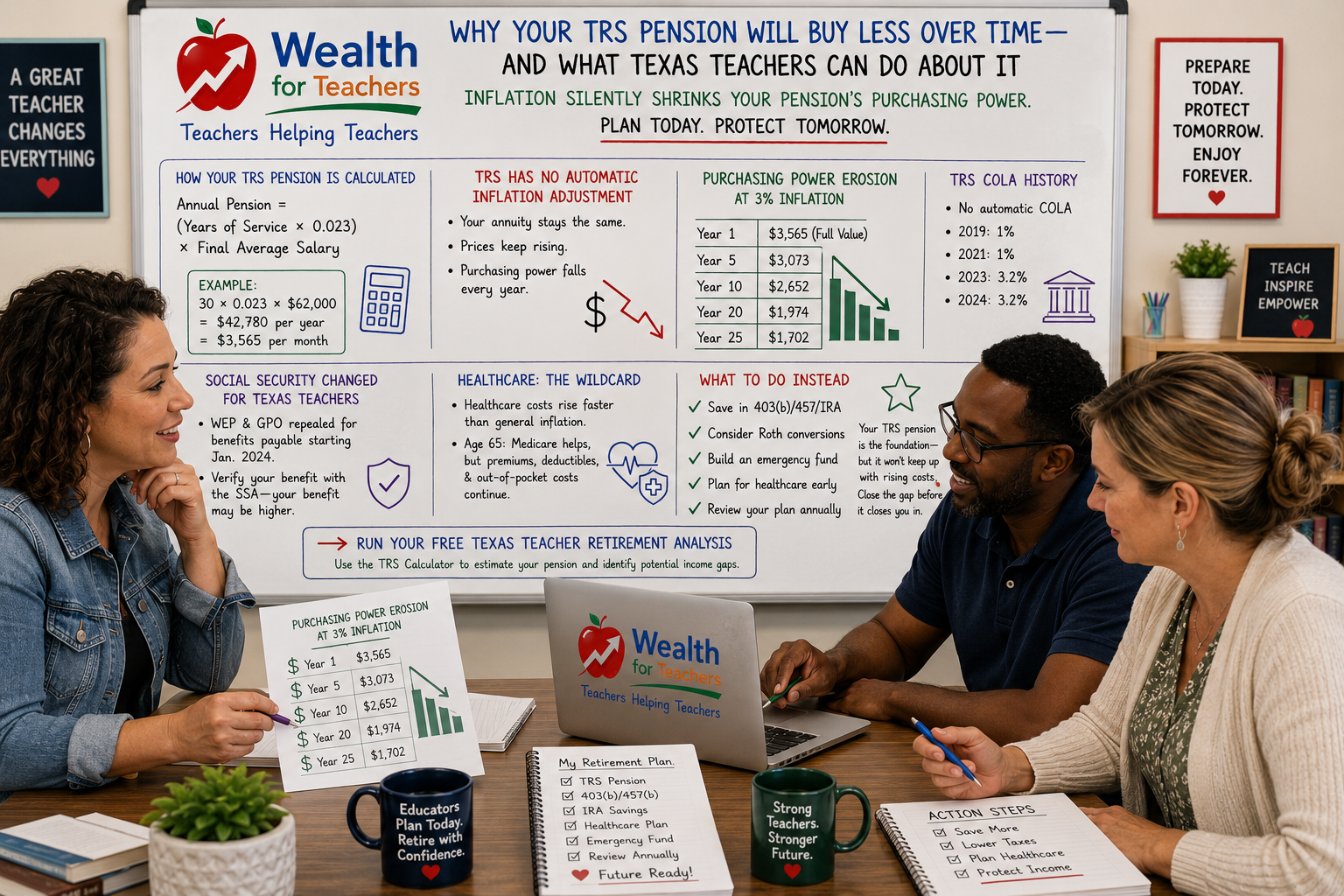
The Texas TRS pension formula is calculated using 2.3 percent (multiplier) times the average of the five highest annual creditable salaries times years of credited service to arrive at the annual standard annuity — except for members who are grandfathered, where the three highest annual salaries are used.
Written as an equation: Annual Pension = (Years of Service × 0.023) × Final Average Salary
Here’s a concrete example. A teacher with 30 years of service and a $62,000 final average salary would calculate: 30 × 0.023 × $62,000 = $42,780 per year from TRS. That’s a reliable income floor — and it changes the withdrawal math significantly.
When a pension already covers a substantial portion of your fixed living expenses, your personal savings do not need to generate the same amount of income as they would for someone with no pension at all. That means you may be able to use a more conservative withdrawal rate and still have plenty of cushion — or you may be able to afford a slightly higher rate because your essential expenses are already covered.
The key is knowing the gap: how much does your pension not cover, and how long do your savings need to bridge that gap?
To understand what can happen when that gap is underestimated, read The Biggest Income Gap Risks Teachers Face in Retirement.
The Replacement Rate Reality
While your TRS pension benefit will provide a valuable source of ongoing retirement income, your pension probably won’t provide enough income to ensure a financially secure retirement. There is a gap between the amount of income provided by the average career employee’s TRS pension and the minimum amount of income you will likely need to live a financially comfortable retirement.
That gap is what your personal savings — and your withdrawal rate — must address.
Key Adjustments Texas Teachers Should Make
Rather than applying the 4% rule directly, Texas teachers should think in terms of an adjusted withdrawal strategy that accounts for their specific income structure.
1. Calculate Your Income Gap First
Before deciding on a withdrawal rate, determine your total anticipated expenses in retirement and subtract your guaranteed TRS pension income. The remaining gap is what your savings need to cover. Your withdrawal rate should be sized to fill that gap — not to replicate your entire pre-retirement income.
2. Account for a Longer Retirement Horizon
Many Texas teachers retire in their late 50s. A 35- to 40-year retirement is realistic. The longer the retirement horizon, the more conservative your withdrawal rate should be. Pulling 5% or 6% from savings when you may need that money to last 40 years introduces serious depletion risk.
3. Build Flexibility Into the Strategy
Rigid withdrawal rules break down during market downturns. A flexible strategy — where you pull less from savings in bad market years and more in strong years — can significantly extend the longevity of your portfolio. This matters more for teachers who retire early, before Social Security income supplements their savings withdrawals.
4. Separate One-Time Costs from Ongoing Expenses
Healthcare costs before Medicare eligibility, home repairs, or a vehicle purchase are one-time events that can distort your withdrawal rate in early retirement years. These should be planned for separately — not absorbed by the standard annual withdrawal amount. For a detailed look at how healthcare costs affect retirement income, see How Healthcare Costs Impact Texas Teacher Retirement.
Social Security and the Fairness Act: What Texas Teachers Need to Know
Approximately 96% of Texas public school employees do not pay into the Social Security system. If you worked in Social Security-covered employment at some point in your career — before or outside of teaching — you may be eligible for benefits.
An important change affects how those benefits are calculated. The Social Security Fairness Act, HR 82, was signed into law on January 5, 2025. The Act eliminates the reduction of Social Security benefits while entitled to public pensions from work not covered by Social Security. Specifically, December 2023 is the last month that WEP and GPO applied. This means that those rules no longer apply to benefits payable for January 2024 and later.
For Texas teachers who are eligible for Social Security benefits, this is a significant planning factor. The timing of when you claim Social Security affects how much you need to withdraw from personal savings in early retirement years. Claiming earlier means receiving benefits sooner but at a permanently reduced monthly amount; delaying earns delayed retirement credits that increase your monthly benefit, though the right claiming age depends on your individual circumstances, health, and other income sources. For a deeper look at that decision, read Should Teachers Delay Social Security Benefits?
Inflation Risk: The Silent Threat to TRS Retirees
Your TRS pension is not automatically adjusted for inflation. Although your pension may be enough to cover your expenses when you first retire, over time, your monthly annuity purchasing power will decrease due to inflation. You’ll need to cover the difference with your personal savings.
This is one of the most underappreciated risks in TRS retirement planning. A pension that covers your expenses at age 58 may cover significantly less of those same expenses by age 73 — even if the dollar amount hasn’t changed. The withdrawal rate you set for your savings must account for this growing gap over time, not just the gap at the moment of retirement.
For a detailed breakdown of how inflation erodes TRS purchasing power over a retirement, see How Inflation Really Impacts TRS Pension Over Time.
How to Make the Right Decision for Your Situation
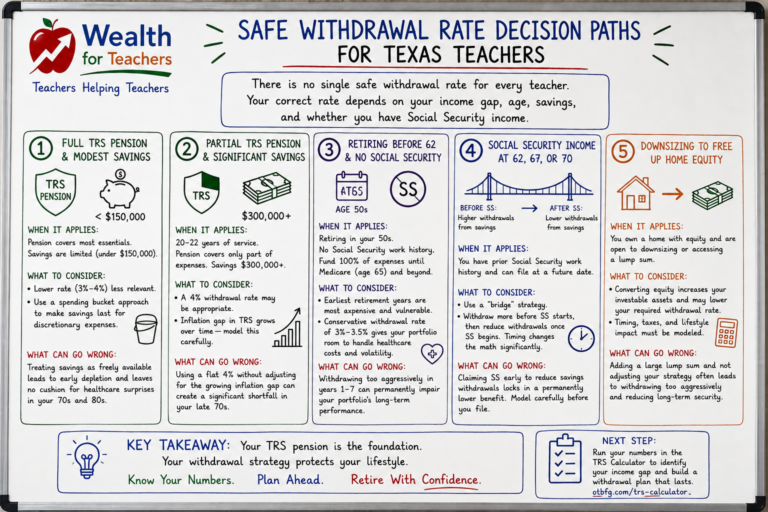
There is no single safe withdrawal rate that applies to every Texas teacher. Your correct rate depends on your income gap, your retirement age, your savings balance, and whether you have Social Security income. Here are five decision paths that reflect real situations Texas teachers face.
Path 1: You Have a Full TRS Pension and Modest Savings
When it applies: Your pension covers most of your essential expenses and your personal savings are relatively limited — under $150,000.
What to consider: A lower withdrawal rate (3% to 4%) may be less relevant here. The priority is making those savings last for discretionary expenses — travel, healthcare, one-time costs — without depleting them early. A spending bucket approach, separating short-term and long-term savings, often works better than a percentage-based rule.
What can go wrong: Treating savings as freely available because “the pension covers the basics” often leads to early depletion, leaving no cushion for healthcare surprises in your 70s and 80s.
Path 2: You Have a Partial TRS Pension and Significant Savings
When it applies: You retired with fewer years of service — perhaps 20 to 22 years — and your pension covers only a portion of your expenses. You have $300,000 or more in a 403(b) or IRA.
What to consider: Your savings must do more work. A 4% withdrawal rate may be appropriate, but the inflation gap in your TRS pension will grow over time, meaning your required withdrawal may increase even if your nominal expenses don’t. Model this carefully.
What can go wrong: Using a flat 4% without adjusting for the growing inflation gap can result in a significant shortfall in your late 70s.
Path 3: You Are Retiring Before Age 62 and Have No Social Security
When it applies: You are retiring in your mid-to-late 50s, have no Social Security-covered work history, and must fund 100% of your non-pension expenses from savings until Medicare eligibility at age 65 and beyond.
What to consider: Your earliest retirement years are the most expensive and the most vulnerable. Healthcare costs before Medicare eligibility are often the largest unplanned expense. A more conservative withdrawal rate — 3% to 3.5% — gives the portfolio room to absorb these years.
What can go wrong: Withdrawing too aggressively in years one through seven, before you stabilize healthcare costs and before Social Security income (if any), can permanently impair the portfolio’s long-term performance.
Path 4: You Have Social Security Income Coming at 62, 67, or 70
When it applies: You have prior Social Security-covered work history and can file for benefits at a future date.
What to consider: In the years before your Social Security starts, your withdrawal rate from savings will be higher. Once Social Security begins, you can reduce the draw on savings. This creates a “bridge” strategy where you temporarily withdraw more from savings and then shift a portion of that income need to Social Security. The math changes significantly depending on when you file.
What can go wrong: Claiming Social Security early just to reduce savings withdrawals locks in a permanently lower monthly benefit. Whether that trade-off makes sense depends on your health, longevity expectations, other income sources, and individual circumstances — and should be modeled carefully before you file.
Path 5: You Are Considering Downsizing to Free Up Home Equity
When it applies: You own a home with substantial equity and are open to moving to reduce housing costs or access a lump sum.
What to consider: Converting home equity to investable assets changes your savings balance and can reduce your required withdrawal rate. However, the timing, tax treatment, and lifestyle impact must all be modeled. For a detailed look at whether this makes sense, see Should You Downsize in Retirement as a Teacher?
What can go wrong: Teachers who downsize and add a large lump sum to savings without adjusting their withdrawal strategy often end up withdrawing too aggressively from the combined balance, negating the benefit of the equity conversion.