

Why Texas Teachers Face a Retirement Income Gap That Their Pension Alone Cannot Close
Most Texas teachers retire with confidence in their TRS pension — and with good reason. A defined benefit plan provides a predictable monthly check for life. But the teacher income gap in retirement is real, and it catches far more educators off guard than it should.
Texas teachers can also run a full pension estimate using the Texas Teacher Retirement Calculator to better understand their retirement outlook.
The problem is not the pension itself. The problem is the space between what the pension pays and what retirement actually costs — a gap shaped by inflation, healthcare expenses, savings shortfalls, and timing decisions that cannot be undone once you leave the classroom.
This article breaks down exactly where those gaps come from, what is at stake if you miss them, and what Texas teachers can do before retirement to protect their income.
For a full overview of how TRS decisions connect to your long-term financial security, start with the Texas Teacher Retirement Planning Guide.
Why Most Retirement Plans Fail Before They Start
Most retirement plans fail not because teachers made bad decisions, but because those plans were never tested against real-world conditions. A number on paper — even an accurate one — does not account for early health events, a spouse’s reduced income, a surge in living costs, or a retirement that lasts 30 years instead of 20.
Run Your Free Texas Teacher Retirement Analysis
Use the TRS calculator to estimate your pension and identify potential income gaps.
The teachers who face the sharpest income gaps in retirement are usually those who assumed the pension calculation told the whole story. It does not. The pension tells you what you will receive. It does not tell you whether that amount is enough, for how long, or what happens when expenses rise and the payment stays the same.
How the TRS Pension Formula Works — and Where It Falls Short
The TRS pension plan is a defined benefit plan, meaning retirement benefits are determined using a formula established by Texas law — not by member contributions.
The formula is straightforward:
- Annual Pension = Years of Service × 2.3% × Final Average Salary
Texas TRS uses a flat 2.3% multiplier for every year of service. There are no progressive tiers or increasing bands based on service length. Every year counts the same.
For example, a member with a final average salary of $50,000, 22 years of service credit, who meets eligibility requirements, would receive: 2.3% × $50,000 × 22 = $25,300 gross annual annuity, or $2,108.33 gross monthly annuity.
Now consider what that number means in practice. A teacher earning $65,000 with 28 years of service would receive:
- 28 × 0.023 × $65,000 = $41,860 per year, or roughly $3,488 per month
For many Texas teachers, that is a meaningful income. But it represents a 36% reduction from their working salary — before taxes, before healthcare premiums, and before any inflation adjustment is applied. That gap is where the real planning begins.
It is also worth understanding that if a member’s age plus years of service do not meet the required threshold, an early-age reduction applies. The percentage of reduction depends on your age, years of service credit at retirement, membership entry date, grandfathered status, and tier membership status. Retiring even a year or two early without meeting eligibility thresholds can permanently reduce a pension — a decision that affects every payment for the rest of a teacher’s life.
To understand how TRS retirement decisions compare to traditional retirement planning, see Why Retirement Income Planning Is Different for Teachers.
The Inflation Gap: A Fixed Income in a Rising-Cost World
One of the most underestimated risks Texas teachers face is the purchasing power erosion that happens over a long retirement. A TRS pension is not automatically adjusted for inflation each year. That means the same monthly payment you receive in year one of retirement will buy less in year ten and significantly less in year twenty.
Texas TRS has provided cost-of-living adjustments, but they are not automatic or guaranteed. The 2024 COLA was a one-time permanent increase to annuities — not an ongoing annual adjustment tied to the Consumer Price Index. That one-time COLA applied to annuitants who retired on or before August 31, 2020. Teachers who retired after that date were not eligible.
The pattern is clear: COLAs require legislative action, voter approval, and available funding. They are not a structural feature of TRS that you can count on year after year.
This makes the inflation gap one of the most predictable — yet most frequently ignored — risks in a Texas teacher’s retirement plan. A pension that feels adequate today may cover only 70 to 80 cents on today’s dollar a decade from now, depending on inflation levels and personal spending patterns.
Healthcare: The Expense Teachers Consistently Underestimate
Healthcare costs in retirement have a way of growing faster than almost any other expense category. For Texas teachers, this risk is compounded by the structure of TRS-Care, the health benefit program for eligible retirees.
Premiums, deductibles, and out-of-pocket limits in TRS-Care are subject to change. Teachers who retire before Medicare eligibility at age 65 face a coverage gap period where they are responsible for a larger share of healthcare costs. Even after Medicare begins, supplemental coverage, prescription costs, and dental and vision expenses continue.
Healthcare is often the single largest variable expense in a retired teacher’s budget — and it is the one most likely to grow unpredictably. A retirement income plan that does not model healthcare cost increases is not a complete plan.
For a detailed breakdown of this risk, see How Healthcare Costs Impact Texas Teacher Retirement.
Social Security and Texas Teachers: What Changed
For decades, many Texas teachers who were eligible for Social Security benefits — through a spouse’s record, a second job, or years outside of TRS-covered employment — had those benefits reduced or eliminated by the Windfall Elimination Provision (WEP) and the Government Pension Offset (GPO).
That changed with the Social Security Fairness Act. The Social Security Fairness Act, HR 82, was signed into law on January 5, 2025. The Act repeals the Windfall Elimination Provision (WEP) and Government Pension Offset (GPO), both of which could reduce Social Security benefits when someone received a pension based on work that was not covered by Social Security.
December 2023 is the last month that WEP and GPO applied. These rules no longer apply to benefits payable for January 2024 and later.
This is a significant development for many Texas teachers. If you or your spouse were previously told that Social Security benefits would be reduced or eliminated because of the TRS pension, that calculation has changed. Eligible teachers should verify their current Social Security benefit status directly with the SSA, particularly if they have not already done so.
If you are weighing when to claim Social Security benefits, the timing decision still matters based on your individual circumstances. See Should Teachers Delay Social Security Benefits? for a teacher-focused breakdown of that decision.
The Savings Shortfall: When TRS Is Your Only Plan
Texas teachers who enter retirement with little or no supplemental savings outside of TRS are the most exposed to an income gap. The pension provides a foundation, but it rarely replaces 100% of pre-retirement take-home pay — especially after taxes and healthcare deductions are applied.
Several factors compound this risk:
- Salary growth in the final years of teaching can raise the final average salary used in the pension formula — but only if those raises occur before retirement. Teachers who plateau in salary earlier than expected may find their pension lower than anticipated.
- Supplemental retirement accounts such as a 403(b) or 457(b) are available to Texas teachers, but enrollment and consistent contributions are not automatic. Many teachers contribute too little for too long and arrive at retirement with a balance that does not meaningfully close the income gap.
- Spending habits built on a working salary do not automatically adjust downward at retirement. Fixed expenses — mortgages, car payments, travel — may not change simply because income does.
Tax planning is also part of the savings gap that teachers often overlook. The structure of your accounts — traditional pre-tax versus Roth — determines how much of your retirement income you actually keep after taxes. This decision is best made before retirement, not after. See Should Teachers Use Roth Conversions Before Retirement? for context on how this decision applies to Texas educators.
How to Make the Right Decision for Your Situation
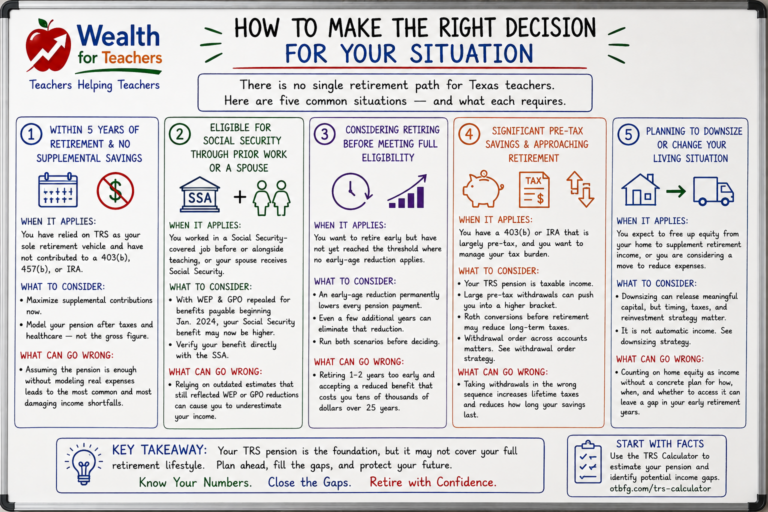
There is no single retirement path for Texas teachers. Here are five common situations — and what each requires.
1. You Are Within Five Years of Retirement and Have No Supplemental Savings
When it applies: You have relied on TRS as your sole retirement vehicle and have not contributed to a 403(b), 457(b), or IRA.
What to consider: Maximize supplemental contributions now. Even five years of aggressive savings can make a meaningful difference in bridging the income gap. Model what your pension will actually pay after taxes and healthcare — not the gross figure.
What can go wrong: Assuming the pension is enough without modeling real expenses leads to the most common and most damaging income shortfalls in teacher retirement.
2. You Are Eligible for Social Security Through Prior Work or a Spouse
When it applies: You worked in a Social Security-covered job before or alongside teaching, or your spouse receives Social Security.
What to consider: With WEP and GPO repealed for benefits payable beginning January 2024, your Social Security benefit may now be higher than previously estimated. Verify your benefit directly with the SSA before building your income plan.
What can go wrong: Relying on outdated Social Security estimates that still reflected WEP or GPO reductions can cause you to underestimate your income and over-save in one area while remaining exposed in another.
3. You Are Considering Retiring Before Meeting Full Eligibility
When it applies: You want to retire early but have not yet reached the threshold where no early-age reduction applies.
What to consider: An early-age reduction permanently lowers every pension payment you will ever receive. Even a few additional years of teaching can eliminate that reduction entirely. Run both scenarios before deciding.
What can go wrong: Retiring one or two years too early and accepting a reduced benefit that costs you tens of thousands of dollars over a 25-year retirement.
4. You Have Significant Pre-Tax Savings and Are Approaching Retirement
When it applies: You have a 403(b) or IRA that is largely pre-tax, and you want to manage your tax burden in retirement.
What to consider: Your TRS pension is taxable income. Adding large pre-tax withdrawals on top of it can push you into a higher bracket than expected. Roth conversions before retirement may reduce your long-term tax exposure. Your withdrawal order across account types also matters. See How Withdrawal Order Impacts Taxes in Retirement for a practical framework.
What can go wrong: Taking withdrawals in the wrong sequence increases lifetime taxes and reduces how long your savings last.
5. You Are Planning on Downsizing or Changing Your Living Situation
When it applies: You expect to free up equity from your home to supplement retirement income, or you are considering a move to reduce expenses.
What to consider: Downsizing can release meaningful capital, but the timing, tax treatment, and reinvestment strategy matter. It is not automatic income. See Should You Downsize in Retirement as a Teacher? for a teacher-specific look at this decision.
What can go wrong: Counting on home equity as income without a concrete plan for how, when, and whether to access it can leave a gap in your early retirement years.
What to Do Instead
Rather than assuming the pension is enough, Texas teachers should stress-test their retirement income plan before they leave the classroom. That means modeling:
- The actual after-tax pension payment — not the gross figure
- Healthcare costs in both the pre-Medicare and post-Medicare phases
- Inflation’s effect on purchasing power across a 20- to 30-year retirement
- Supplemental income from Social Security, savings accounts, or part-time work
- The tax impact of drawing down multiple account types simultaneously
The goal is to identify the income gap before it appears — not after the retirement date has passed and the decisions are locked in.
Quick Self-Check Before You Move Forward
Use these five diagnostic questions to identify gaps or uncertainty in your current retirement plan:
- Do you know your actual after-tax monthly TRS pension amount — not just the gross figure? If you have only seen the gross estimate, your real take-home income may be meaningfully lower than you expect.
- Have you modeled healthcare costs for both the years before Medicare and the years after? If TRS-Care premiums and out-of-pocket costs are not part of your budget, your income plan has a significant blind spot.
- If you are eligible for Social Security, have you verified your benefit with the SSA since the repeal of WEP and GPO? Old estimates that reflected those reductions are no longer accurate for benefits payable beginning January 2024.
- Does your retirement date allow you to avoid an early-age reduction on your TRS benefit? If you are unsure how your age and years of service interact at your planned retirement date, this needs to be verified before you submit any paperwork.
- Do you have supplemental savings outside of TRS — and have you stress-tested how long those savings will last? If the answer to either part of that question is no, your income plan has not been fully tested.
Most Teachers Discover Gaps Too Late
The most damaging income gaps in teacher retirement share a common pattern: they were predictable, but no one tested the assumptions before the retirement date arrived.
A teacher who retires at 58 with a pension that feels adequate may not realize the purchasing power problem until year eight or year ten, when inflation has quietly widened the gap between income and expenses. A teacher who assumed Social Security would offset TRS income may have built a plan around outdated WEP calculations. A teacher who never modeled healthcare costs may face premium increases that eliminate the cushion they thought they had.
These are not rare outcomes. They are the predictable result of planning around a single number — the TRS pension estimate — without stress-testing what happens when real life diverges from the projection. The window to correct these gaps closes at retirement. Once you have left TRS-covered employment and submitted your retirement paperwork, most of these decisions become permanent.
The only way to protect yourself is to identify the gaps before that window closes.
Common Questions Texas Teachers Ask
Is my TRS pension enough to retire on?
For some teachers it is — but that depends entirely on your years of service, final average salary, expected expenses, healthcare costs, and whether you have supplemental savings. A pension that replaces 60–70% of your pre-retirement salary may feel sufficient until healthcare costs rise, inflation reduces purchasing power, or an unexpected expense appears. The question is not whether the pension is large — the question is whether it has been tested against your real retirement costs.
Does TRS automatically adjust my pension for inflation each year?
No. TRS does not provide an automatic annual cost-of-living adjustment tied to inflation. COLAs have been provided, but they require legislative action and voter approval. The most recent was a one-time permanent increase for eligible annuitants beginning in January 2024, available to annuitants who retired on or before August 31, 2020. Future COLAs are not guaranteed.
I was told Social Security would be reduced because of my TRS pension. Is that still true?
No. The Social Security Fairness Act, signed into law on January 5, 2025, repealed both the Windfall Elimination Provision (WEP) and the Government Pension Offset (GPO). These reductions no longer apply to benefits payable beginning January 2024. If you previously received an estimate that reflected WEP or GPO reductions, that estimate is outdated. Verify your current benefit directly with the Social Security Administration.
What happens to my pension if I retire before I am fully eligible?
If you retire before meeting the eligibility threshold for an unreduced benefit, an early-age reduction is applied to your pension. That reduction is permanent — it applies to every payment for the rest of your life. The size of the reduction depends on your age, years of service, membership entry date, and tier. Running a comparison of your pension at multiple retirement dates is one of the most important steps a teacher approaching retirement can take.
What supplemental savings options do Texas teachers have?
Texas teachers in TRS-covered positions can contribute to a 403(b) annuity or a 457(b) deferred compensation plan through their employer. These accounts allow tax-advantaged savings outside of TRS and can meaningfully close the income gap in retirement. Contribution limits for these accounts are set by the IRS and are subject to change. Check with your district’s benefits administrator for enrollment options and current limits.
Get Your TRS Analysis
A TRS pension estimate is not a retirement income plan. If you want to know whether your income will actually cover your retirement — including inflation, healthcare, taxes, and savings — the next step is a complete analysis of your specific situation.