

Why Your TRS Pension Will Buy Less Over Time — and What Texas Teachers Can Do About It
You spent decades in the classroom. You earned a pension. And on paper, the numbers look reasonable. But there is a problem that most Texas teachers do not think about until they are already in retirement: inflation TRS pension impact is real, it is cumulative, and it quietly shrinks the real value of your monthly check every single year.
Texas teachers can also run a full pension estimate using the Texas Teacher Retirement Calculator to better understand their retirement outlook.
Your TRS benefit is calculated once at retirement using a flat formula. After that, the dollar amount is largely fixed. Prices do not stop moving just because your pension did.
This article explains exactly how purchasing power erodes over a long retirement, what TRS does and does not do to address it, and the specific steps Texas teachers can take to protect their income before it is too late.
For a complete overview of how TRS fits into your overall income strategy, start with the Texas Teacher Retirement Planning Guide.
Most retirement plans fail not because the math was wrong at the start, but because they were never pressure-tested against real-world conditions — inflation, rising healthcare costs, longevity, and income gaps. A plan that looks solid on paper can quietly unravel over fifteen or twenty years if it was built assuming your expenses would stay flat.
How Your TRS Pension Is Calculated
Texas TRS uses a straightforward formula with a flat 2.3% multiplier per year of service:
Run Your Free Texas Teacher Retirement Analysis
Use the TRS calculator to estimate your pension and identify potential income gaps.
Annual Pension = (Years of Service × 0.023) × Final Average Salary
For example, a teacher who retires with 30 years of service and a final average salary of $62,000 would receive:
30 × 0.023 × $62,000 = $42,780 per year, or $3,565 per month.
That is a meaningful income. But it is the same $3,565 whether you are in year one of retirement or year twenty. The formula does not grow with inflation. The pension is locked in at retirement based on your service and salary history — and it stays there.
This matters enormously because Texas teachers often retire in their mid-to-late 50s and may spend 25 to 30 years in retirement. That is a long time for a fixed dollar amount to cover rising costs.
TRS Has No Automatic Inflation Adjustment
There are no automatic increases to your annuity once you have retired. Your TRS pension is not automatically adjusted for inflation.
The modesty of TRS’s benefit is due, primarily, to the lack of an automatic cost-of-living increase. This directly reflects the loss of purchasing power over time.
This is not a flaw that gets quietly corrected. It is a structural feature of the plan. Every year that passes without a legislative COLA is a year your pension falls further behind actual prices.
The roughly 69% replacement ratio that TRS provides applies only to replacement income at initial retirement. Inflation will lower effective purchasing power over time.
What Purchasing Power Erosion Actually Looks Like
Consider the teacher in the example above retiring with $3,565 per month. At a modest 3% average annual inflation rate — a historically reasonable long-run assumption — here is what that pension is worth in real purchasing power:
- Year 1: $3,565 (full value)
- Year 5: Approximately $3,073 in today’s dollars
- Year 10: Approximately $2,652 in today’s dollars
- Year 20: Approximately $1,974 in today’s dollars
- Year 25: Approximately $1,702 in today’s dollars
The nominal check never changes. The real purchasing power shrinks by nearly half over 25 years. A retirement that felt comfortable at 58 can feel strained at 75 — not because circumstances changed, but because prices did.
Although your pension may be enough to cover your expenses when you first retire, over time, your monthly annuity purchasing power will decrease due to inflation. You will need to cover the difference with your personal savings.
The gap between what your pension covers in year one and what it covers in year twenty is the core planning problem. Most teachers underestimate it because it grows slowly and is invisible until it becomes painful.
This is also why understanding the income gap risks teachers face in retirement is such a critical planning step — not just a theoretical exercise.
When the Legislature Steps In: The TRS COLA History
Texas teachers do not have a reliable, recurring COLA built into their pension. Any adjustment requires action by the Texas Legislature and, in some cases, approval by Texas voters. That is a meaningful distinction.
A one-time 2024 cost-of-living adjustment was dependent on Texas voters approving a constitutional amendment (Proposition 9) to authorize it. Voters approved the amendment in the November 2023 election, and the COLA was applied to eligible annuitants’ payments beginning with their January 2024 payment.
This COLA applied to annuitants who retired on or before August 31, 2020. Teachers who retired more recently did not qualify for this particular adjustment.
The COLA amounts under SB 10 were tiered by retirement date: 2% for retirees with retirement dates from September 1, 2013 through August 31, 2020; 4% for retirees with retirement dates from September 1, 2001 through August 31, 2013; and 6% for those who retired on or before August 31, 2001.
Even the largest of those adjustments — 6% — does not fully restore purchasing power lost over a decade or more of no increases. These legislative COLAs are infrequent, eligibility-limited, and cannot be counted on as a planning assumption. Decades can pass between adjustments.
The practical implication: a Texas teacher cannot plan as if periodic COLAs will protect their retirement income. They need to build that protection themselves.
Social Security Changed for Texas Teachers
Approximately 96% of public school employees in Texas do not pay into the Social Security system. For most Texas teachers, TRS is their primary — and often only — pension income.
However, an important change occurred for teachers who do have Social Security work history. The Social Security Fairness Act, HR 82, was signed into law on January 5, 2025. The Act repealed the Windfall Elimination Provision (WEP) and the Government Pension Offset (GPO) — two rules that had reduced or eliminated Social Security benefits for certain individuals who also receive a pension from work not covered by Social Security.
December 2023 is the last month that WEP and GPO applied. Those rules no longer apply to benefits payable for January 2024 and later.
This matters for teachers who worked in Social Security-covered employment at some point in their careers — either before teaching, during summers, or through a second job. If that applies to you, your Social Security benefit calculation is no longer reduced by those prior rules for benefits payable beginning January 2024. This represents a meaningful change to your overall retirement income picture and deserves a fresh look if you had previously written off Social Security income.
Understanding how Social Security timing interacts with your TRS income is a separate planning decision worth examining. Should teachers delay Social Security benefits? is a question that now has a different answer for many educators than it did before the law changed.
Healthcare: The Inflation Wildcard Inside Your Retirement
Inflation does not hit every category of spending equally. Healthcare costs have historically risen faster than general inflation. For a retiree on a fixed pension, this creates a compounding squeeze: your income is flat, but one of your biggest expense categories grows faster than the general price level.
Texas teachers who retire before Medicare eligibility at age 65 face an especially exposed window. TRS-Care options exist, but premiums, deductibles, and out-of-pocket costs shift over time in ways that cannot be fully predicted at retirement. How healthcare costs impact Texas teacher retirement is a planning dimension that belongs inside every inflation stress test — not as a footnote, but as a central assumption.
If you retired at 58, you may face seven years of pre-Medicare healthcare costs before federal coverage begins. Over that window, even a modest annual increase in premiums can consume a significant portion of any savings buffer you built.
What to Do Instead
The goal is not to panic about inflation — it is to plan for it specifically. A Texas teacher who understands the inflation TRS pension impact has real options. Here is how to think about building protection:
- Build a supplemental income layer. Personal savings such as a 403(b), 457, or IRA play an important part in your financial security and can supplement your TRS pension at retirement. These accounts give you flexibility to increase withdrawals in years when prices rise faster than expected.
- Size your savings target using inflation-adjusted projections. Do not calculate how much you need based on today’s prices. Project forward at a reasonable inflation rate for the length of your expected retirement. A 25-year retirement at 3% inflation requires a meaningfully larger savings buffer than most teachers initially estimate.
- Do not assume legislative COLAs will rescue your plan. They are infrequent, eligibility-limited, and require political will that cannot be predicted. Treat any future COLA as a possible bonus — not a guaranteed income source.
- Reassess Social Security eligibility. If you have Social Security work history, the repeal of WEP and GPO means your benefit may now be higher than previously estimated. A revised Social Security projection can change the shape of your overall income plan.
- Consider the sequence of your income sources. In early retirement years, while your pension still covers a higher percentage of your needs, drawing less from savings allows those accounts to continue growing. As inflation erodes pension purchasing power over time, having a larger savings balance available in later years provides a critical buffer.
- Stress-test against higher inflation scenarios. Do not plan only for 2% to 3% average inflation. Model what your plan looks like at 4% or 5% sustained over a decade. If the plan breaks, you want to know now — not at age 72.
This is also why retirement income planning is structurally different for teachers than it is for workers with Social Security-covered employment and automatic pension adjustments. The tools available and the risks to manage are genuinely different.
How to Make the Right Decision for Your Situation
Inflation affects Texas teachers differently depending on when they retire, what supplemental savings they have, and whether they have Social Security work history. Here are the most common decision paths and what each teacher needs to consider:
1. You Are 5 to 10 Years From Retirement and Have No Supplemental Savings
When it applies: Mid-career teachers who have relied entirely on TRS and have not opened a 403(b) or IRA.
What to consider: This window is your most powerful opportunity to build the supplemental layer that will compensate for inflation in retirement. Even modest contributions made consistently over 7 to 10 years can build a meaningful buffer. Time and compounding still work in your favor.
What can go wrong: Waiting until age 58 to start saving creates a short runway with little time for growth. Teachers who retire with only a TRS pension and no supplemental savings are the most exposed to purchasing power erosion in years 10 through 25 of retirement.
2. You Are Retiring in the Next 1 to 2 Years and Have Some Savings
When it applies: Teachers close to retirement who have accumulated some personal savings but have not stress-tested the plan against inflation.
What to consider: Run an inflation-adjusted projection of your pension, your savings withdrawal rate, and your expected expenses through your 80s. Pay particular attention to healthcare costs if you are retiring before Medicare eligibility. Consider whether Roth conversion strategies before retirement could reduce your tax burden on savings withdrawals later. Roth conversions before retirement can be a meaningful tool if used in the right window.
What can go wrong: Assuming your current savings balance is sufficient without testing it against real inflation over a 20- to 25-year horizon. What feels like a comfortable cushion today can erode faster than expected when healthcare inflation and general price increases combine.
3. You Have Social Security Work History
When it applies: Teachers who worked in Social Security-covered employment at any point in their careers.
What to consider: With WEP and GPO repealed for benefits payable beginning January 2024, your Social Security benefit may now be meaningfully higher than you estimated under prior rules. Recalculate your projected benefit and factor Social Security’s annual cost-of-living adjustments into your inflation planning. Unlike TRS, Social Security does receive annual COLA increases, which makes it a valuable inflation hedge within a combined income strategy.
What can go wrong: Failing to file for or recalculate Social Security benefits under the new rules, leaving money on the table. Also, poorly timed claiming can reduce the lifetime value of the benefit significantly.
4. You Are Already Retired and Living Primarily on Your TRS Pension
When it applies: Current TRS retirees who retired primarily or entirely on their pension without a significant supplemental savings buffer.
What to consider: The first priority is assessing the current gap between your pension’s original purchasing power and what it covers today. Look at whether part-time work, housing adjustments, or downsizing can meaningfully offset the shortfall. Downsizing in retirement can convert housing equity into liquid assets that provide the inflation buffer a fixed pension cannot.
What can go wrong: Waiting too long to make adjustments. The longer a teacher remains in a situation where the pension is falling further behind expenses, the fewer good options remain.
5. You Have a Robust Savings Buffer and a Strong Pension
When it applies: Teachers with 30-plus years of service, a well-funded 403(b) or IRA, and potentially Social Security income as well.
What to consider: Your risk from inflation TRS pension impact is lower, but the planning question shifts to sequencing — which accounts you draw from first, how you manage required minimum distributions, and how you optimize Social Security timing to maximize the inflation-adjusted income stream over your lifetime.
What can go wrong: Overconfidence. Even a strong plan needs to be reviewed regularly. A decade of higher-than-expected inflation can erode even well-built plans if withdrawals are not adjusted.
Common Questions Texas Teachers Ask
Does TRS automatically adjust my pension for inflation each year?
No. There are no automatic increases to your annuity once you have retired. Your TRS pension is not automatically adjusted for inflation. Any increase requires a specific act of the Texas Legislature.
How often does TRS give retirees a COLA?
Infrequently, and there is no scheduled cycle. COLAs have been granted periodically but are not guaranteed. Funding for the one-time 2024 COLA was provided by the 88th Texas Legislature to protect the health of the pension trust fund. There is no guarantee that future Legislatures will act on a similar timeline.
My TRS pension replaces about 70% of my salary. Is that enough?
At retirement, it may feel close. But that replacement ratio erodes over time. The roughly 69% replacement ratio applies only to replacement income at initial retirement. Inflation will lower effective purchasing power over time. The gap between what your pension covers and what you actually need grows every year.
Does the Social Security Fairness Act affect Texas teachers?
It affects teachers who have Social Security work history. The Social Security Fairness Act was signed into law on January 5, 2025, and repealed the Windfall Elimination Provision (WEP) and the Government Pension Offset (GPO), which had reduced Social Security benefits for certain individuals who also receive a pension from work not covered by Social Security. Teachers who previously expected reduced Social Security benefits due to WEP or GPO should reassess their eligibility and projected amounts.
What can I use to supplement my TRS pension against inflation?
Personal savings such as a 403(b), 457, or IRA play an important part in your financial security and can supplement your TRS pension at retirement. These accounts provide the flexible withdrawal capacity that a fixed pension cannot.
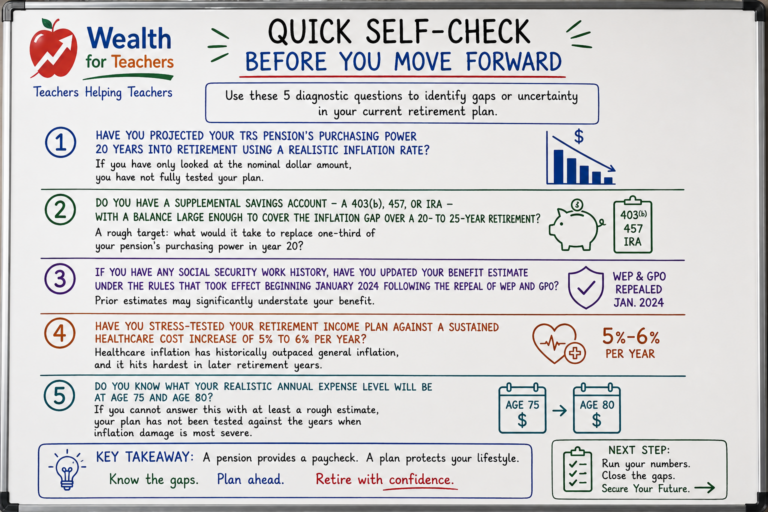
Quick Self-Check Before You Move Forward
Use these five diagnostic questions to identify gaps or uncertainty in your current retirement plan:
- Have you projected your TRS pension’s purchasing power 20 years into retirement using a realistic inflation rate? If you have only looked at the nominal dollar amount, you have not fully tested your plan.
- Do you have a supplemental savings account — a 403(b), 457, or IRA — with a balance large enough to cover the inflation gap over a 20- to 25-year retirement? A rough target: what would it take to replace one-third of your pension’s purchasing power in year 20?
- If you have any Social Security work history, have you updated your benefit estimate under the rules that took effect beginning January 2024 following the repeal of WEP and GPO? Prior estimates may significantly understate your benefit.
- Have you stress-tested your retirement income plan against a sustained healthcare cost increase of 5% to 6% per year? Healthcare inflation has historically outpaced general inflation, and it hits hardest in later retirement years.
- Do you know what your realistic annual expense level will be at age 75 and age 80? If you cannot answer this with at least a rough estimate, your plan has not been tested against the years when inflation damage is most severe.
Most Teachers Discover the Gaps Too Late
The most consistent pattern in Texas teacher retirement planning is not that people make bad decisions. It is that they make decisions based on assumptions they never tested. The pension looked solid at retirement. The savings balance seemed adequate. Expenses felt manageable.
But inflation is not dramatic. It does not announce itself as a crisis in year one or year three. It works slowly — and by the time the gap between your fixed income and your actual expenses becomes undeniable, the options for correcting it have narrowed significantly.
A teacher who retires at 58 with a plan that was never stress-tested against inflation may not feel the full impact until her early 70s. By then, she may have limited ability to return to work, few remaining years for savings to grow, and healthcare costs that have risen well beyond what the original budget assumed.
The right time to test your assumptions is before you retire — not after. And the right time to identify gaps is when you still have room to close them.
Get a Clear Picture of Your TRS Retirement Plan
Understanding the inflation TRS pension impact is the starting point. Knowing exactly how your specific pension, savings, Social Security eligibility, and expense projections interact over a 20- to 25-year retirement is what actually protects your income.
Every teacher’s situation is different — years of service, supplemental savings, Social Security work history, retirement age, and healthcare needs all change the math in meaningful ways. Generic projections miss the details that matter.