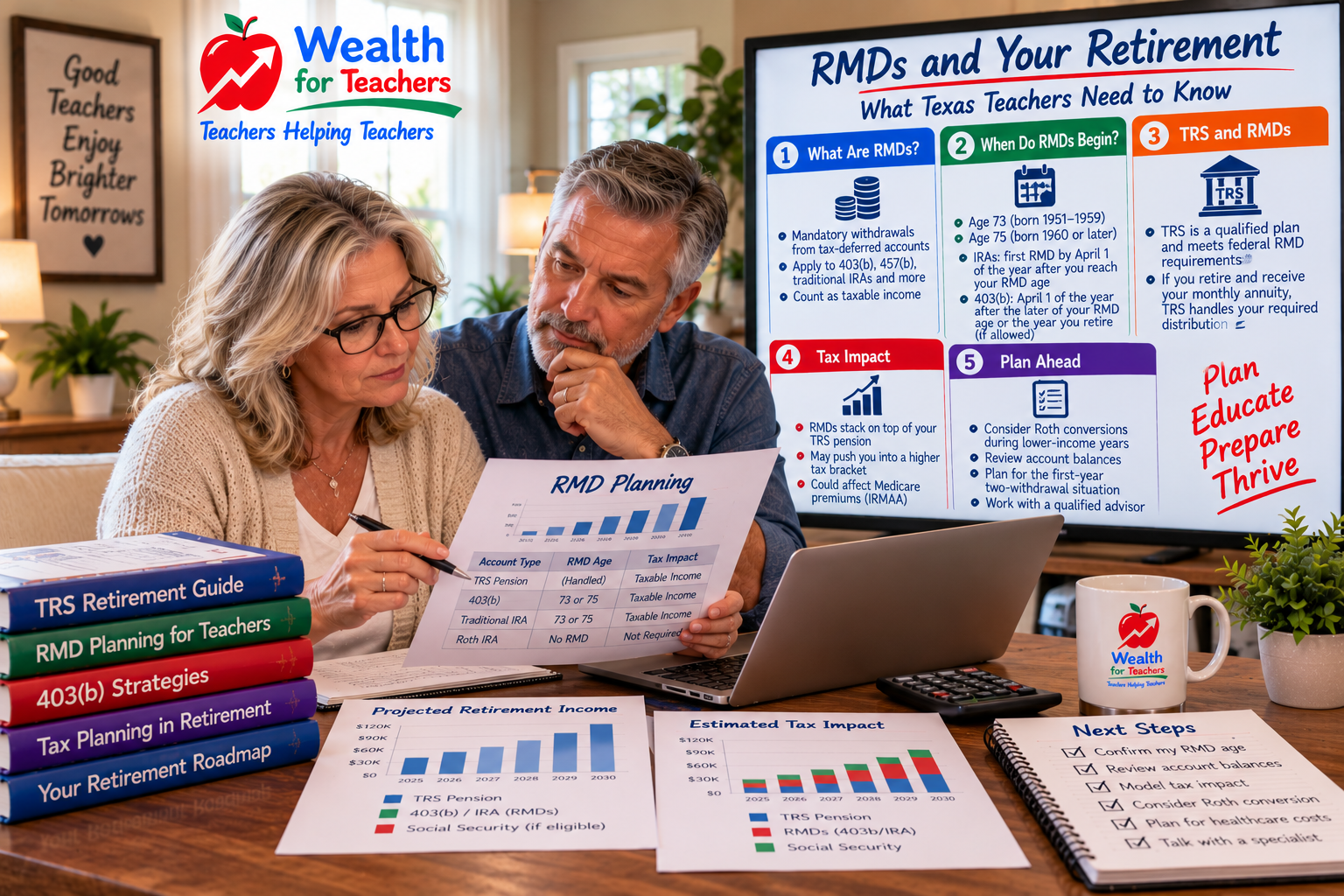
How Required Minimum Distributions Affect Retirement Strategy
Required withdrawals can change your tax and income plan.

Many teachers discover income gaps too late. Learn where they come from.

Most Texas teachers assume their TRS pension will cover their retirement expenses. They calculate their years of service, multiply by 2.3%, and feel confident about their financial future. But there’s a dangerous teacher income gap retirement planning that catches educators completely off guard.
Texas teachers can also run a full pension estimate using the Texas Teacher Retirement Calculator to better understand their retirement outlook.
The gap isn’t just about having less money than you expected. It’s about discovering fundamental flaws in your retirement assumptions when it’s too late to fix them. Many teachers realize too late that their TRS pension, while reliable, creates income shortfalls that force difficult lifestyle choices in their golden years.
This comprehensive Texas Teacher Retirement Planning Guide will show you exactly where these gaps develop and what you can do to prevent them from derailing your retirement.
The reality is that most retirement plans fail because they’re built on untested assumptions. Teachers often plan for an idealized retirement that doesn’t account for inflation, healthcare costs, or the lifestyle changes that come with fixed pension income. By the time these gaps become obvious, it’s often too late to make meaningful corrections.
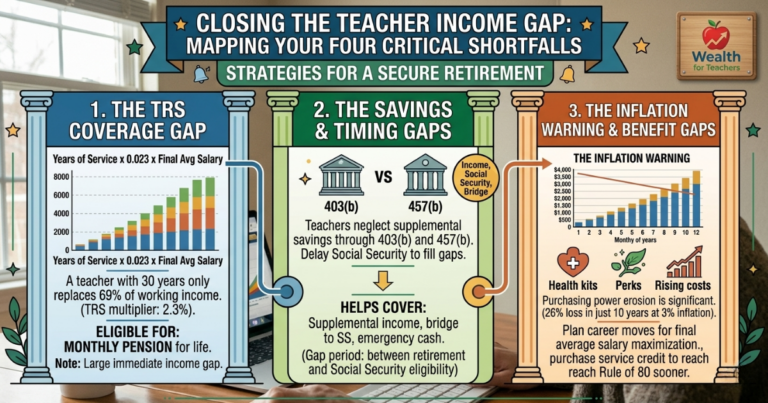
Texas teachers face four specific income gaps that create retirement challenges. Understanding these gaps early gives you time to address them before they become permanent financial problems.
Use the TRS calculator to estimate your pension and identify potential income gaps.
Your Texas TRS pension replaces a percentage of your working income, but rarely covers 100% of your pre-retirement expenses. Even teachers with 30 years of service only receive 69% of their final average salary (30 years × 2.3% = 69%).
Here’s a real example: A teacher with 30 years of service and a $60,000 final average salary receives $41,400 annually from TRS. That’s an immediate $18,600 annual gap from their working income. Most teachers haven’t prepared for this substantial reduction in available money.
Many teachers retire before they’re eligible for full Social Security benefits. This creates a gap period where you’re living solely on TRS income without Social Security supplementation. This gap can last several years and significantly reduces your total retirement income during those critical early retirement years.
Teachers often focus exclusively on their pension and neglect building additional retirement savings. Without supplemental savings through 403(b), 457(b), or IRA accounts, you’re entirely dependent on TRS income. This creates vulnerability if you need additional money for emergencies, healthcare, or lifestyle expenses your pension doesn’t cover.
Working teachers receive benefits like health insurance, professional development funding, and other perks that have real monetary value. In retirement, you’re responsible for replacing these benefits with your own money, creating an often-overlooked expense that reduces your effective spending power.
The standard TRS calculation gives you a monthly pension amount, but it doesn’t account for the realities of retirement spending. Your pension calculation assumes your retirement expenses will be proportionally similar to your working expenses, but this assumption often proves incorrect.
Teachers frequently underestimate specific retirement costs while overestimating how much their daily expenses will decrease. You might save money on commuting and work clothes, but you’ll likely spend more on healthcare, home maintenance, and activities that fill your newfound free time.
The TRS calculation also doesn’t factor in your spouse’s income needs if they’re not also receiving a teacher pension. Many teacher households rely on dual incomes during working years, but retirement planning often focuses only on the teacher’s pension without adequately replacing the spouse’s lost income.
Texas TRS provides cost-of-living adjustments, but they’re not automatic and don’t always keep pace with actual inflation. Over a 20-30 year retirement, even modest inflation significantly reduces your pension’s purchasing power.
Consider this scenario: A teacher retires with a $3,500 monthly TRS pension. With 3% annual inflation, that same pension has the purchasing power of only $2,590 after 10 years of retirement. This gradual erosion happens so slowly that many retirees don’t notice until the gap becomes significant.
Teachers who retire in their 50s face decades of potential inflation erosion. The longer your retirement, the more critical it becomes to have retirement income streams teachers can rely on that grow with or ahead of inflation.
TRS-Care provides retiree health insurance, but it doesn’t cover all healthcare expenses. Medicare supplementation, long-term care, dental, vision, and prescription costs can create substantial out-of-pocket expenses that many teachers haven’t budgeted for.
Healthcare costs retired teachers face often increase faster than general inflation. Medical expenses that seem manageable on a teacher’s working salary can become burdensome when living on a fixed pension income.
Many teachers also underestimate the likelihood of needing long-term care services. These costs can easily exceed your entire TRS pension, making it essential to plan for healthcare expenses beyond what TRS-Care provides.
Teachers often retire with plans to travel, pursue hobbies, and enjoy activities they couldn’t afford during their working years. However, their fixed pension income may not support the active retirement lifestyle they envisioned.
This creates a psychological and financial challenge. You have more free time but potentially less disposable income to enjoy that time. Many teachers find themselves needing to significantly adjust their retirement expectations or find ways to generate additional income.
The lifestyle mismatch becomes particularly acute for teachers who retire relatively young. You might have 30 years of retirement ahead of you, but your pension income may not support three decades of active living without careful budgeting and planning.
Address these income gaps systematically rather than hoping they won’t affect your retirement. Start by calculating your actual retirement expenses, not just assuming they’ll be lower than your working expenses.
Build supplemental retirement savings through available tax-advantaged accounts. Even modest contributions to a 403(b) or 457(b) plan can significantly reduce income gaps over time. Consider roth conversion teachers strategies if they make sense for your tax situation.
Plan for healthcare costs beyond TRS-Care coverage. Research Medicare supplement options and consider health savings accounts if available. Factor long-term care insurance into your planning if you want to protect your retirement assets.
Consider whether downsizing retirement teachers makes sense for your situation. Reducing housing costs can free up significant income for other retirement expenses or extend the life of your savings.
Most importantly, test your retirement plan under different scenarios. What happens if inflation is higher than expected? What if you need long-term care? What if market conditions affect any investments you’re counting on? Planning for these contingencies helps prevent surprises.
Your specific income gap solutions depend on your individual circumstances, timeline, and risk tolerance. Here are the most common decision paths Texas teachers face:
You have time to build substantial supplemental savings and adjust your retirement timeline if needed. Focus on maximizing contributions to available retirement accounts and getting your savings on track early. Consider increasing your TRS contributions if you can afford to work additional years for a higher pension.
What could go wrong: Procrastinating because retirement feels far away. Starting late makes closing income gaps much more expensive and difficult.
You need to get serious about calculating exact retirement expenses and identifying specific income gaps. This is your window to make meaningful changes to your savings rate, consider part-time work in retirement, or adjust your retirement timeline.
What could go wrong: Assuming your current lifestyle will automatically cost less in retirement without doing the detailed math to verify this assumption.
Focus on concrete steps to address identified gaps. This might include delaying retirement slightly, planning for part-time income, or making significant lifestyle adjustments. Consider strategies like RMD strategy teachers can use to optimize retirement account withdrawals.
What could go wrong: Making irreversible retirement decisions based on incomplete information about your actual retirement costs and income needs.
Monitor your actual expenses against your retirement income and make adjustments as needed. This might include finding part-time work, adjusting your lifestyle, or optimizing your withdrawal strategies from any additional savings you have.
What could go wrong: Ignoring growing gaps hoping they’ll resolve themselves, or making emotional financial decisions based on short-term market conditions rather than long-term retirement needs.
Use the TRS calculator to estimate your pension and identify potential income gaps.