Understanding Safe Withdrawal Rates for Teachers
Withdrawal strategy determines how long your money lasts.

Healthcare is one of the biggest retirement expenses teachers underestimate.

Most Texas teachers understand their TRS pension formula. They know Social Security won’t be there in the same way. But when it comes to healthcare costs in retirement, the vast majority are flying blind into a financial storm that could wipe out decades of careful planning.
Texas teachers can also run a full pension estimate using the Texas Teacher Retirement Calculator to better understand their retirement outlook.
Healthcare costs retired teachers face aren’t just another expense line item. They’re the single biggest wild card that can turn a comfortable retirement into a financial nightmare. The teachers who retire successfully aren’t necessarily the ones who saved the most money. They’re the ones who planned for the reality of medical expenses that can easily consume 20-30% of retirement income.
Understanding this risk isn’t optional anymore. With TRS-Care changes, Medicare gaps, and long-term care costs that can reach $100,000 per year, the teachers who ignore healthcare planning are setting themselves up for devastating financial consequences. This guide shows you exactly what you’re facing and how to protect yourself before it’s too late.
Most retirement plans look great on paper but collapse under real-world conditions because they never account for the unpredictable nature of healthcare costs. The teachers who succeed in retirement are those who test their assumptions against worst-case scenarios and build multiple layers of protection into their financial plan.
TRS-Care isn’t the safety net most Texas teachers believe it to be. While active teachers pay relatively low premiums, retirees face a completely different financial reality that catches many off guard.
Use the TRS calculator to estimate your pension and identify potential income gaps.
For retirees under 65, TRS-Care premiums can range from $200 to over $1,000 per month depending on your coverage level and family situation. But the real shock comes when you realize these premiums increase every year, often outpacing your pension’s cost-of-living adjustments.
Here’s what a typical scenario looks like: A teacher with 30 years of service and a $60,000 final average salary receives an annual pension of $41,400 using the TRS formula (30 × 0.023 × $60,000). If TRS-Care premiums cost $6,000 annually, that’s already 14% of their pension income before considering deductibles, copays, or uncovered services.
The coverage gaps are equally concerning. TRS-Care doesn’t cover everything, and out-of-pocket maximums can still reach several thousand dollars per year. Dental and vision coverage is limited. Prescription drug costs continue rising faster than pension adjustments.
Many teachers also don’t realize that TRS-Care eligibility requires specific service and age combinations. You can’t simply assume you’ll have coverage available when you retire. Some teachers lose access to TRS-Care entirely if they don’t meet the eligibility requirements, forcing them into expensive individual market plans.
At 65, most Texas teachers transition from TRS-Care to Medicare, but this transition brings its own set of financial challenges that can derail retirement budgets.
Medicare Part B premiums start at around $175 per month for most retirees, but high-income earners pay significantly more through Income-Related Monthly Adjustment Amounts (IRMAA). If your retirement income from multiple income streams pushes you into higher tax brackets, your Medicare premiums can double or triple.
The bigger problem is what Medicare doesn’t cover. Standard Medicare has no annual out-of-pocket maximum, meaning catastrophic medical events can create unlimited financial exposure. A single hospital stay can easily cost tens of thousands of dollars in deductibles and coinsurance.
Most retirees need Medicare Supplement insurance, which adds another $100-300 monthly premium. Even with supplement coverage, you’re still responsible for Medicare Part A and B deductibles, plus the cost of services Medicare doesn’t cover at all.
Prescription drug coverage through Medicare Part D comes with its own complexity. The coverage gap (donut hole) means you pay higher percentages of drug costs once you reach certain spending thresholds. For teachers taking multiple medications, annual drug costs can easily exceed $3,000-5,000.
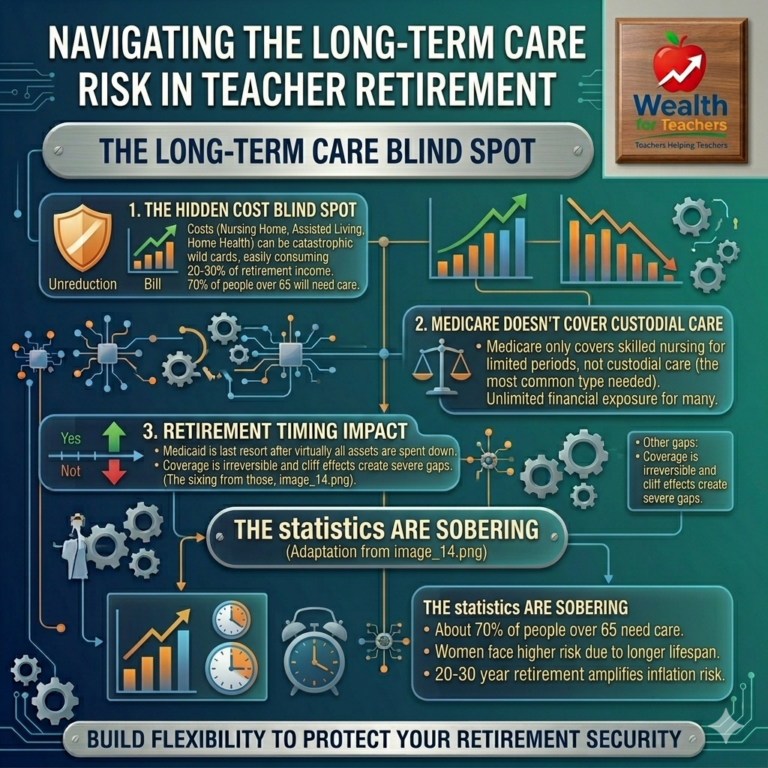
Long-term care represents the biggest Medicare gap. Medicare covers skilled nursing care for limited periods under specific conditions, but it doesn’t cover custodial care that most people need. This gap can expose retirees to unlimited financial liability.
Long-term care costs represent the single biggest healthcare risk most Texas teachers completely ignore in their retirement planning. This isn’t just about nursing homes. It includes home health aides, adult day care, assisted living, and any ongoing care needed for daily activities.
In Texas, nursing home costs average $60,000-80,000 per year. Home health aide services run $20-30 per hour. Even basic assisted living facilities cost $40,000-60,000 annually. These expenses can easily consume an entire teacher’s pension and then some.
The statistics are sobering. About 70% of people over 65 will need some form of long-term care during their retirement. Women face higher risk because they typically live longer and are more likely to need extended care periods.
For a teacher couple, the risk is compounded. If one spouse needs long-term care, the healthy spouse often faces impossible financial decisions. Do they spend down all their retirement savings on care? Do they try to provide care themselves, potentially damaging their own health?
Medicaid will eventually cover long-term care costs, but only after you’ve spent down virtually all your assets to poverty levels. For teachers who spent decades building retirement security, watching it disappear to pay for care represents the ultimate financial failure.
Long-term care insurance can provide protection, but premiums are expensive and continue increasing over time. The key is understanding that ignoring this risk doesn’t make it go away. It just guarantees that you’ll face it unprepared if and when it happens.
Healthcare costs consistently increase faster than general inflation, creating a compounding problem that gets worse every year of retirement. While your TRS pension might receive periodic cost-of-living adjustments, they rarely keep pace with medical expense increases.
Over a 20-30 year retirement, healthcare inflation can double or triple medical expenses. A premium that costs $300 monthly at retirement might cost $600-900 monthly two decades later. Prescription drugs, medical devices, and specialized treatments often see even steeper price increases.
This creates a cash flow crisis that intensifies over time. Early in retirement, healthcare costs might consume 15-20% of income. By the end of retirement, the same expenses could represent 30-40% of income or more. Teachers living on fixed pension income find themselves squeezed harder each year.
The problem extends beyond premiums. Deductibles, copays, and out-of-pocket maximums all increase with inflation. Services that were covered under insurance plans get dropped or moved to higher cost-sharing tiers. New treatments and technologies often come with premium pricing that insurance doesn’t fully cover.
Geographic inflation adds another layer of complexity. Healthcare costs in major Texas metropolitan areas like Dallas, Houston, and Austin consistently outpace smaller communities. Teachers who planned to retire in high-cost areas often find themselves priced out by medical expenses alone.
This depends entirely on your specific situation. TRS-Care is available to eligible retirees, but eligibility requires meeting specific age and service requirements. If you don’t qualify for TRS-Care, you’ll need to find coverage through the individual market, which is typically much more expensive with fewer benefits.
A realistic starting point is 20-25% of retirement income for healthcare expenses. This includes premiums, deductibles, copays, uncovered services, and long-term care preparation. Many financial advisors recommend budgeting for healthcare costs to increase 5-7% annually throughout retirement.
Medical debt is one of the leading causes of bankruptcy among retirees. While your TRS pension has some protection from creditors, other retirement assets can be vulnerable. The key is planning ahead rather than hoping nothing goes wrong.
Moving states can affect your TRS pension taxation and healthcare costs, but it’s a complex decision. Some states have lower healthcare costs but higher overall cost of living. You also need to consider access to quality care and proximity to family support systems.
Long-term care insurance makes sense for teachers with significant assets to protect but not enough wealth to self-insure. The key is buying coverage while you’re healthy and can qualify for reasonable premiums. Waiting too long often means facing higher costs or being denied coverage entirely.
The solution isn’t to panic about healthcare costs, but to build a comprehensive protection strategy that addresses each major risk area.
Start by maximizing your health while you’re still working. Preventive care, regular exercise, stress management, and addressing chronic conditions early can significantly reduce future healthcare costs. Teachers who retire in good health have much better financial outcomes.
Build dedicated healthcare reserves beyond your regular retirement savings. Consider this a separate bucket specifically for medical expenses. Teacher retirement planning requires multiple specialized strategies that don’t run out of money.
Use the TRS calculator to estimate your pension and identify potential income gaps.