
Should Teachers Create a Written Retirement Plan?
A written plan provides clarity and direction. Here’s why it matters.

TRS is only one income source. Learn how teachers can build multiple retirement income streams.

Your Texas TRS pension is not enough. That’s the harsh reality most teachers don’t realize until they’re already retired and watching their purchasing power erode year after year.
Texas teachers can also run a full pension estimate using the Texas Teacher Retirement Calculator to better understand their retirement outlook.
The problem isn’t that TRS is a bad pension system. The problem is that relying on a single income source—no matter how reliable—leaves you vulnerable to inflation, unexpected expenses, and the simple fact that TRS income replacement rates rarely match what teachers actually need to maintain their lifestyle.
Building multiple retirement income streams for teachers isn’t just smart financial planning—it’s essential for maintaining financial security throughout retirement. Each income source serves a different purpose, provides different tax advantages, and protects against different risks.
This comprehensive approach to retirement planning is covered in detail in our Texas Teacher Retirement Planning Guide, but here we’ll focus specifically on how to layer these income sources for maximum stability and tax efficiency.
Most retirement plans fail because they look good on paper but were never tested under real-world conditions. Inflation spikes, market crashes, healthcare emergencies, and sequence of returns risk can destroy even well-intentioned retirement strategies if they rely too heavily on a single income source or fail to account for tax implications.
Smart teachers don’t put all their retirement eggs in one basket. They build four distinct layers of retirement income, each serving a specific purpose:
Use the TRS calculator to estimate your pension and identify potential income gaps.
Each layer protects against different risks. TRS protects against longevity risk. 403(b) plans provide tax-deferred growth. IRAs offer flexibility. IUL provides tax-free income and legacy planning.
The key is understanding how these layers work together, not just individually.
Your TRS pension forms the bedrock of your retirement income strategy. It’s the only guaranteed income stream that adjusts for inflation and lasts your entire lifetime, regardless of market conditions.
Texas TRS calculates your pension using a simple formula: Years of Service × 2.3% × Final Average Salary. A teacher with 30 years of service and a $65,000 final average salary would receive: 30 × 0.023 × $65,000 = $44,850 annually.
While this provides a solid foundation, it typically replaces only 60-70% of your pre-retirement income. That’s where the other layers become critical.
The biggest mistake teachers make is assuming their TRS pension will cover all their retirement needs. Even with annual adjustments, inflation can slowly erode your purchasing power over a 20-30 year retirement.
Your school district’s 403(b) plan offers the most immediate benefit for teachers: employer matching contributions. This is free money that compounds tax-deferred until retirement.
Most Texas school districts match 50 cents for every dollar you contribute, up to a certain percentage of your salary. If your district matches up to 6% of your salary, and you earn $55,000, they’ll contribute up to $1,650 annually if you contribute $3,300.
403(b) funds grow tax-deferred, meaning you pay no taxes on gains until you withdraw the money in retirement. This provides powerful compound growth over a teaching career.
The challenge with 403(b) plans is that withdrawals in retirement are taxed as ordinary income. This is where coordinating TRS and retirement accounts becomes crucial for managing your tax burden.
Individual Retirement Accounts provide the flexibility that employer-sponsored plans often lack. You control the investment options, withdrawal timing, and beneficiary designations.
Traditional IRAs offer tax-deferred growth similar to 403(b) plans, while Roth IRAs provide tax-free growth and tax-free withdrawals in retirement. For many teachers, a combination of both makes sense.
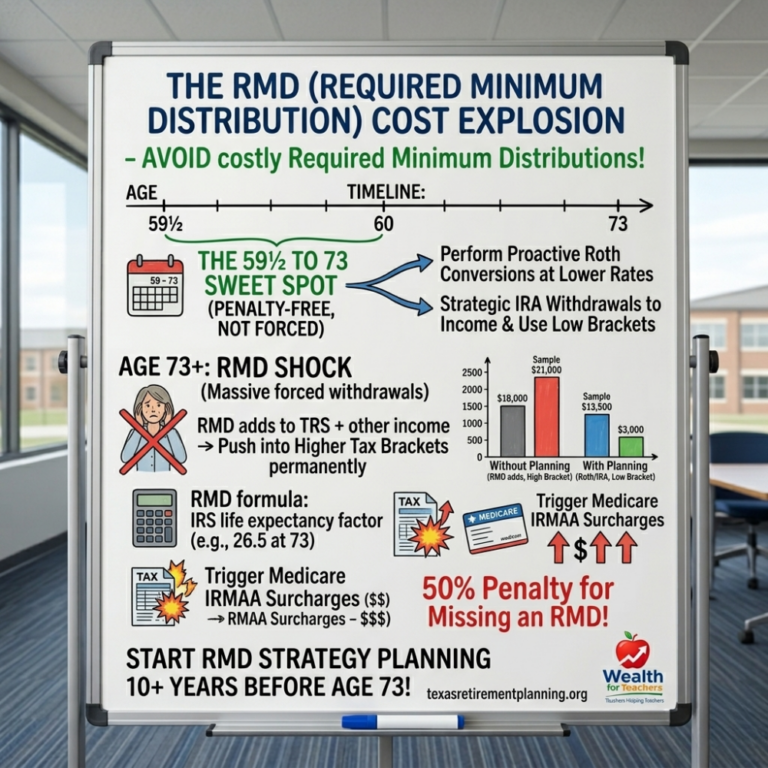
Roth IRAs are particularly valuable because they don’t require minimum distributions at age 73. This means you can let the money continue growing tax-free and use it for unexpected expenses or leave it to heirs.
The key advantage of IRAs is withdrawal flexibility. Unlike 403(b) plans that may have limited withdrawal options, IRAs allow you to access your money when you need it most, subject to IRS rules.
Indexed Universal Life insurance provides a unique combination of death benefits and tax-free income potential that other retirement vehicles can’t match.
IUL policies allow you to build cash value that grows based on the performance of a stock market index, but with downside protection. Your cash value won’t decrease when the market falls, but it can participate in market gains up to a cap.
The real power of IUL comes from tax-free policy loans. Once your cash value reaches a sufficient level, you can borrow against it tax-free to supplement your retirement income. These loans don’t have to be repaid during your lifetime—they’re simply deducted from the death benefit.
For teachers who expect to be in a higher tax bracket in retirement (perhaps due to TRS pension income and 403(b) withdrawals), IUL provides a valuable source of tax-free income.
Building multiple retirement income streams is only half the battle. The real skill lies in coordinating withdrawals to minimize taxes and maximize income throughout retirement.
The general strategy involves drawing from different accounts in a specific order:
This approach helps you manage tax brackets, avoid RMD penalties, and preserve tax-free accounts for later in retirement or for heirs.
The key is understanding that your tax situation in retirement may be very different from your working years, especially as a teacher with a guaranteed pension income.
Let’s look at how a typical Texas teacher might stack these income sources:
Example: Maria, 30-year TRS veteran, $65,000 final average salary
This stacking approach provides Maria with 23% more income than her final working salary, with significant portions coming from tax-advantaged sources.
The diversification also protects against various risks. If healthcare costs spike, she can increase IUL loans. If taxes rise, she can rely more heavily on Roth withdrawals. If inflation accelerates, her TRS pension adjusts automatically.
Instead of hoping your TRS pension will be enough, start building your four-layer income strategy now:
Immediate Actions:
Long-term Strategy:
Use the TRS calculator to estimate your pension and identify potential income gaps.