
Should Teachers Create a Written Retirement Plan?
A written plan provides clarity and direction. Here’s why it matters.

Many Texas teachers believe retirement myths that can lead to costly mistakes. Learn what to avoid.

Texas teachers face unique retirement challenges that don’t apply to most other professions. Yet many educators rely on outdated assumptions, partial information, or well-meaning advice that simply doesn’t match the reality of Teacher Retirement System of Texas (TRS) benefits.
Texas teachers can also run a full pension estimate using the Texas Teacher Retirement Calculator to better understand their retirement outlook.
These teacher retirement myths aren’t just harmless misconceptions. They lead to delayed retirement decisions, inadequate savings, and income shortfalls that could have been prevented with accurate information.
The stakes are particularly high for Texas educators because TRS operates differently from Social Security or typical employer 401(k) plans. Understanding these differences isn’t optional—it’s essential for making sound retirement decisions.
For comprehensive guidance on navigating these complexities, refer to our Texas Teacher Retirement Planning Guide.
Most retirement plans fail because they’re built on assumptions that never get tested against real-world conditions. Teachers often discover critical gaps in their planning only after they’ve already made irreversible retirement decisions.
Many Texas teachers assume their TRS pension will replace most or all of their working income. This dangerous misconception leads to inadequate retirement savings and unrealistic spending expectations.
Use the TRS calculator to estimate your pension and identify potential income gaps.
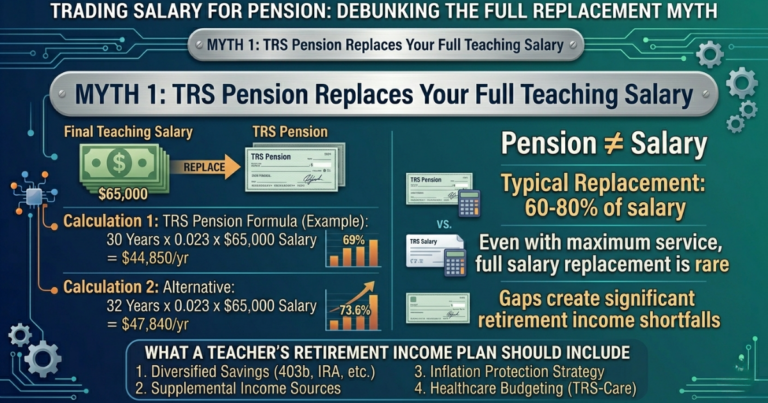
Here’s the reality: Texas TRS uses a flat 2.3% multiplier per year of service. Your annual pension equals: Years of Service × 0.023 × Final Average Salary.
Consider a teacher with 30 years of service and a $65,000 final average salary. Their TRS pension would be: 30 × 0.023 × $65,000 = $44,850 annually. That’s only 69% of their working salary—before taxes.
Even teachers with maximum service rarely see their TRS pension replace their full salary. A teacher with 40 years of service would receive 92% of their final average salary (40 × 0.023 = 0.92), but this assumes they worked the full four decades without career interruptions.
The gap between working income and retirement income creates real financial pressure. Teachers who don’t plan for this shortfall often face difficult choices about housing, healthcare, and lifestyle in retirement.
This myth stems from an era when pensions were more generous and living costs were lower. Today’s financial reality requires multiple income sources in retirement.
TRS benefits include your monthly pension and access to TRS-Care health insurance. While valuable, these benefits alone rarely provide the financial security most teachers expect in retirement.
The monthly pension covers basic living expenses for some retirees, but it doesn’t account for:
Teachers who rely solely on TRS benefits often find themselves financially constrained. They may delay necessary home improvements, limit healthcare options, or reduce their standard of living significantly.
Understanding how much a retired teacher can safely spend each year becomes crucial when TRS benefits don’t cover all expenses.
The “one more year” syndrome affects many Texas teachers who believe additional service years always improve their retirement position. While working longer does increase your TRS pension, it’s not always the financially optimal choice.
Each additional year of service adds 2.3% of your final average salary to your annual pension. But this increase comes with opportunity costs:
Some teachers work additional years hoping to significantly boost their final average salary. However, Texas teacher pay scales often flatten at higher experience levels, making dramatic salary increases unlikely.
The break-even analysis for working additional years involves comparing the increased pension value against the benefits you forfeit by delaying retirement. This calculation requires careful analysis of your specific financial situation.
Texas teachers often assume their TRS pension will automatically adjust for inflation throughout retirement. This assumption creates dangerous gaps in long-term financial planning.
TRS pensions do not include automatic cost-of-living adjustments (COLAs). The Texas Legislature can authorize pension increases, but these decisions are discretionary, not guaranteed.
Historical COLA patterns show irregular timing and amounts. Some years provide no increases, while others offer modest adjustments that may not fully offset inflation.
Over a 25-year retirement, even modest inflation significantly erodes purchasing power. A $45,000 annual pension loses substantial value if it remains flat while living costs increase 2-3% annually.
This reality makes supplemental retirement savings essential. Teachers need inflation-protected income sources beyond their TRS pension to maintain their standard of living throughout retirement.
Many Texas teachers believe they’ll receive both their full TRS pension and Social Security benefits in retirement. This misconception can lead to serious retirement income shortfalls.
Texas teachers don’t pay into Social Security on their teaching income, so they don’t earn Social Security credits from their education career. However, teachers who worked other jobs may have some Social Security benefits.
Even teachers with Social Security benefits face potential reductions due to the Windfall Elimination Provision (WEP) and Government Pension Offset (GPO). Understanding WEP and GPO impacts is crucial for accurate retirement planning.
WEP can reduce your Social Security benefits if you receive a pension from employment where you didn’t pay Social Security taxes. GPO can eliminate spousal or survivor Social Security benefits.
These provisions don’t affect all teachers, but those impacted often see significant benefit reductions. Planning without understanding these rules can create substantial retirement income gaps.
Many Texas teachers automatically assume they should elect maximum survivor benefits for their spouse. While this seems protective, it’s not always the optimal financial choice.
TRS offers several survivor benefit options, each with different costs and benefits. Maximum survivor coverage provides the highest monthly benefit for your surviving spouse but reduces your monthly pension while you’re both alive.
The decision depends on several factors:
Some couples benefit more from choosing lower survivor benefits and investing the monthly savings in other accounts. This strategy works particularly well when the teacher has significant life insurance or the spouse has their own retirement benefits.
Detailed analysis of TRS survivor benefits and options helps determine the right choice for your specific situation.
Teachers often assume their health insurance will seamlessly continue into retirement with minimal cost increases. This assumption can create serious healthcare coverage and budgeting problems.
TRS-Care provides health insurance for eligible retirees, but coverage isn’t automatic. You must apply during specific enrollment periods and meet eligibility requirements.
TRS-Care costs have increased significantly in recent years, and retirees pay higher premiums than active employees. These costs can consume a substantial portion of your monthly pension.
Additionally, TRS-Care coverage differs from active employee plans. Benefit levels, provider networks, and cost-sharing may change, potentially affecting your healthcare decisions and expenses.
Some retirees discover they need supplemental insurance or must change healthcare providers. These transitions can be costly and disruptive if not planned properly.
Avoiding these myths requires proactive planning and accurate information. Start by calculating your actual TRS pension using the correct formula: Years of Service × 0.023 × Final Average Salary.
Compare this amount to your current expenses to identify the income gap you’ll need to fill. Understanding how taxes impact your retirement income helps you plan more accurately.
Diversify your retirement income beyond TRS benefits. Consider 403(b) contributions, IRAs, and other savings vehicles that provide inflation protection and flexibility.
Research your healthcare options well before retirement.
Use the TRS calculator to estimate your pension and identify potential income gaps.