How Required Minimum Distributions Affect Retirement Strategy
Required withdrawals can change your tax and income plan.
Required Minimum Distributions can increase taxes if not planned correctly. Learn how teachers should handle RMDs.

Required Minimum Distributions hit many Texas teachers harder than expected because they never planned for the tax consequences. Unlike your TRS pension, which provides steady income without surprise tax bills, RMDs from your 403(b) and IRA accounts can push you into higher tax brackets and increase Medicare premiums when you least expect it.
Texas teachers can also run a full pension estimate using the Texas Teacher Retirement Calculator to better understand their retirement outlook.
The problem isn’t just the extra taxes. It’s the timing. RMDs start at age 73 whether you’re ready or not, and the IRS doesn’t care if withdrawing that money creates financial hardship or forces you to sell investments during a market downturn.
Most teachers discover this reality too late to implement an effective RMD strategy. Our Texas Teacher Retirement Planning Guide shows how proper coordination between TRS and your other accounts can prevent these costly surprises.
The key difference between teachers who handle RMDs smoothly and those who struggle comes down to planning. Teachers who understand how RMDs interact with their TRS pension and Medicare can make strategic moves years before the distributions begin.
Most retirement plans fail because they look good on paper but fall apart when tested against real-world conditions like market volatility, unexpected medical expenses, or changing tax laws. Your RMD strategy needs to account for these variables before they become problems.
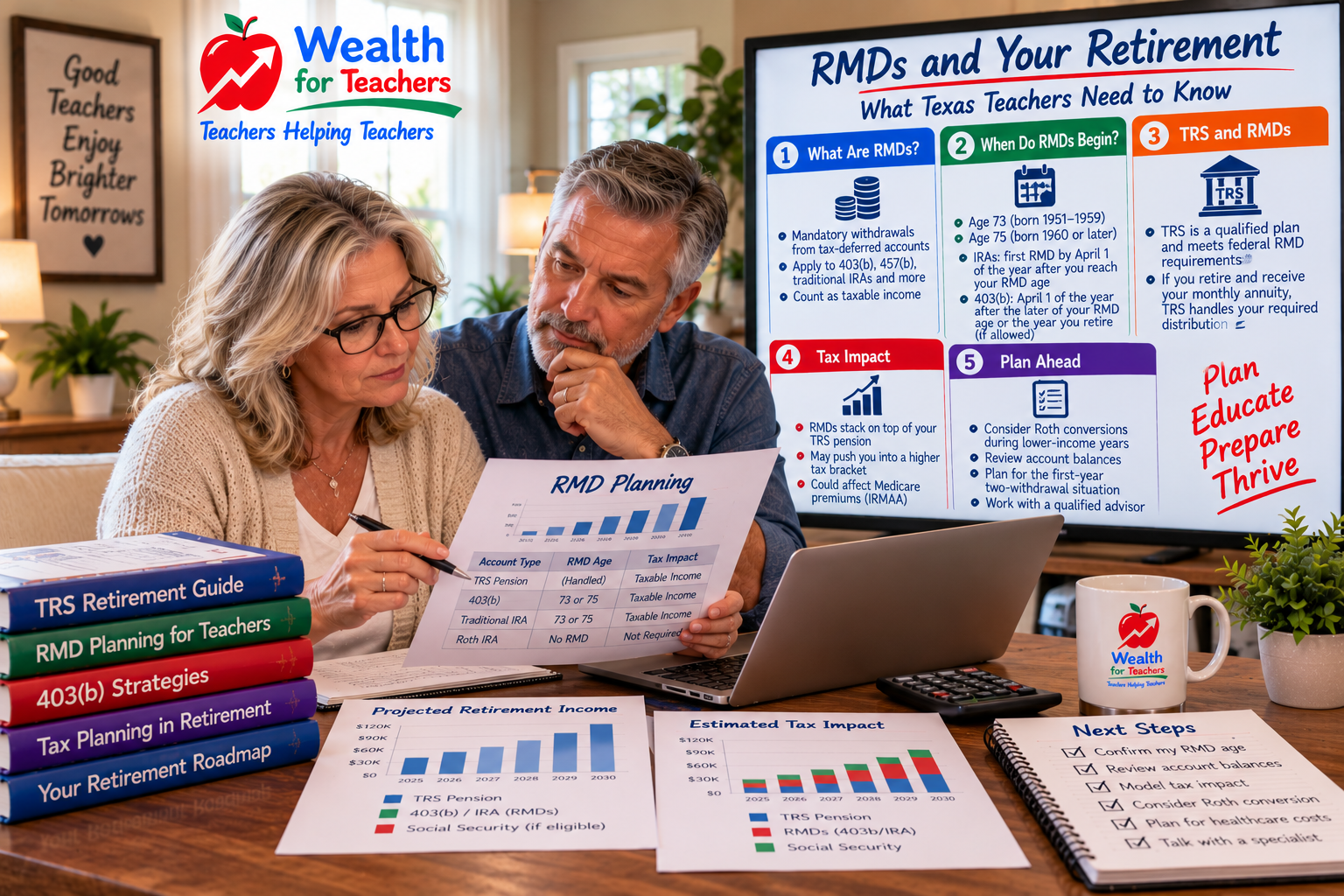
Required Minimum Distributions are mandatory withdrawals from certain retirement accounts that begin at age 73. The IRS requires these withdrawals to ensure they eventually collect taxes on money that has grown tax-deferred for decades.
Use the TRS calculator to estimate your pension and identify potential income gaps.
For Texas teachers, RMDs apply to these accounts:
RMDs do not apply to:
This distinction matters because many teachers assume their TRS pension protects them from RMD issues. Your TRS pension provides stable monthly income, but it doesn’t eliminate the requirement to withdraw money from your 403(b) or IRA accounts starting at age 73.
Your first RMD must be taken by April 1st of the year after you turn 73. Every subsequent year, you must take your RMD by December 31st.
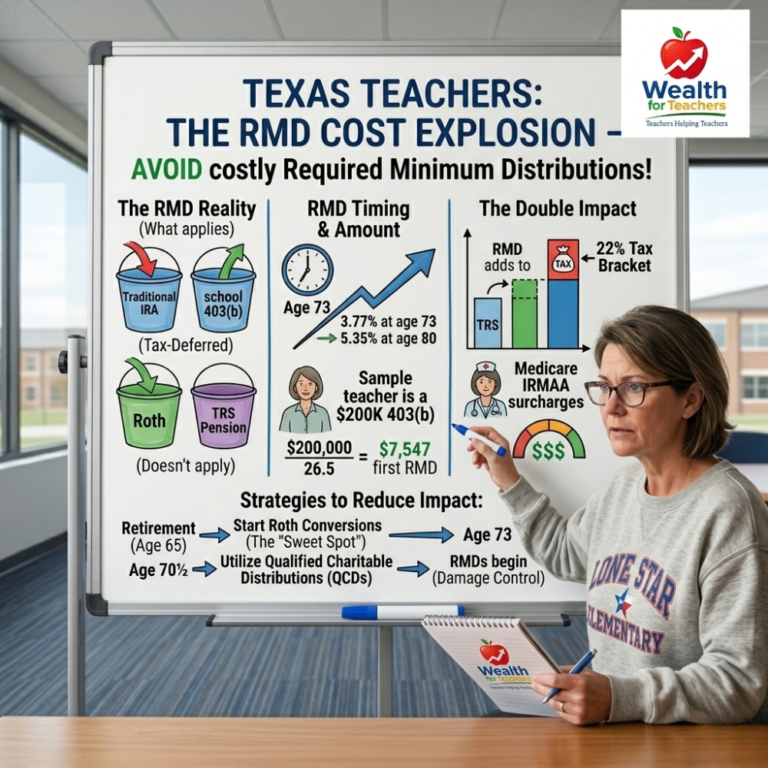
The withdrawal amount is calculated by dividing your account balance on December 31st of the previous year by a life expectancy factor from IRS tables. At age 73, this factor is 26.5, meaning you must withdraw approximately 3.77% of your account balance.
Here’s how this works for a Texas teacher:
Sarah, a retired teacher with $200,000 in her 403(b) at age 72, must withdraw $7,547 ($200,000 ÷ 26.5) during her first RMD year. This amount gets added to her TRS pension and any other income for tax purposes.
The withdrawal percentage increases each year as the life expectancy factor decreases. By age 80, you’re required to withdraw about 5.35% of your account balance annually.
If you’re still working as a teacher past age 73 and participating in your current employer’s 403(b) plan, you may be able to delay RMDs from that specific account until you retire. However, this exception only applies to your current employer’s plan, not to IRAs or 403(b)s from previous school districts.
RMDs from traditional retirement accounts are taxed as ordinary income in the year you withdraw them. This creates a double impact for Texas teachers: higher income taxes and potentially higher Medicare premiums.
When your RMD pushes your adjusted gross income above certain thresholds, you’ll pay Income-Related Monthly Adjustment Amounts (IRMAA) surcharges on Medicare Part B and Part D premiums. These surcharges can add hundreds of dollars per month to your healthcare costs.
Consider this example: A Texas teacher receiving $3,000 monthly from TRS ($36,000 annually) might be in the 12% tax bracket. But if required withdrawals from a large 403(b) account add another $20,000 in taxable income, they could jump to the 22% tax bracket and trigger Medicare surcharges.
The Medicare surcharge thresholds start at $97,000 for single filers and $194,000 for married couples filing jointly. Many teachers with substantial 403(b) balances and TRS pensions find themselves crossing these thresholds unexpectedly.
Unlike TRS income replacement calculations that teachers can plan for years in advance, RMD tax impacts often catch teachers off guard because the account balances and tax brackets may have changed significantly since they last checked.
The most expensive mistake teachers make is waiting until age 73 to think about RMD strategy. By then, your options are limited to damage control rather than proactive planning.
Teachers frequently underestimate how RMDs will affect their tax situation because they focus only on their TRS pension income. They forget that 403(b) withdrawals, combined with TRS benefits, Social Security, and any part-time work income, can push them into much higher tax brackets.
Another common error is poor withdrawal sequencing. Some teachers withdraw more than required from their 403(b) accounts early in retirement, leaving larger balances subject to higher RMD percentages later. Others avoid touching retirement accounts entirely, allowing them to grow to sizes that create massive RMD requirements.
Many teachers also fail to coordinate RMDs across multiple accounts. If you have both a 403(b) and traditional IRA, you might be able to take your total RMD from one account rather than both, potentially providing more investment flexibility.
The penalty for missing an RMD is severe: 50% of the amount you should have withdrawn. If you were required to withdraw $10,000 but only took $6,000, the penalty would be $2,000 on top of the regular income taxes owed.
Roth conversions represent the most powerful tool for reducing future RMD burdens, but they must be executed carefully. Converting traditional IRA or 403(b) money to Roth accounts eliminates that money from future RMD calculations, but you pay income taxes on the converted amount in the year of conversion.
The optimal time for Roth conversions is often the gap between retirement and age 73, when your income might be lower than during your teaching career. If you retire at 65 and delay Social Security until 70, you might have several years where strategic Roth conversions keep you in relatively low tax brackets.
Qualified Charitable Distributions (QCDs) allow you to send up to $100,000 annually directly from your IRA to qualified charities starting at age 70½. This amount counts toward your RMD requirement but doesn’t increase your taxable income, making it particularly valuable for teachers who regularly support charitable causes.
Asset location strategy also matters. Keeping growth-oriented investments in Roth accounts and more conservative investments in traditional accounts can help manage the size of future RMDs while maintaining your desired asset allocation.
Some teachers benefit from deliberately spending down traditional retirement accounts in early retirement years to reduce the balances subject to RMDs. This approach works best when coordinated with TRS and IRA coordination strategies that optimize the timing of various income sources.
Start your RMD strategy planning at least 10 years before you turn 73. This gives you time to implement Roth conversions, adjust your asset allocation, and coordinate withdrawal timing with your TRS pension and Social Security benefits.
Calculate projected RMD amounts using current account balances and growth assumptions. This exercise often reveals that doing nothing will create much larger tax problems than taking proactive steps now.
Consider front-loading some retirement account withdrawals in your early retirement years when your income is lower. This strategy can reduce the account balances subject to RM
Use the TRS calculator to estimate your pension and identify potential income gaps.