
Should Teachers Create a Written Retirement Plan?
A written plan provides clarity and direction. Here’s why it matters.

Withdrawal strategy determines how long your money lasts. Learn the right approach.
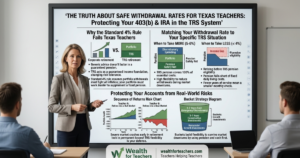
Most Texas teachers retire without knowing if their money will last. They follow generic retirement advice, apply the famous “4% rule” without question, and hope their Texas Teacher Retirement System (TRS) pension covers the gaps.
Texas teachers can also run a full pension estimate using the Texas Teacher Retirement Calculator to better understand their retirement outlook.
The problem runs deeper than most teachers realize. A safe withdrawal rate determines how much you can take from your retirement accounts each year without running out of money. Get it wrong, and you could face financial stress in your 70s and 80s when it’s too late to return to work.
For Texas teachers, the calculation becomes more complex because TRS provides a foundation of guaranteed income. This changes everything about how you should approach withdrawal rates from your personal retirement accounts. Our comprehensive Texas Teacher Retirement Planning Guide covers the full picture, but this article focuses specifically on safe withdrawal strategies.
Most retirement plans fail because they are never tested under real-world conditions. Teachers often use online calculators or follow general rules without considering how market downturns, inflation, healthcare costs, and TRS pension limitations interact over 25-30 years of retirement.
The 4% rule suggests you can safely withdraw 4% of your retirement portfolio’s initial value each year, adjusted for inflation. This rule comes from research on balanced portfolios over 30-year retirement periods.
Use the TRS calculator to estimate your pension and identify potential income gaps.
Here’s how it works in practice:
The 4% rule assumes your portfolio will survive market crashes, inflation, and sequence of returns risk over three decades. For many retirees, this approach works. For Texas teachers with TRS pensions, the calculation needs adjustment.
The 4% rule was designed for retirees who depend entirely on their investment portfolios. Texas teachers have TRS providing guaranteed monthly income. This pension income changes your risk tolerance and withdrawal strategy in three important ways.
First, your TRS pension covers basic living expenses, which means your portfolio withdrawals fund discretionary spending, travel, healthcare premiums, and unexpected costs. You can potentially withdraw at higher rates because the pension provides a safety net.
Second, inflation affects your TRS pension differently than your portfolio withdrawals. While your personal accounts can theoretically grow to combat inflation, TRS benefits may not keep pace with rising costs over time.
Third, the timing of your TRS pension versus portfolio withdrawals matters. If you retire before your TRS pension begins, you’ll rely more heavily on personal savings initially, then transition to lower withdrawal rates once pension payments start.
Texas teachers face unique retirement challenges that generic withdrawal rules don’t address. Understanding these differences helps you develop a withdrawal strategy that actually fits your situation.
Your TRS pension uses a flat 2.3% multiplier per year of service. The formula is straightforward: Annual Pension = (Years of Service × 0.023) × Final Average Salary.
A teacher with 30 years of service and a $65,000 final average salary receives: 30 × 0.023 × $65,000 = $44,850 annually before taxes.
This guaranteed income changes your withdrawal strategy because you’re not withdrawing from portfolios to cover basic living expenses. Instead, you’re supplementing a pension that may lose purchasing power over time.
Many Texas teachers have limited Social Security benefits due to the Windfall Elimination Provision (WEP) and Government Pension Offset (GPO). This means you can’t rely on Social Security to bridge income gaps the way private sector workers can.
Without full Social Security benefits, your personal retirement accounts become more critical for maintaining your standard of living throughout retirement.
Having a TRS pension doesn’t automatically mean you can withdraw more from personal accounts. The relationship between guaranteed pension income and portfolio withdrawals requires careful analysis.
Teachers with substantial TRS pensions relative to their expenses may safely withdraw 5-6% from personal accounts because:
However, this higher withdrawal rate only works if your TRS pension truly covers your basic living costs and you have flexibility to reduce discretionary spending when necessary.
Some Texas teachers should use withdrawal rates below 4%:
The key is matching your withdrawal rate to your actual income needs and the reliability of your other income sources.
The biggest threat to any withdrawal strategy is sequence of returns risk – experiencing poor market performance early in retirement when you’re taking withdrawals.
Consider two teachers who retire with identical $400,000 portfolios and 4% withdrawal rates:
Teacher A retires during a bull market and experiences good returns for the first five years. Teacher B retires just before a market crash and faces negative returns early in retirement. Even if both teachers experience identical average returns over 20 years, Teacher B runs out of money while Teacher A’s portfolio continues growing.
This risk is why some financial experts recommend the “bucket strategy” – keeping 1-2 years of expenses in cash, 3-7 years in conservative investments, and the remainder in growth investments.
Your TRS pension provides crucial protection against sequence of returns risk. During market downturns, you can reduce or eliminate portfolio withdrawals and live primarily on pension income. This flexibility can save your portfolio during the critical early retirement years.
Inflation poses a particular challenge for teachers because your TRS pension has limited inflation protection while your personal account withdrawals must keep pace with rising costs.
Fixed pension income loses purchasing power over time, which means your portfolio withdrawals may need to increase beyond normal inflation adjustments to maintain your lifestyle.
A teacher receiving a $45,000 TRS pension today will find that same $45,000 buys significantly less in 15-20 years. Your personal retirement accounts must bridge this growing gap, which may require adjusting your withdrawal strategy over time.
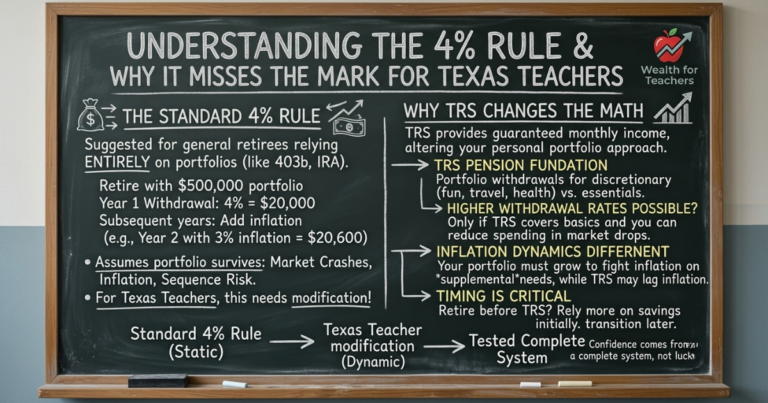
The 4% rule serves as a starting point, but your TRS pension changes the calculation. Teachers with substantial pensions relative to their expenses can often withdraw more than 4% because the pension provides a safety net. Those with smaller pensions or higher expenses may need more conservative withdrawal rates.
Potentially yes, but this requires careful analysis of your total retirement income picture. You need to ensure your pension truly covers basic expenses, account for inflation’s impact on purchasing power, and maintain flexibility to reduce withdrawals during market downturns.
If you retire before TRS pension eligibility, you’ll need lower withdrawal rates initially because your portfolio must cover all expenses. Once pension payments begin, you can potentially increase withdrawal rates as your guaranteed income provides a foundation.
Teachers whose TRS pensions fall short of basic living costs need more conservative withdrawal strategies. Your portfolio withdrawals will fund essential expenses, which means you need the reliability that comes with lower withdrawal rates.
Healthcare costs can significantly impact your withdrawal needs. TRS-Care availability and costs change over time, and you may face substantial out-of-pocket expenses. Factor healthcare inflation into your withdrawal strategy and consider maintaining higher cash reserves for medical emergencies.
Rather than blindly following the 4% rule, develop a withdrawal strategy
Use the TRS calculator to estimate your pension and identify potential income gaps.