
Should Teachers Create a Written Retirement Plan?
A written plan provides clarity and direction. Here’s why it matters.

A fixed income doesn’t adjust to real-life retirement risks. Learn what to watch.

Most Texas teachers view their TRS pension as rock-solid retirement security. After all, it’s a defined benefit plan that promises a specific monthly payment for life. But this fixed income approach creates hidden vulnerabilities that many teachers don’t recognize until retirement begins.
Texas teachers can also run a full pension estimate using the Texas Teacher Retirement Calculator to better understand their retirement outlook.
The fixed income retirement risk teachers face isn’t about TRS going bankrupt. It’s about how a static monthly payment struggles against inflation, rising healthcare costs, and longer lifespans. These pressures can quietly erode your purchasing power and leave gaps in your retirement security that grow larger each year.
Understanding these risks now allows you to build a more complete retirement strategy. Our comprehensive Texas Teacher Retirement Planning Guide breaks down the full picture, but let’s focus on the specific challenges that come with depending primarily on fixed pension income.
Most retirement plans fail not because they’re poorly designed, but because they’re never tested against real-world conditions. A plan that looks adequate on paper can quickly fall short when inflation accelerates, healthcare needs increase, or economic conditions change unexpectedly.
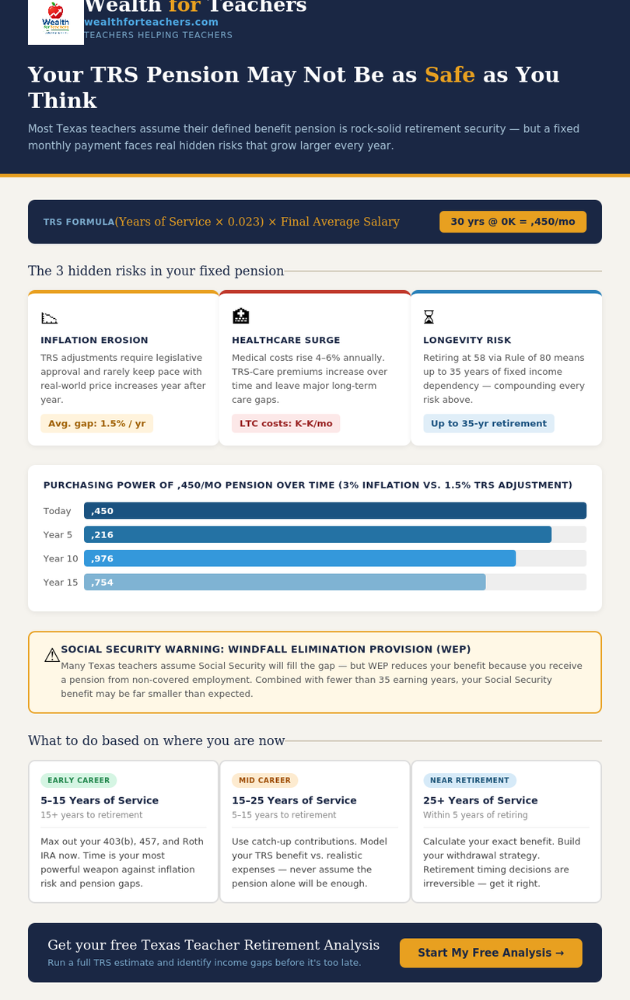
Your TRS pension calculation is straightforward: (Years_of_Service × 0.023) × Final_Average_Salary. A teacher with 30 years of service earning a final average salary of $60,000 receives an annual pension of $41,400, or $3,450 per month.
Use the TRS calculator to estimate your pension and identify potential income gaps.
This fixed amount feels secure, but it faces three major pressures:
These aren’t theoretical risks. They’re mathematical certainties that affect every retiree with fixed income sources.
Texas TRS provides cost-of-living adjustments, but they’re not automatic and don’t always match actual inflation. The state legislature must approve increases, and they’re often smaller than the real inflation rate teachers experience.
Consider a teacher who retires with a $3,450 monthly pension. If inflation averages 3% annually but TRS adjustments average only 1.5%, the purchasing power gap grows each year:
This erosion happens gradually, but the cumulative effect is substantial. How inflation quietly reduces your TRS pension over time provides detailed analysis of this challenge and its long-term implications.
Healthcare expenses historically rise faster than general inflation. While your pension might receive a 2% annual adjustment, healthcare costs often increase 4-6% per year.
Texas teachers have access to TRS-Care in retirement, but it requires monthly premiums that increase over time. Additionally, many medical services, prescription drugs, and long-term care needs aren’t fully covered by any insurance plan.
A teacher budgeting $500 monthly for healthcare at retirement may find those costs reaching $800-1,000 within a decade, while their pension increase covers only a fraction of the difference.
Long-term care represents the largest potential healthcare expense teachers face. Neither TRS-Care nor Medicare covers extended nursing home stays or in-home care assistance. These costs can easily exceed $5,000-8,000 monthly in Texas, far beyond what most teacher pensions can sustain.
Teachers often retire in their late 50s or early 60s and may live 25-30 years in retirement. This extended period amplifies both inflation risk and healthcare cost increases.
A teacher retiring at 58 with a Rule of 80 retirement faces potentially 35 years of fixed income dependency. Even modest inflation and healthcare cost increases compound into significant purchasing power reduction over such extended periods.
The challenge intensifies because expenses don’t typically decrease in later retirement years. While some costs may decline, healthcare and care assistance needs often increase, creating higher expenses precisely when your fixed income has lost the most purchasing power.
Many Texas teachers assume Social Security will supplement their TRS pension adequately. However, teachers face unique Social Security challenges:
Social Security does provide cost-of-living adjustments, but the reduced benefit amount means the adjustment dollars are smaller. Should teachers delay Social Security explores strategies for maximizing these benefits despite the limitations.
Recognizing fixed income retirement risk doesn’t mean avoiding your TRS pension. It means building additional retirement resources that can adapt to changing conditions.
Develop retirement income streams that can grow with inflation or provide flexibility to adjust spending. This might include:
The goal isn’t replacing your pension, but supplementing it with resources that can respond to economic pressures. How teachers can build multiple retirement income streams provides specific strategies for diversifying your retirement resources.
Healthcare expenses deserve separate planning attention because they increase faster than general inflation and represent non-negotiable costs.
Consider establishing a Health Savings Account if you’re eligible, maximizing contributions to tax-advantaged accounts specifically earmarked for healthcare, and researching long-term care insurance options while you’re still working and healthy.
Your specific situation determines which risks pose the greatest threat and which strategies make the most sense.
When this applies: You have 15+ years until retirement and can build substantial supplemental savings.
What to consider: Focus on maximizing tax-advantaged savings through 403(b), 457, and Roth IRA contributions. Time is your greatest advantage against inflation risk.
What could go wrong: Assuming TRS alone will provide adequate retirement security, or delaying savings because retirement feels distant.
When this applies: You’re 5-15 years from retirement and need to balance catch-up savings with current financial obligations.
What to consider: Take advantage of catch-up contribution limits, evaluate your projected TRS benefit against realistic expense projections, and consider whether delayed retirement could significantly improve your financial position.
What could go wrong: Underestimating healthcare costs or assuming minimal lifestyle adjustments will compensate for inflation erosion. The biggest retirement income gaps teachers don’t see coming identifies common blind spots at this career stage.
When this applies: You’re within 5 years of retirement and need to finalize your strategy.
What to consider: Calculate your exact TRS benefit, model different retirement timing scenarios, plan your withdrawal strategy from supplemental accounts, and consider whether downsizing in retirement makes financial sense.
What could go wrong: Making irreversible retirement timing decisions without fully understanding the long-term implications could cause serious implications on your retirement.
Use the TRS calculator to estimate your pension and identify potential income gaps.