

Inflation Risk in Retirement: What Texas Teachers Must Understand Before It’s Too Late
Most Texas teachers spend decades building toward a TRS pension. They calculate their projected benefit, estimate their expenses, and feel confident about the future. What many do not factor in is inflation risk in retirement — the slow, compounding erosion of purchasing power that can turn a comfortable income into a financial struggle over 20 or 30 years.
Texas teachers can also run a full pension estimate using the Texas Teacher Retirement Calculator to better understand their retirement outlook.
A pension that replaces 70% of your salary today may only replace 45% of your real purchasing power a decade from now if inflation runs persistently high. That gap does not announce itself. It builds quietly, year after year, until a retiree realizes their fixed income no longer covers what it once did.
This guide explains exactly how sustained inflation affects a Texas TRS retirement, why the standard pension assumptions most teachers use are incomplete, and what you can do to protect your income over the long term.
For a broader view of how inflation fits into your overall retirement strategy, start with the Texas Teacher Retirement Planning Guide.
Most retirement plans fail not because they were designed poorly, but because they were never stress-tested under real-world conditions. A plan that works at 2% inflation looks entirely different at 4% or 5% inflation sustained over a decade. Until you run those numbers against your actual TRS benefit and projected expenses, you do not have a plan — you have an assumption.
How Inflation Works Against a Fixed Income
A pension is a fixed monthly payment. That is its greatest strength and its most significant structural vulnerability. Inflation risk comes from the randomness in the purchasing power of each dollar of a retiree’s savings over time — uncertainty arising largely from the variability in the price of everyday goods and services.
Run Your Free Texas Teacher Retirement Analysis
Use the TRS calculator to estimate your pension and identify potential income gaps.
Inflation risk is made worse during the spending-down phase of retirement, because retirees have little ability to hedge against rising costs through rising wages. When you were working, salary increases could partially offset inflation. In retirement, that mechanism disappears.
The longer your retirement lasts, the more damage inflation can do. This exposure extends over many decades, especially eroding the purchasing power of those invested in less risky assets with little potential to receive high long-term rates of portfolio return. A teacher who retires at 58 and lives to 88 faces 30 years of potential purchasing power erosion.
What Texas TRS Does — and Does Not — Provide
Texas TRS provides a defined benefit pension calculated using a flat 2.3% multiplier per year of service applied to your final average salary. The formula is straightforward:
Annual Pension = (Years of Service × 0.023) × Final Average Salary
For example, a teacher with 30 years of service and a final average salary of $60,000 would receive an annual pension of $41,400 (30 × 0.023 × $60,000 = $41,400), or $3,450 per month before taxes.
That amount is fixed at retirement. Texas TRS does not include a built-in annual cost-of-living adjustment that automatically increases with inflation each year. Any adjustments to retiree benefits require legislative action and voter approval — they are not guaranteed and do not happen on a regular schedule.
To illustrate what has happened historically: funding for a one-time 2024 COLA was provided by the 88th Texas Legislature, and it was dependent on Texas voters approving a constitutional amendment — Proposition 9 — to authorize it. Voters approved the amendment in the November 2023 election. That 2024 COLA was a one-time permanent increase to annuities — not a recurring annual adjustment.
The practical implication: if inflation runs persistently above the occasional legislative adjustment, a TRS pension loses real value over time. You cannot count on a COLA to protect you every year.
Social Security and the Inflation Gap
According to Texas TRS, approximately 96% of Texas public-school employees do not pay into Social Security through their teaching employment. However, some teachers have Social Security eligibility from prior careers or part-time work outside TRS-covered employment.
For those who do qualify, Social Security provides an important inflation hedge. The purpose of the Social Security COLA is to ensure that the purchasing power of Social Security benefits is not eroded by inflation. Social Security benefits are adjusted annually based on changes in the Consumer Price Index — something TRS does not do automatically.
One important change for Texas teachers with Social Security eligibility: the Social Security Fairness Act, HR 82, was signed into law on January 5, 2025, and it eliminates the reduction of Social Security benefits for those entitled to public pensions from work not covered by Social Security. December 2023 is the last month that the Windfall Elimination Provision (WEP) and Government Pension Offset (GPO) applied, meaning those rules no longer apply to benefits payable for January 2024 and later.
This is a meaningful change for eligible Texas teachers. If you previously believed your Social Security benefit would be significantly reduced by WEP or GPO, that assumption no longer holds for benefits payable beginning January 2024. Social Security income — with its built-in inflation adjustments — may now play a larger role in your retirement income planning than you had estimated.
The Compounding Math Problem: A Concrete Example
Numbers make this real. Consider a teacher retiring with a TRS pension of $3,450 per month. At 3% annual inflation, that same pension would need to pay approximately $4,641 per month in 12 years just to maintain the same purchasing power. At 4% inflation, the gap opens even faster.
The pension payment stays at $3,450. The cost of living does not.
Over a 20-year retirement, even modest inflation compounds into a significant shortfall. Groceries, utilities, insurance premiums, and healthcare costs all rise. A fixed income that feels sufficient at 58 can feel inadequate at 72 — not because anything went wrong with the pension, but because the world around it became more expensive.
This is why understanding how long your retirement savings need to last is inseparable from understanding inflation. Longevity and inflation are two sides of the same risk.
Where Inflation Hits Retired Teachers Hardest
Not all inflation hits retirees equally. Teachers tend to be most exposed in three specific areas:
- Healthcare costs: Medical expenses historically rise faster than general inflation. As teachers age, healthcare becomes a larger portion of total spending — and that portion is subject to above-average price increases.
- Housing and property taxes: Texas has no state income tax, but property taxes are substantial and rise with property values. A teacher who owns a home may face escalating property tax bills on a fixed pension income.
- Supplemental insurance premiums: TRS-Care premiums and out-of-pocket costs can change from year to year, and coverage structures have shifted over time. Rising premiums directly compress net monthly income.
These categories do not move with a general inflation average — they can rise faster, compressing purchasing power more aggressively than a headline CPI number would suggest.
What to Do Instead: Mitigation Strategies That Actually Work
The goal is not to eliminate inflation risk — that is not possible for most retirees. The goal is to build enough flexibility and income diversity that inflation does not derail your retirement. Here is what actually helps for Texas teachers:
1. Build a Supplemental Income Layer
A TRS pension is your income floor, not your entire retirement plan. Supplemental savings — TRS 403(b) accounts, IRAs, or other investment accounts — give you assets that can grow over time and be drawn on when inflation compresses your fixed income. Understanding how to build a retirement income floor as a teacher is the first step toward real inflation resilience.
2. Time Withdrawals Strategically
How and when you draw from supplemental accounts matters as much as how much you have. Withdrawing too aggressively early in retirement reduces the portfolio’s ability to grow and keep pace with inflation. A well-constructed safe withdrawal strategy accounts for inflation explicitly — it does not just divide savings by years remaining.
3. Consider the Role of Growth Assets
A fully conservative portfolio that generates no real return is not safe — it is just slowly losing ground to inflation. Inflation especially erodes the purchasing power of those invested in less risky assets with little potential to receive high long-term rates of portfolio return. Retired teachers who move entirely to cash or bonds at retirement may underestimate the quiet damage of a zero-growth allocation over two decades. Review how asset allocation should change for teachers in retirement — and why eliminating growth assets entirely is often the wrong move.
4. Maximize Social Security If You Qualify
If you are eligible for Social Security, it provides automatic annual inflation adjustments that TRS does not. Delaying your Social Security benefit, if your situation allows for it, increases the inflation-adjusted base payment for the rest of your life. The right claiming age depends on your individual circumstances, including your health, other income sources, and financial needs. Given the repeal of WEP and GPO for benefits payable beginning January 2024, any prior calculations that assumed heavy reductions should be revisited.
5. Evaluate Whether Guaranteed Income Products Add Value
Some teachers with limited supplemental savings explore guaranteed income products — such as certain annuities — to create additional income that does not run out. These products have tradeoffs, including cost and liquidity limitations. Understanding whether guaranteed income products make sense for a teacher requires comparing them directly against your TRS benefit structure and overall income picture.
6. Review Your Retirement Timing
Every additional year of teaching increases your TRS benefit by 2.3% of your final average salary. For a teacher earning $65,000, that is approximately $1,495 more per year in pension income — for life. Working two or three additional years can meaningfully change your inflation resilience, because you are starting with a higher base income rather than trying to compensate for a smaller one. Think carefully before leaving early. Consider whether shifting how you invest in the years before retirement is also part of the timing equation.
How to Make the Right Decision for Your Situation
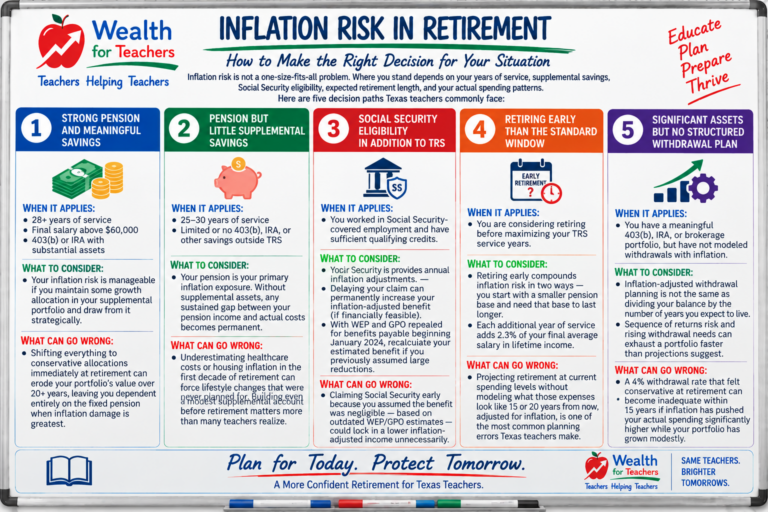
Inflation risk is not a one-size-fits-all problem. Where you stand depends on your years of service, your supplemental savings, your Social Security eligibility, your expected retirement length, and your actual spending patterns. Here are five decision paths Texas teachers commonly face:
Path 1: You Have a Strong TRS Pension and Meaningful Supplemental Savings
When it applies: 28+ years of service, final salary above $60,000, and a 403(b) or IRA with substantial assets.
What to consider: Your inflation risk is manageable if you maintain some growth allocation in your supplemental portfolio and draw from it strategically.
What can go wrong: Shifting everything to conservative allocations immediately at retirement can slowly erode the portfolio’s value over 20+ years, leaving you dependent entirely on the fixed pension in later years when inflation damage is greatest.
Path 2: You Have a TRS Pension but Little Supplemental Savings
When it applies: 25–30 years of service, but limited or no 403(b), IRA, or other savings outside TRS.
What to consider: Your pension is your primary inflation exposure. Without supplemental assets to draw on, any sustained gap between your pension income and your actual costs becomes permanent.
What can go wrong: Underestimating healthcare costs or housing inflation in the first decade of retirement can force lifestyle changes that were never planned for. Building even a modest supplemental account before retirement matters more than many teachers realize.
Path 3: You Have Social Security Eligibility in Addition to TRS
When it applies: You worked in Social Security-covered employment before or alongside your teaching career and have sufficient qualifying credits.
What to consider: Social Security provides annual inflation adjustments. Delaying your claim, if financially feasible, permanently increases the inflation-adjusted baseline, though the right claiming age depends on your individual circumstances. Given the repeal of WEP and GPO for benefits payable beginning January 2024, your estimated benefit should be recalculated if you had previously assumed large reductions.
What can go wrong: Claiming Social Security early because you assumed the benefit was negligible — based on outdated WEP/GPO estimates — could lock in a lower inflation-adjusted income unnecessarily.
Path 4: You Are Planning to Retire Earlier Than the Standard Eligibility Window
When it applies: You are considering retiring before maximizing your TRS service years, either for personal reasons or because you believe your savings will cover the gap.
What to consider: Retiring early compounds inflation risk in two directions — you start with a smaller pension base and you need that base to last longer. Each year of additional service adds 2.3% of your final average salary in lifetime income.
What can go wrong: Projecting retirement at current spending levels without modeling what those expenses look like 15 or 20 years from now, adjusted for inflation, is one of the most common planning errors Texas teachers make.
Path 5: You Have Significant Assets but No Structured Withdrawal Plan
When it applies: You have accumulated a meaningful supplemental portfolio — in a 403(b), IRA, or brokerage account — but have not modeled how withdrawals interact with inflation over a 25- to 30-year retirement.
What to consider: Inflation-adjusted withdrawal planning is not the same as dividing your balance by the number of years you expect to live. Sequence of returns risk and rising withdrawal needs can exhaust a portfolio faster than projections suggest.
What can go wrong: A 4% withdrawal rate that felt conservative at retirement can become inadequate within 15 years if inflation has pushed your actual spending significantly higher while your portfolio has grown modestly.
Common Questions Texas Teachers Ask
Does my TRS pension automatically increase with inflation each year?
No. Texas TRS does not include an automatic annual cost-of-living adjustment. Any increase to TRS benefits requires action by the Texas Legislature and, in some cases, voter approval of a constitutional amendment. These adjustments are not guaranteed, not annual, and not indexed to CPI.
Should I delay retirement to get a larger pension?
In many cases, yes — from an inflation-protection standpoint. A larger base pension is your most durable inflation buffer. Each additional year of service adds 2.3% of your final average salary in annual pension income, permanently. A higher starting point gives you more cushion before inflation creates a meaningful gap.
Now that WEP and GPO are repealed, does Social Security change my inflation planning?
It can, significantly. The Social Security Fairness Act repealed WEP and GPO, both of which could reduce Social Security benefits when someone received a pension based on work not covered by Social Security. The law applies with respect to benefits payable for months after December 2023. If you previously assumed your Social Security benefit would be sharply reduced, you should recalculate that estimate. A higher Social Security benefit — with its built-in annual inflation adjustments — meaningfully improves your long-term inflation resilience.
Is it safe to move all my supplemental savings to conservative investments at retirement?
Not necessarily. A fully conservative portfolio that earns little or no real return is still subject to inflation erosion. The goal is to balance income stability with enough growth to preserve purchasing power over time. An allocation that felt prudent in year one of retirement may be inadequate in year 15.
How much of a problem is inflation for a teacher who plans a shorter retirement?
Even a 15-year retirement is long enough for inflation to cause meaningful purchasing power loss. A teacher who retires at 65 and projects to age 80 still faces the compounding effect of a decade and a half of rising prices on a fixed income. Shorter expected retirements reduce — but do not eliminate — the inflation planning obligation.
Most Teachers Discover Gaps Too Late
The problem with inflation is that it does not feel urgent at retirement. In year one, the pension covers expenses. In year three, it still mostly works. By year ten or twelve, the quiet gap between income and actual cost of living has grown large enough to require real adjustments — cutting spending, drawing down savings faster than planned, or making difficult choices about healthcare.
By the time those adjustments become necessary, the options are fewer. The pension is fixed. The working years are over. The one lever most teachers have left is their supplemental savings — and if those were not positioned correctly, they may not be adequate to fill the gap.
The teachers who navigate inflation successfully are not the ones who got lucky. They are the ones who tested their retirement assumptions before they stopped working, not after. They modeled higher inflation scenarios, built income diversity intentionally, and understood exactly where their fixed income would fall short before it became a problem.
Testing your plan now — while you still have time to adjust your savings rate, your investment allocation, or your retirement date — is the only way to know whether your current assumptions are sufficient.
Quick Self-Check Before You Move Forward
Before finalizing your retirement plan, answer these five questions honestly:
- Have you modeled your TRS pension at 3%, 4%, or higher inflation over a 20-year retirement? If your plan only works at 2% inflation, it has not been stress-tested.
- Do you have a supplemental income source outside your TRS pension? A 403(b), IRA, or Social Security income stream is not a luxury — it is your inflation buffer. If your answer is no or “a small one,” that is a gap that needs attention.
- Have you recalculated your Social Security estimate since the repeal of WEP and GPO for benefits payable beginning January 2024? If you are eligible and previously assumed large reductions, your actual benefit may be substantially higher than your old estimate.
- Does your supplemental portfolio include any growth allocation? A portfolio positioned entirely in cash or bonds after retirement may feel conservative but still loses real purchasing power over time.
- Do you know what your actual monthly spending will look like at age 72 or 78 — not just at retirement? If your income plan only covers your current expenses without accounting for healthcare cost growth and general price increases, you are planning for year one, not year twenty.
If any of these questions revealed uncertainty, that is exactly the kind of gap a proper retirement analysis should address before you finalize your decision.
Ready to See How Inflation Affects Your Specific TRS Retirement?
A personalized analysis can show you exactly where your income holds up — and where it does not — under different inflation scenarios. Don’t rely on assumptions that have never been tested.