Should Teachers Work Part-Time in Retirement?
Working part-time can improve retirement income—but is it worth it?

A fixed income may not adjust to real-life retirement challenges.

Your Texas TRS pension can feel like the finish line after a career spent in the classroom. You earned it. It is predictable. It arrives every month. But a fixed income — no matter how reliable — is not the same thing as a secure retirement. The gap between those two ideas is where fixed income retirement risk for teachers quietly grows into a real financial problem.
Texas teachers can also run a full pension estimate using the Texas Teacher Retirement Calculator to better understand their retirement outlook.
The pension you collect on Day One of retirement will very likely not carry the same purchasing power in Year 15 or Year 25. Healthcare costs will rise. Life expectancy for educators is long. And the legislature, not a formula in your contract, determines whether your check ever increases.
This article explains the three core risks Texas teachers face when relying exclusively on TRS pension income, why those risks are routinely underestimated, and what decisions you can make now to protect yourself.
For a broader view of how TRS fits into your overall financial picture, start with the Texas Teacher Retirement Planning Guide.
Most retirement plans fail not because teachers made bad decisions, but because they never stress-tested those decisions against real-world conditions. A pension that looks sufficient on paper can fall short under sustained inflation, an unexpected health event, or a retirement that simply lasts longer than projected. The assumptions built into your retirement plan deserve the same scrutiny as the plan itself.
This is the foundational risk and the one most Texas teachers underestimate when they first retire.
Use the TRS calculator to estimate your pension and identify potential income gaps.
The TRS retirement plan does not provide for regular cost-of-living adjustments to the amount of your annuity. State law provides that the legislature may only consider issuing benefit enhancements if the TRS Pension Trust Fund is actuarially sound.
That means your pension check is not indexed to inflation. It does not automatically rise when the cost of groceries, utilities, or gas goes up. Any increase requires a separate act of the Texas Legislature — a political process, not a guaranteed mechanism.
Your TRS pension is not automatically adjusted for inflation. Although your pension may be enough to cover your expenses when you first retire, over time, your monthly annuity purchasing power will decrease due to inflation.
The most recent example of legislative action was a COLA approved by the 88th Texas Legislature. This cost-of-living adjustment applied to annuitants who retired on or before August 31, 2020. As Proposition 9 was approved by Texas voters, pending eligibility, annuities increased permanently beginning with the January 2024 payment. That adjustment was welcome relief — but it was a legislatively authorized action funded to protect the health of the pension trust fund, not a permanent annual mechanism.
Consider a teacher who retires with 28 years of service and a final average salary of $58,000. The TRS formula — 2.3% multiplier per year of service — produces this result:
28 × 0.023 × $58,000 = $37,352 per year ($3,113/month)
That income may feel sufficient today. But if purchasing power erodes at even a modest annual rate over a 20-year retirement, the real value of that $3,113 check shrinks significantly — without a single dollar changing on your statement. The check stays the same. Everything around it gets more expensive.
Teachers who retire earlier — at 55 or 57 — face this dynamic for an even longer window before Medicare eligibility and any potential legislative relief arrive.
Healthcare is one of the largest and least predictable expenses in retirement. For Texas teachers, the structure of TRS-Care creates specific decisions that directly affect how much of your fixed pension income gets consumed by premiums, deductibles, and out-of-pocket costs.
TRS retirees may be eligible for TRS-Care Standard for non-Medicare-eligible retirees or TRS-Care Medicare Advantage for Medicare-eligible retirees. The transition between those two tiers — which happens at age 65 — is a critical planning point. Before 65, TRS-Care Standard carries higher premiums and a different cost structure. Once you enroll in Medicare and move to TRS-Care Medicare Advantage, your costs shift again.
There is also a firm re-enrollment warning that few teachers fully absorb when they first retire: if a retiree or surviving spouse leaves TRS-Care, they will only have limited opportunities to re-enter the program. In most situations, retirees and surviving spouses cannot re-enroll in TRS-Care. However, retirees and surviving spouses may re-enroll when they turn 65 or if they have a special enrollment event, which are rare.
There is also the Medicare Part B dimension to consider. You must buy and continue enrollment in Medicare Part B to be eligible for TRS-Care Medicare. Failure to buy and maintain Medicare Part B will result in total loss of TRS-Care. A teacher who misses this enrollment window does not simply pay a penalty — they can lose access to their retiree health coverage entirely.
The point for income planning: healthcare costs in retirement are not fixed, predictable, or small. They grow over time. A pension that does not grow to match them gradually loses ground — and a single major health event can accelerate that loss dramatically.
Understanding how to structure supplemental income around healthcare needs is a core component of building a retirement income floor as a teacher.
Longevity risk is the risk of outliving your resources. For Texas teachers, this risk is amplified by two factors that often work in opposite directions: educators tend to live longer than average, and most Texas public school teachers do not pay into Social Security during their careers.
Approximately 96% of public school employees do not pay into the Social Security system. This makes it even more important to have personal savings. If you are currently contributing or have contributed in the past, you may receive a Social Security benefit.
Note: The Social Security Fairness Act repealed the Windfall Elimination Provision (WEP) and the Government Pension Offset (GPO) for benefits payable beginning January 2024. This means that if you earned Social Security benefits through other employment, those benefits are no longer subject to the reductions those provisions previously imposed.
But for the majority of Texas teachers who have little or no Social Security benefit, the TRS pension is the primary — or only — reliable income source in retirement. That concentration creates a specific version of longevity risk: a single, fixed monthly check must cover an increasing cost of living across a retirement that could span three decades.
A teacher who retires at age 57 with 30 years of service could realistically live into her late 80s or beyond. That is a 25-to-30-year retirement window. A pension that felt comfortable at 57 will face inflation erosion, rising healthcare costs, and the possibility of long-term care needs — none of which are addressed by the base TRS annuity formula.
This is precisely why understanding how long your retirement savings need to last as a teacher is not an abstract exercise. It is a planning requirement.
Inflation, healthcare, and longevity do not arrive on separate schedules. They compound each other. A teacher 15 years into retirement may find that:
At that point, options are limited. The pension cannot be increased by personal choice. Returning to work may not be realistic. And the savings cushion — if it was not deliberately built — may not exist at all.
The teachers who navigate this well are typically those who treated supplemental savings, not just the pension, as a required part of their retirement income plan. Personal savings such as a 403(b), 457, or IRA play an important part in financial security and can supplement a TRS pension at retirement.
How those savings are invested and withdrawn matters enormously. Knowing what a safe withdrawal rate looks like for teachers helps prevent the common mistake of drawing down savings too quickly in early retirement — right when those funds are most needed later.
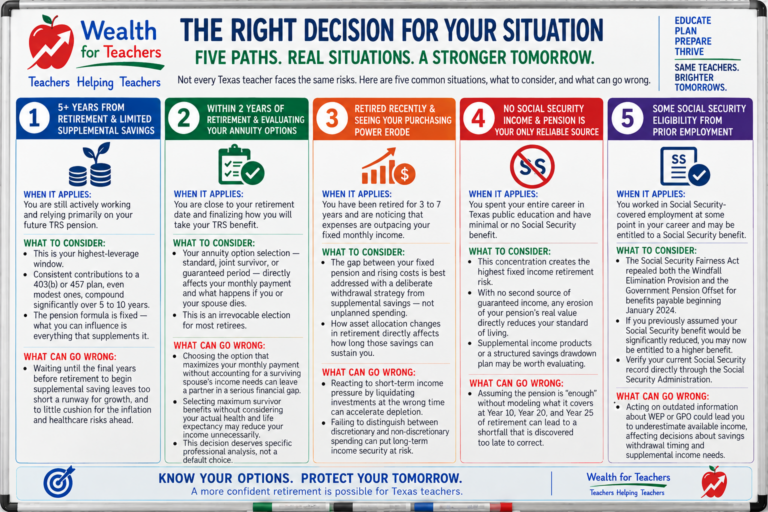
Not every Texas teacher faces these risks in the same way. Here are five decision paths that commonly apply, along with what to consider and what can go wrong.
When it applies: You are still actively working and relying primarily on your future TRS pension.
What to consider: This is your highest-leverage window. Consistent contributions to a 403(b) or 457 plan, even modest ones, compound significantly over 5 to 10 years. The pension formula is fixed — what you can influence is everything that supplements it.
What can go wrong: Waiting until the final years before retirement to begin supplemental saving leaves too short a runway for growth, and too little cushion for the inflation and healthcare risks ahead.
When it applies: You are close to your retirement date and finalizing how you will take your TRS benefit.
What to consider: Your annuity option selection — standard, joint survivor, or guaranteed period — directly affects your monthly payment amount and what happens to income if you or your spouse dies. This is an irrevocable election for most retirees.
What can go wrong: Choosing the option that maximizes your monthly payment without accounting for a surviving spouse’s income needs can leave a partner in a serious financial gap. Conversely, selecting maximum survivor benefits without considering your actual health and life expectancy may reduce your income unnecessarily. This decision deserves specific professional analysis, not a default choice.
When it applies: You have been retired for 3 to 7 years and are noticing that expenses are outpacing your fixed monthly income.
What to consider: The gap between your fixed pension and rising costs is best addressed with a deliberate withdrawal strategy from supplemental savings — not unplanned spending. How asset allocation changes in retirement directly affects how long those savings can sustain you.
What can go wrong: Reacting to short-term income pressure by liquidating investments at the wrong time, or failing to distinguish between discretionary and non-discretionary spending, can accelerate depletion of savings that are needed for the back half of retirement.
When it applies: You spent your entire career in Texas public education and have minimal or no Social Security benefit.
What to consider: This concentration creates the highest fixed income retirement risk. With no second source of guaranteed income, any erosion of your pension’s real value directly reduces your standard of living. Supplemental income products or a structured savings drawdown plan may be worth evaluating.
What can go wrong: Assuming the pension is “enough” without modeling what it covers at Year 10, Year 20, and Year 25 of retirement can lead to a shortfall that is discovered too late to correct.
When it applies: You worked in Social Security-covered employment at some point in your career and may be entitled to a Social Security benefit.
What to consider: The Social Security Fairness Act repealed both the Windfall Elimination Provision and the Government Pension Offset for benefits payable beginning January 2024. If you previously assumed your Social Security benefit would be significantly reduced due to those provisions, you may now be entitled to a higher benefit than you expected. Verify your current Social Security record directly through the Social Security Administration.
What can go wrong: Acting on outdated information about WEP or GPO — assuming significant reductions still apply — could lead you to underestimate available income, affecting decisions about savings withdrawal timing and supplemental income needs.
The answer is not to dismiss the TRS pension. It is a valuable, reliable foundation. The answer is to stop treating it as a complete retirement plan and start treating it as one part of a deliberately built income structure.
Practically, that means:
Use these five questions to identify gaps or blind spots in your current retirement plan:
The difficult reality is that fixed income retirement risk is invisible during the years it is building. A teacher in her first decade of retirement may feel comfortable — the pension covers expenses, savings are still intact, and healthcare costs feel manageable. The risks do not announce themselves. They accumulate.
By Year 15 or Year 20, when the compounded effects of inflation erosion, rising healthcare costs, and reduced savings become visible, the options for correction are far more limited than they were at retirement. The annuity option cannot be changed. TRS-Care coverage decisions made years ago are largely locked in. The window to build supplemental savings has closed.
The teachers who avoid this outcome are the ones who tested their plan’s assumptions before finalizing retirement — not after. That kind of stress-testing requires honest projections, not optimistic ones. It requires looking at what your fixed income does not cover, not just what it does.
No. The TRS retirement plan does not provide for regular cost-of-living adjustments to the amount of your annuity. Any adjustment requires action by the Texas Legislature and is subject to the actuarial soundness of the pension trust fund.
No — not for benefits payable beginning January 2024. The Social Security Fairness Act repealed both the Windfall Elimination Provision and the Government Pension Offset for those benefit periods. If you previously received reduced Social Security benefits due to WEP or GPO, contact the Social Security Administration directly to understand how this change may affect your benefit amount.
In most situations, retirees and surviving spouses cannot re-enroll in TRS-Care. However, retirees and surviving spouses may re-enroll when they turn 65 or if they have a special enrollment event, which are rare. This makes the initial TRS-Care enrollment decision one that deserves careful consideration before acting.
Yes. Although your pension may be enough to cover your expenses when you first retire, over time, your monthly annuity purchasing power will decrease due to inflation. The pension covers your baseline needs today. Supplemental savings are what protect that baseline from eroding over a 20-to-30-year retirement.
The annuity option you select at retirement determines your monthly payment and what income, if any, continues to a surviving spouse or beneficiary after your death. A higher monthly payment for yourself may translate to no payment — or a reduced payment — to your spouse. This tradeoff is permanent for most election types and cannot be reversed after the fact. It is one of the highest-stakes decisions in the TRS retirement process.
Understanding the risks in your TRS pension is the first step. Knowing exactly how those risks apply to your years of service, your savings, your healthcare situation, and your retirement timeline is what actually protects your income.
A personalized TRS analysis looks at your specific numbers — not generic projections — so you can make confident decisions before they become permanent ones.
Use the TRS calculator to estimate your pension and identify potential income gaps.
