

Annuity vs Pension for Teachers: Why Getting This Decision Wrong Can Cost You Decades of Income Security
You already have a pension. That’s the starting point most Texas teachers forget when they begin exploring guaranteed income products like annuities. The real question isn’t whether guaranteed income is good in theory—it’s whether adding more of it makes sense given what your Texas TRS pension already provides, what it doesn’t cover, and what you could lose by misreading that gap.
Texas teachers can also run a full pension estimate using the Texas Teacher Retirement Calculator to better understand their retirement outlook.
The annuity vs pension decision for teachers isn’t abstract. It has direct consequences for how much income you receive each month, how long your savings last, and whether you can absorb a financial emergency without unraveling your retirement plan. Getting it right requires understanding both what your TRS benefit actually does and what it structurally cannot do.
This guide is built for Texas public school teachers who are navigating that decision—whether you’re five years out, approaching eligibility, or already retired and reconsidering your income structure.
For a broader view of how all the pieces connect, start with the Texas Teacher Retirement Planning Guide before working through the specifics below.
Most retirement plans fail not because teachers made bad choices, but because those plans were never stress-tested under real conditions—inflation, a market drop in year two of retirement, a health event, or a spouse’s death. A plan that looks solid on paper can collapse quickly when the assumptions underneath it are wrong. The sections below are designed to surface those assumptions before they become problems.
What Your TRS Pension Actually Provides
Texas TRS uses a straightforward formula. Your annual pension equals your years of service multiplied by 2.3%, multiplied by your highest average salary (the average of your five highest annual salaries, or three highest if you are grandfathered).
Run Your Free Texas Teacher Retirement Analysis
Use the TRS calculator to estimate your pension and identify potential income gaps.
Annual Pension = (Years of Service × 0.023) × Highest Average Salary
A teacher with 28 years of service and a highest average salary of $62,000 receives:
28 × 0.023 × $62,000 = $39,928 per year, or roughly $3,327 per month.
That monthly payment arrives reliably, for life, regardless of market conditions. The TRS retirement plan offers a number of payment options for service retirement annuities, with the Standard Annuity paying the maximum benefit amount to the retiree for life.
That certainty is real and valuable. But it comes with a structural limitation that shapes every income decision you’ll make in retirement.
What TRS Does Not Cover—and Where the Gap Lives
Your TRS pension does not automatically grow with inflation. The TRS retirement plan does not provide for regular COLAs to the amount of your annuity. State law provides that the legislature may only consider issuing benefit enhancements if the TRS Pension Trust Fund is actuarially sound.
This matters more than most teachers realize. A fixed monthly payment of $3,327 today will have meaningfully less purchasing power ten or fifteen years into retirement. That gap—between what your pension pays and what your expenses actually cost—is where guaranteed income products, savings withdrawals, and Social Security all compete for relevance.
Your TRS pension also does not provide:
- A built-in emergency fund
- Long-term care coverage
- Liquidity for large one-time expenses
- Income flexibility if your needs change
Understanding what you actually need beyond your pension—and in what form—is the foundation of the annuity vs pension decision for teachers.
Annuity vs Pension for Teachers: Defining the Difference
Your TRS pension is itself a defined-benefit pension—a lifetime income stream calculated by a formula, funded by the state, and paid regardless of investment returns. You did not choose it; it is the core of your retirement structure.
When people ask about annuities in this context, they typically mean one of two things:
- TRS annuity payment options — choices you make at retirement about how your TRS benefit is structured, including survivor benefits and guaranteed payment periods.
- Commercial annuities — products purchased from an insurance company, outside of TRS, designed to generate additional guaranteed income from your savings.
TRS options 1 through 5 pay a reduced monthly annuity payable during the retiree’s life but provide for a beneficiary to receive a monthly benefit after the retiree’s death, either for life or for a guaranteed period of time.
Choosing among those TRS options is a separate—and often irreversible—decision from choosing whether to buy a commercial annuity. Confusing the two is one of the most common errors Texas teachers make at retirement.
Pros, Cons, and Scenarios for Adding Guaranteed Income
When Adding Guaranteed Income Can Make Sense
- Your TRS pension covers basic expenses but leaves little margin for variable costs
- You have retirement savings you would otherwise withdraw at an unpredictable rate
- You want to protect a surviving spouse beyond what a TRS survivor option would provide
- You have a family history of longevity and are concerned about how long your retirement savings need to last
- You are willing to accept reduced liquidity in exchange for predictability
When It Likely Doesn’t Add Value
- Your TRS pension already covers all essential expenses with room to spare
- You need your savings to remain accessible for healthcare costs or emergencies
- You are still years from retirement and have time to build savings through other vehicles
- You haven’t fully mapped your income floor—knowing whether there’s actually a gap to fill
The Liquidity Trade-Off
Annuities generate guaranteed income by giving up flexibility. Once funds are committed to most annuity contracts, accessing them in a lump sum is limited or penalized. For teachers who carry meaningful healthcare expenses in early retirement—before Medicare eligibility—that trade-off deserves careful attention.
Before layering any guaranteed income product on top of your TRS pension, it’s worth building a clear retirement income floor that maps your guaranteed income against your fixed expenses. If TRS already covers your floor, additional guaranteed income may reduce flexibility without solving a real problem.
Social Security Has Changed for Many Texas Teachers
Many Texas teachers spent years planning around the assumption that Social Security would be partially or fully unavailable to them. That assumption is now outdated for benefits payable beginning January 2024.
On January 5, 2025, the President signed into law H.R. 82, the Social Security Fairness Act of 2023. The law repeals the Windfall Elimination Provision (WEP) and Government Pension Offset (GPO) provision, both of which could reduce Social Security benefits when someone received a pension based on work that was not covered by Social Security. The law applies with respect to benefits payable for months after December 2023.
This matters directly for the annuity vs pension decision. According to TRS, approximately 96% of Texas public-school employees do not pay into Social Security, meaning most Texas public-school employees work for employers that do not withhold Social Security taxes. Those teachers who do have qualifying Social Security-covered work history outside of their TRS-covered employment—whether before, during, or after their teaching career—may see their Social Security benefit increase as a result of the repeal.
If you worked in Social Security-covered employment before or during your teaching career, your Social Security benefit may now be larger than you previously calculated. That changes how much additional guaranteed income you actually need—and may make a commercial annuity less necessary than it appeared. Review your Social Security earnings record and consider the timing question covered in our article on whether Texas teachers should delay Social Security benefits.
How to Make the Right Decision for Your Situation
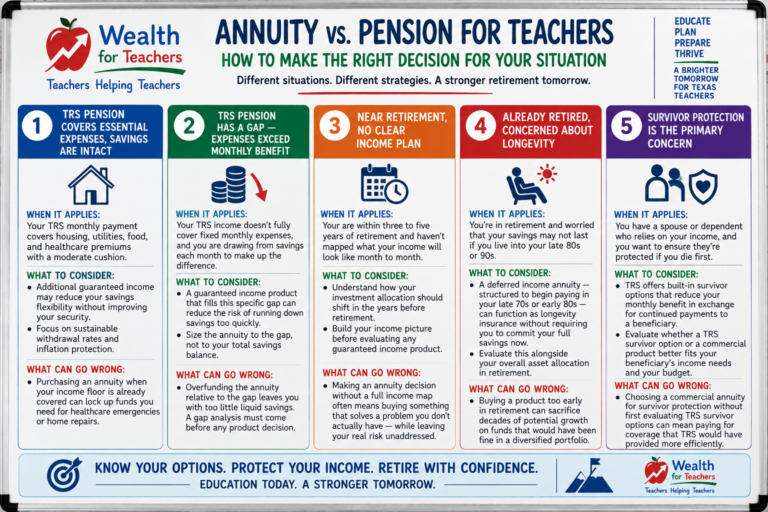
Path 1: TRS Pension Covers Essential Expenses, Savings Are Intact
When it applies: Your TRS monthly payment covers housing, utilities, food, and healthcare premiums with a moderate cushion.
What to consider: Additional guaranteed income may reduce your savings flexibility without improving your security. Focus instead on how your savings are structured for sustainable withdrawal rates and inflation protection.
What can go wrong: Purchasing an annuity when your income floor is already covered can lock up funds you need for healthcare emergencies or home repairs, creating cash-flow pressure that your pension cannot solve.
Path 2: TRS Pension Has a Gap—Expenses Exceed Monthly Benefit
When it applies: Your TRS income doesn’t fully cover fixed monthly expenses, and you are drawing from savings each month to make up the difference.
What to consider: A guaranteed income product that fills this specific gap can reduce the risk of running down savings too quickly. Size the annuity to the gap, not to your total savings balance.
What can go wrong: Overfunding the annuity relative to the gap leaves you with too little liquid savings. A gap analysis must come before any product decision.
Path 3: Near Retirement, No Clear Income Plan
When it applies: You are within three to five years of retirement and haven’t mapped what your income will look like month to month.
What to consider: Understand how investment allocation should shift in the years before retirement, and build your income picture before evaluating any guaranteed income product.
What can go wrong: Making an annuity decision without a full income map often means buying something that solves a problem you don’t actually have—while leaving your real risk unaddressed.
Path 4: Already Retired, Concerned About Longevity
When it applies: You’re in retirement and worried that your savings may not last if you live into your late 80s or 90s.
What to consider: A deferred income annuity—structured to begin paying in your late 70s or early 80s—can function as longevity insurance without requiring you to commit your full savings now. Evaluate this alongside your overall asset allocation in retirement.
What can go wrong: Buying a product too early in retirement, when the longevity risk hasn’t materialized, can sacrifice decades of potential growth on funds that would have been fine in a diversified portfolio.
Path 5: Survivor Protection Is the Primary Concern
When it applies: You have a spouse or dependent who relies on your income, and you want to ensure they’re protected if you die first.
What to consider: TRS offers built-in survivor options that reduce your monthly benefit in exchange for continued payments to a beneficiary. The Joint and Survivor Annuity options are reduced monthly annuities that are paid to you for life and then for a named beneficiary’s lifetime after you pass away. Evaluate whether a TRS survivor option or a commercial product better fits your beneficiary’s income needs and your budget.
What can go wrong: Choosing a commercial annuity for survivor protection without first evaluating TRS survivor options can mean paying for coverage that TRS would have provided more efficiently.
What to Do Instead of Guessing
The most common mistake Texas teachers make isn’t choosing the wrong product. It’s making a product decision before doing the foundational work that reveals whether a product is needed at all.
Here’s what to do first:
- Calculate your actual TRS benefit using the formula: Years of Service × 0.023 × Highest Average Salary. Don’t estimate—run the actual number.
- List your fixed monthly expenses in retirement. Include healthcare premiums, housing, utilities, and any debt payments. Compare this number to your TRS benefit.
- Account for Social Security if you have qualifying work history. With WEP and GPO repealed for benefits payable beginning January 2024, your Social Security benefit may be larger than older planning assumptions suggested.
- Identify the actual gap between guaranteed income and fixed expenses. That gap—if one exists—is what needs to be solved. Size any solution to the gap, not to fear or a sales pitch.
- Test your plan under stress: What happens if you live to 90? What if healthcare costs rise significantly? What if your savings drop 25% in the first three years of retirement?
Common Questions Texas Teachers Ask
Do I even need an annuity if I have TRS?
Not automatically. Your TRS pension is already a lifetime guaranteed income stream. Whether you need additional guaranteed income depends entirely on whether your pension covers your fixed expenses and how much flexibility you need from your savings. Many teachers with strong TRS benefits and moderate savings are better served by a well-structured withdrawal strategy than by layering on another product.
Can I take a lump sum from TRS instead of monthly payments?
Eligible members may select a Partial Lump Sum Option (PLSO) equal to 12, 24, or 36 months of a standard service retirement annuity. When a PLSO is selected, the member’s monthly annuity is reduced to reflect the PLSO distribution. This is not a full lump-sum option—it is a partial one that permanently reduces your monthly benefit. The trade-off must be evaluated carefully before committing.
Are commercial annuities regulated and safe?
Annuities sold by insurance companies are regulated at the state level and backed by the issuing insurance company’s financial strength. They are not FDIC-insured. Evaluating the insurer’s financial ratings and understanding surrender charges, fees, and contract terms is essential before purchasing.
What’s the difference between a fixed annuity and a variable annuity?
A fixed annuity pays a set interest rate and provides predictable income. A variable annuity ties returns to investment sub-accounts, which introduces market risk—the opposite of what most teachers are trying to achieve when they want guaranteed income. For teachers seeking income certainty to complement TRS, fixed or fixed-indexed annuities are generally more relevant than variable products.
Does buying an annuity affect my TRS benefit?
No. A commercial annuity purchased outside of TRS has no effect on your TRS pension. The two are completely separate. Your TRS benefit is determined by your service credit and salary history, not by what you do with personal savings.
Quick Self-Check Before You Move Forward
Before making any decision about guaranteed income products, work through these five questions honestly:
- Do you know your exact TRS monthly benefit? If you’re estimating rather than calculating, you’re building a plan on an assumption that may be wrong.
- Have you listed every fixed monthly expense you’ll carry in retirement? Including healthcare premiums, mortgage or rent, and insurance—not just general estimates.
- Do you know whether your Social Security benefit has changed? With WEP and GPO repealed for benefits payable beginning January 2024, teachers with qualifying outside work history may have more Social Security income than their previous calculations showed.
- Have you tested what happens to your income plan if you live 30 years in retirement? A plan that works for 15 years may not survive 30.
- Do you know how much of your savings you need to keep liquid? Healthcare emergencies, home repairs, and family needs don’t wait for annuity surrender periods to expire.
If you answered “no” or “not sure” to two or more of these questions, you are not ready to make a product decision. You need a retirement income map first.
Most Teachers Don’t Find the Gaps Until It’s Too Late
The most dangerous moment in retirement planning isn’t making a wrong choice. It’s being unaware that a gap exists until after the decisions that could have addressed it are behind you.
TRS annuity payment options are selected once, at retirement, and are generally not reversible. Commercial annuity contracts often carry surrender charges that last years. Social Security claiming decisions—while sometimes adjustable—carry long-term income consequences that compound over decades.
Teachers who delay testing their retirement income assumptions often find themselves discovering a problem when they have fewer options and less time to correct it. The income gap that seems manageable at 58 can become a serious structural problem at 72, when market losses or healthcare costs have eroded the savings buffer that was supposed to fill it.
Pressure-testing your retirement plan before you finalize any decisions—not after—is how you avoid that outcome.