
What Makes Teacher Retirement Different From 401(k) Plans
Teacher retirement works differently than traditional plans. Here’s what to know.

Retirement isn’t just financial—it’s emotional too. Here’s what to expect.

Most Texas teachers spend decades mastering their craft. They build classroom routines, earn the trust of students and colleagues, and quietly define themselves by the work they do every single day. Then comes the retirement transition—and almost no one is prepared for how much that shift changes who they are, not just what they do.
Texas teachers can also run a full pension estimate using the Texas Teacher Retirement Calculator to better understand their retirement outlook.
The financial side of retiring from Texas TRS gets a lot of attention. The emotional side gets almost none. That gap is where many teachers quietly struggle after leaving the classroom.
Understanding what to expect—and how to prepare for it—can be the difference between a retirement that energizes you and one that leaves you feeling lost within the first six months.
For a complete overview of TRS decisions, timelines, and income planning, start with the Texas Teacher Retirement Planning Guide before diving deeper into the human side of the transition.
Most retirement plans fail not because the math is wrong, but because they were never tested against real-world emotional and lifestyle conditions. A teacher can have the right TRS start date, a solid pension calculation, and still find themselves completely unprepared for the daily reality of retired life. Knowing your numbers is not the same as knowing how you will actually feel when the alarm clock stops mattering.
Teaching is not just a job. For most educators, it is a core part of who they are. The school year gives structure to time. Students give purpose to each day. The classroom gives a sense of authority, belonging, and meaning that is hard to replicate anywhere else.
Use the TRS calculator to estimate your pension and identify potential income gaps.
When that ends—even by choice—the loss can feel disorienting.
Researchers who study career transitions describe retirement as a process of identity reconstruction, not just a change in employment status. For teachers especially, the professional self and the personal self are often deeply intertwined. Removing one does not leave the other intact.
Common signs of identity disruption after retirement include:
None of these feelings indicate that retirement was the wrong decision. They indicate that the transition is real, and that navigating it requires more than a date on the TRS retirement form.
Teaching involves daily emotional investment in other people. The student-teacher relationship creates feedback loops of meaning and validation that are difficult to replace in retirement. When those daily interactions disappear, many teachers discover that the structure of their emotional life—not just their schedule—was built around the classroom.
This is not weakness. It is the natural consequence of spending a career in a profession that demands deep human connection.
Beyond identity, the practical rhythms of retired life look nothing like what most teachers imagined. The transition from a school-year schedule to an open, unstructured calendar is one of the most underestimated adjustments in the entire retirement transition.
Teachers are accustomed to operating under constant time pressure. Every minute of the school day has a purpose. Retirement removes that pressure entirely—and for many people, the sudden abundance of unstructured time feels paralyzing rather than freeing.
The first few weeks can feel like a long weekend. By the third month, some retirees report a creeping anxiety that comes from having no external accountability and no clear measure of whether their day was well spent.
Much of a teacher’s social world is built inside the school building—colleagues down the hall, the rhythm of the teachers’ lounge, the shared language of school life. Retirement severs those ties suddenly, and rebuilding social connection outside of work takes deliberate effort that many people do not anticipate.
Spending patterns in retirement look different from spending patterns during a working career. Early in retirement, many teachers spend more—on travel, hobbies, and long-deferred plans. Later, spending often moderates. Understanding that rhythm in advance helps avoid financial stress during the transition. A useful starting point is reviewing how spending strategy in early retirement differs from what teachers expect.
Many teachers retire expecting their health to improve once work-related stress is removed. That often happens—but energy levels and health needs change over time, and retirement plans built around an assumed level of activity need room to adapt.
The emotional adjustment to retirement is not a single event. It unfolds in phases, and each phase brings its own challenges.
The first weeks of retirement often bring relief and excitement. The stress of teaching is gone. The freedom feels earned. This phase can last anywhere from a few weeks to a few months, and it can mask the harder adjustment that comes next.
This is the phase that most retirement planning literature ignores. It arrives when the initial excitement fades and the retiree is left with the daily reality of an unstructured life. Feelings of boredom, restlessness, and even mild depression are common during this period. Recognizing this phase as normal—rather than a sign that something has gone wrong—is essential.
Over time, most retirees develop new routines, find meaningful activities, and rebuild a sense of purpose. This phase does not happen automatically. It requires intentional choices about how to structure time, maintain relationships, and define meaning outside of a professional role.
The teachers who navigate this best tend to be the ones who thought about it before they retired—not after.
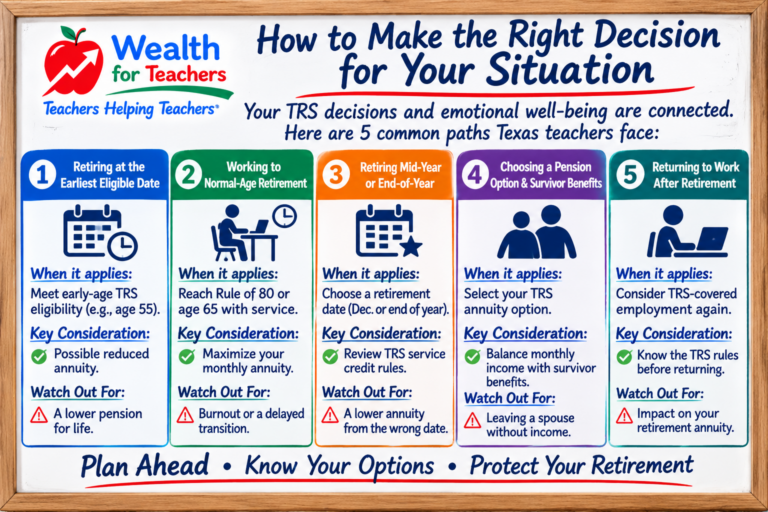
The emotional side of retirement does not exist in a vacuum. It is directly connected to the timing, structure, and financial security of the TRS decisions you make before you leave. Here are five decision paths Texas teachers commonly face, and what can go wrong when they are handled without considering the full picture.
When it applies: You meet TRS early-age retirement eligibility—for example, age 55 with at least five years of service credit but without meeting the Rule of 80, or 30 or more years of service credit without meeting the Rule of 80—but have not reached normal-age retirement thresholds. Exact early-age eligibility requirements vary by membership tier.
What to consider: An early retirement may carry an actuarially reduced annuity, which permanently lowers your monthly income. The emotional appeal of leaving early must be weighed against decades of reduced pension payments.
What can go wrong: Teachers who retire early for emotional reasons—burnout, frustration, a difficult school year—sometimes discover that the financial trade-off is larger than they expected, and the reduction is permanent.
When it applies: You are approaching the eligibility threshold for normal-age retirement under your TRS membership tier—such as the Rule of 80 or age 65 with at least five years of service credit, with specific age requirements varying by tier.
What to consider: Working to full eligibility maximizes your monthly annuity and may affect TRS-Care health benefit eligibility. The emotional challenge is pushing through the final years of teaching when motivation may be fading.
What can go wrong: Staying too long can lead to burnout that damages the final years of a career and the transition itself. Having a specific target date—rather than a vague “a few more years”—reduces this risk.
When it applies: You are deciding whether to retire in December or at the end of the school year in May or June.
What to consider: TRS service credit rules treat mid-year and end-of-year retirement differently. The salary used in your annuity calculation and the amount of service credit you receive can vary based on your retirement date. Review your options directly with TRS before committing to a date.
What can go wrong: Choosing a retirement date based only on personal preference—without reviewing how TRS calculates service credit and salary for that specific date—can result in a lower annuity than you expected.
When it applies: Every retiring TRS member selects an annuity option that determines how benefits are paid and what, if anything, a surviving spouse receives.
What to consider: The standard annuity pays the maximum monthly amount but stops at death with no survivor benefit. Optional annuity selections reduce the monthly payment in exchange for continued benefits to a designated beneficiary. This is one of the most consequential and least reversible decisions in the TRS retirement process.
What can go wrong: Teachers who choose the maximum monthly benefit without fully understanding the survivor implications can leave a spouse with no income from TRS after the retiree’s death. This decision deserves careful analysis—see the comparison of lump sum vs. lifetime pension income for related considerations.
When it applies: You retire and later consider returning to work at a TRS-covered employer.
What to consider: TRS has specific rules governing employment after retirement, including required breaks in service. Returning to TRS-covered employment without understanding those rules can affect your retirement annuity.
What can go wrong: Some retirees return to school-based work to fill the emotional void left by retirement, without first verifying how it affects their TRS annuity. The financial consequences can be significant if the return violates TRS post-retirement employment rules.
Rather than reacting to retirement when it arrives, Texas teachers benefit from preparing for the emotional transition with the same deliberateness they bring to TRS paperwork and financial decisions.
Here is what that looks like in practice:
Consider also understanding how your taxes will change once your TRS pension is your primary income source—what worked during your teaching years may not apply the same way in retirement. How taxes change after teachers retire is a practical resource for working through those differences.
Before finalizing your retirement plans, answer these five questions honestly. Uncertainty in any one of them is worth addressing before your retirement date becomes official.
One of the most serious risks in the retirement transition is that the most important decisions are often already final by the time their consequences become clear. A teacher who selects a TRS annuity option, locks in a retirement date, and declines TRS-Care during the initial enrollment window cannot easily undo those choices if the reality of retirement turns out to be different from what they imagined.
The emotional side of retirement amplifies this risk. When a teacher is burned out, excited to be done, or simply eager to leave a difficult school year behind, the decisions that shape the next twenty or thirty years of financial and personal life can get made quickly—under pressure, without full information, and without having tested the underlying assumptions against real conditions.
Pension decisions are particularly permanent. The annuity option you select, the date you retire, and the age at which you claim retirement benefits all interact in ways that can be difficult to fully appreciate until you are living with the result. That is why working through these decisions with someone who understands Texas TRS specifically—not just general retirement planning—matters more than many teachers realize until after the fact. If you are unsure whether to handle this alone or with help, understanding when to hire a retirement specialist is a useful place to start.
It is more common than most people admit. The loss of daily purpose, social connection, and professional identity is real, and many retirees experience a period of emotional difficulty after the initial excitement fades. Recognizing this as a normal phase of the transition—rather than a sign that retirement was a mistake—is the first step toward moving through it.
For most people, the active adjustment period lasts between six months and two years. Teachers who had a clear plan for how to spend their time and had already begun building a life outside the classroom before retiring tend to adjust faster.
Generally, teachers notify their school district first so the district can plan accordingly, and then submit the formal application to TRS. TRS recommends submitting the retirement application well in advance of your planned retirement date. Verify the specific timeline requirements with TRS directly, as the deadlines can affect your effective retirement date.
TRS retirees may return to work at TRS-covered employers under certain conditions, but specific rules—including required breaks in service—apply. Working at a non-TRS-covered employer generally has fewer restrictions, but verifying the current rules with TRS before accepting any position is essential. Violations can affect your annuity.
For members who retire before reaching normal-age eligibility thresholds, TRS applies early-age actuarial reductions to the standard annuity. These reductions are based on age and years of service at the time of retirement. A teacher retiring before reaching normal-age eligibility could see a meaningful permanent reduction in monthly income. The exact amount depends on your membership tier and retirement date.
You are not alone. Most retirement conversations focus almost entirely on numbers—pension amounts, health insurance, taxes, and income planning. The emotional and lifestyle dimensions of the transition rarely get equal attention until they become impossible to ignore. Starting that conversation before your last day—rather than after—makes a significant difference.
The retirement transition for teachers is one of the most significant life changes a person can navigate, and it touches almost every dimension of daily existence—identity, purpose, relationships, structure, and financial security. The teachers who move through it most successfully are not necessarily the ones who had the largest pension or the most savings. They are the ones who prepared honestly for what life after the classroom would actually require—and who made their most important decisions with clear information, tested assumptions, and enough time to get it right.
Use the TRS calculator to estimate your pension and identify potential income gaps.