
What Makes Teacher Retirement Different From 401(k) Plans
Teacher retirement works differently than traditional plans. Here’s what to know.

Safety in retirement comes from balancing income, risk, and planning.

Most Texas teachers spend decades building toward retirement without ever stress-testing the plan they assume will hold. They know they have a TRS pension. They know roughly when they can leave. And they believe that reaching an eligibility threshold is the same as being financially ready. It is not.
Texas teachers can also run a full pension estimate using the Texas Teacher Retirement Calculator to better understand their retirement outlook.
The safest retirement strategy for teachers is not a single product or a single move. It is a coordinated approach that accounts for pension timing, income layering, health coverage continuity, Social Security eligibility, and the spending demands of a 25- to 30-year retirement horizon. Miss one piece, and the rest can unravel.
This article breaks down the specific risk points Texas TRS members face, how to build a layered income strategy that holds under real-world pressure, and how to identify which path fits your situation before a decision becomes permanent.
For a broader foundation, start with the Texas Teacher Retirement Planning Guide before working through the decisions below.
A retirement plan that has never been tested under real-world conditions is not a plan — it is a wish. Most teachers enter retirement with a general sense of how much their pension will pay and a loose idea that savings and Social Security will fill the rest. What they lack is a concrete model of how those income streams interact across different retirement dates, different spending levels, and different life events. The gap between what a teacher expects and what actually arrives in month one of retirement is where financial stress begins.
Use the TRS calculator to estimate your pension and identify potential income gaps.
The Texas TRS pension is a defined benefit plan, which means your monthly income is calculated by a formula rather than determined by investment performance. That formula is straightforward: your annual pension equals your years of service credit multiplied by 2.3%, then multiplied by your average salary — calculated using the average of your highest five annual salaries for most members, or your highest three annual salaries if you are a grandfathered member.
Example: A non-grandfathered member with 28 years of service and an average of their five highest annual salaries of $62,000 would calculate as follows:
28 × 0.023 × $62,000 = $39,928 per year, or roughly $3,327 per month before any deductions.
That is a meaningful base. But it is a base, not a complete income strategy. A TRS pension does not adjust automatically for inflation at a guaranteed rate, does not cover long-term care costs, and does not account for the healthcare expense gap that exists for teachers who retire before Medicare eligibility at age 65.
Timing your retirement date matters more than most teachers realize. Retiring one or two years early can permanently reduce your monthly benefit if you do not meet normal-age eligibility thresholds. Early-age reduction rules differ depending on your TRS membership tier, and the reduction follows you for the rest of your life. Understanding the difference between taking a lump sum or lifetime income from TRS is also a decision that cannot be undone once made.
Income layering means structuring retirement so that multiple independent income sources cover different expenses and time periods. For a Texas teacher, that typically means building on top of the TRS pension rather than relying on it alone.
Your guaranteed monthly base. The starting point for every other decision. Know your exact projected monthly benefit at different retirement dates, not just a rough estimate.
Texas public school employees have access to 403(b) and 457(b) plans through their district. These are separate from TRS and function as supplemental savings vehicles. Teachers who did not contribute heavily during their careers often reach retirement with a pension income that covers fixed expenses but leaves little room for irregular costs, travel, or emergencies. Supplemental savings fill that gap. Understanding how required minimum distributions affect your retirement strategy is a critical part of managing these accounts once you reach distribution age.
Most Texas public school teachers do not pay into Social Security through their TRS-covered position. However, teachers who worked in Social Security-covered jobs before or alongside their teaching career may have earned benefits. This layer has changed significantly and is covered in the next section.
Liquid savings, a spouse’s income or retirement benefits, or investment accounts that provide flexibility and a buffer against unexpected expenses. This layer matters most in the first decade of retirement, when spending often runs higher than projected. Learning how to adjust spending in early retirement years is a skill most teachers underestimate before they leave the classroom.
The goal of income layering is not complexity for its own sake. It is resilience. A retirement built on one income stream — even a strong one — is more vulnerable than a retirement built on several coordinated streams with different risk profiles.
For years, two provisions in federal law — the Windfall Elimination Provision (WEP) and the Government Pension Offset (GPO) — reduced or eliminated Social Security benefits for public school teachers who also received a pension from a non-Social Security-covered employer like TRS.
That changed. The Social Security Fairness Act of 2023 (HR 82), which became law on January 5, 2025, repealed both provisions. The repeal applies beginning with benefits payable for January 2024; December 2023 is the last month that WEP and GPO applied.
This means that Texas teachers who qualify for Social Security benefits based on their own work record or through a spouse’s record are no longer subject to those offsets for benefits payable from January 2024 forward. If you had previously been told Social Security would be significantly reduced or eliminated due to your TRS pension, that calculation has changed and your situation deserves a fresh look.
What this does not do: it does not create Social Security eligibility where none previously existed. Teachers who spent their entire careers in TRS-covered positions and never worked in Social Security-covered jobs may still have little or no Social Security benefit. The repeal of WEP and GPO increases the benefit for those who qualify — it does not manufacture eligibility.
Health coverage in retirement is one of the most underestimated costs a Texas teacher faces, particularly if they retire before age 65 and Medicare eligibility. TRS-Care is the retiree health benefit program for eligible TRS members, but eligibility is not automatic upon retirement.
A service retiree must have at least 10 years of service credit in the TRS pension when they retire. Service credit may include up to five years of military service credit. In addition, the retiree must meet one of the following: age plus years of service credit must equal or exceed 80 with at least 10 years of service credit, or the retiree must have 30 or more years of service credit in the TRS pension.
Teachers who retire early and do not meet TRS-Care eligibility requirements face a coverage gap that can be expensive to bridge privately. Planning for this gap — especially in the years between early retirement and Medicare at 65 — is a central part of a safe retirement strategy.
Additionally, if you are eligible for Medicare, you must buy and maintain Medicare Part B coverage to participate in TRS-Care Medicare Advantage. Missing an enrollment window can result in permanent premium penalties and coverage gaps.
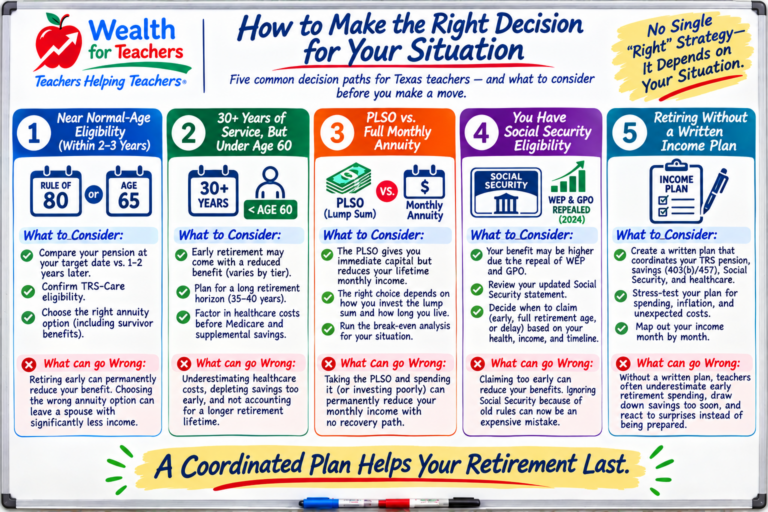
There is no single safest retirement strategy for every Texas teacher. The right path depends on your service credit, your age, your savings, your health coverage needs, and what you want retirement to look like. Below are five common decision paths and what each one demands.
When it applies: You are close to meeting the Rule of 80 or age 65 with enough service credit for an unreduced benefit.
What to consider: Run your exact pension projection at the proposed date versus one or two years later. Additional service credit and salary increases can meaningfully raise your lifetime benefit. Also confirm TRS-Care eligibility and which annuity payment option fits your household.
What can go wrong: Retiring before reaching normal-age eligibility thresholds locks in a permanently reduced benefit. Choosing the wrong annuity option at retirement — particularly regarding survivor benefits — is irreversible through TRS and can leave a surviving spouse significantly underserved.
When it applies: Members who have earned 30 years of service can retire regardless of their age, which means someone who is only 49 years old may be able to retire. Retiring at the earliest opportunity may result in a reduced early-age service retirement depending on your membership tier.
What to consider: A long retirement horizon — potentially 35 to 40 years — requires income that will hold over decades. A pension that looks sufficient at 52 may feel very different at 72 without supplemental savings or income growth.
What can go wrong: Underestimating healthcare costs before Medicare eligibility, depleting supplemental savings too early, and underestimating total retirement duration are all common failures in this path.
When it applies: You qualify for the Partial Lump Sum Option and are deciding whether to take a lump sum in exchange for a reduced monthly benefit.
What to consider: The PLSO trades future monthly income for immediate capital. The break-even math depends heavily on how you invest the lump sum and how long you live. This is not a question with a universal right answer. Review the detailed breakdown of lump sum versus lifetime income decisions before making this call.
What can go wrong: Teachers who take the PLSO expecting to invest the lump sum effectively but spend it instead — or invest it poorly — permanently reduce their monthly income with no recovery path.
When it applies: You worked in Social Security-covered employment before or alongside your TRS career and have earned Social Security credits.
What to consider: With WEP and GPO repealed for benefits payable from January 2024 forward, your Social Security benefit may be higher than previously estimated. Revisit your Social Security statement and factor the updated amount into your income plan. Timing your Social Security claim — whether to take it early, at full retirement age, or delay — is now a more meaningful decision for Texas teachers than it was under the old rules. The right claiming age depends on your individual circumstances, including your health, other income sources, and retirement timeline.
What can go wrong: Claiming Social Security too early while still working can reduce your benefits if you are below full retirement age. Ignoring Social Security entirely because a prior advisor said it would be eliminated is now an expensive oversight given the repeal of WEP and GPO.
When it applies: You know your pension amount and have savings but have not mapped out how those sources will work together month by month.
What to consider: Understanding why teachers should create a written retirement plan is more than an organizational exercise. A written plan forces you to stress-test assumptions about spending, inflation, healthcare costs, and income sequencing before those assumptions become consequences.
What can go wrong: Without a written plan, teachers tend to underestimate early retirement spending, draw down savings prematurely, and react to surprises reactively rather than from a position of preparation.
Rather than hoping that the pension alone is enough, or delaying the planning work until the retirement date is near, the safest approach is to treat your TRS benefit as the anchor — and build deliberately around it.
Use these questions to identify gaps in your current retirement thinking before a decision becomes final.
It depends on your years of service, your average of highest annual salaries, your spending needs, and whether you have supplemental savings or other income sources. A TRS pension is a strong foundation, but a 25- or 30-year retirement typically requires more than one income stream to stay financially stable across different life stages.
If you retire before reaching normal-age eligibility under your membership tier, your monthly annuity will be permanently reduced. Early-age reduction rules and percentages vary depending on your TRS membership tier. That reduction follows you for life and cannot be reversed after retirement is effective.
Yes, under certain conditions, but restrictions apply. A 12-full-consecutive-calendar-month break in service applies for effective service retirement dates after January 1, 2021, after which a service retiree may return to work without restrictions or loss of annuity. Returning to work before completing the required break in service, or in positions that do not qualify for an employment-after-retirement exception, can affect your annuity. Review TRS rules carefully before agreeing to return to any TRS-covered position.
The Social Security Fairness Act of 2023, signed into law on January 5, 2025, repealed the Windfall Elimination Provision and the Government Pension Offset. The repeal applies beginning with benefits payable for January 2024; December 2023 is the last month that WEP and GPO applied. If you have Social Security eligibility from prior work, your benefit should no longer be reduced because of your TRS pension for benefits payable from January 2024 forward.
Income layering means building retirement income from multiple coordinated sources rather than depending entirely on one. For Texas teachers, that typically means TRS pension income as the base, supplemental 403(b) or 457(b) savings, Social Security where applicable, and liquid reserves. Each layer serves a different function and covers a different type of expense or risk. A retirement built on only one layer — even a reliable one — is more exposed to disruption than a retirement with multiple coordinated sources. The differences between a teacher pension and a 401(k)-style plan explain why the supplemental layer matters even when TRS is strong.
The shift from a predictable paycheck to retirement income is not only a financial change — it is a behavioral one. Many teachers find that the emotional side of retirement affects spending patterns, decision-making, and how quickly they adapt to living within a fixed income. Planning for that transition practically — not just financially — is part of a complete retirement strategy.
One of the quiet risks in Texas teacher retirement planning is that many of the most consequential decisions — retirement date, annuity payment option, TRS-Care enrollment, Social Security timing, and lump sum elections — are made within a compressed window. In some cases, they are made in a single meeting or a series of forms submitted under time pressure.
The assumptions embedded in those decisions often go untested until the decisions are already locked in. A teacher who assumed their TRS-Care premiums would be manageable, assumed their Social Security benefit was negligible, or assumed their savings would last 25 years may not discover the gap in those assumptions until they are already living inside them. By that point, several of the options that could have changed the outcome are no longer available.
Testing retirement assumptions before finalizing major decisions — not after — is what separates a retirement plan that holds from one that slowly reveals its weaknesses. The risk is not always obvious at retirement age. It becomes visible over time, when the assumptions that felt reasonable at 58 start to strain against the reality of being 72 with fewer financial options and less flexibility to respond.
A well-built retirement strategy for Texas teachers is one that has been examined from multiple angles, stress-tested against real spending scenarios, and structured so that no single gap — in income, in health coverage, or in timing — can destabilize the whole. That kind of plan does not happen by accident. It is built deliberately, tested honestly, and adjusted as circumstances change.
Use the TRS calculator to estimate your pension and identify potential income gaps.