
Should Teachers Take Lump Sum or Lifetime Income?
Choosing the wrong option can impact your long-term security.

A written plan provides clarity and direction. Here’s why it matters.

Most Texas teachers spend decades building toward a TRS pension — and then make the most consequential financial decisions of their careers based on memory, assumptions, and general impressions rather than a documented, tested plan. That gap between what a teacher assumes and what is actually true is where costly mistakes are made.
Texas teachers can also run a full pension estimate using the Texas Teacher Retirement Calculator to better understand their retirement outlook.
Creating a written retirement plan is one of the most practical steps any teacher can take to protect the outcome they have worked toward. It is not a luxury for people with complicated finances. It is the tool that turns a general intention to retire into a decision that has been thought through, checked, and pressure-tested before it becomes permanent.
For Texas teachers, the stakes are specific. TRS retirement decisions — including when to retire, which annuity option to select, how to coordinate a pension with supplemental savings, and whether Social Security benefits factor in — are largely irreversible once made. A written plan forces each of those decisions into the open before the moment of no return.
This guide is part of the broader Texas Teacher Retirement Planning Guide, which covers the full scope of TRS retirement decisions from early career through the first years of income.
Most retirement plans fail not because teachers make reckless choices, but because the plan was never tested against real numbers, real timelines, and real tradeoffs. A mental plan — or a folder of TRS printouts — is not the same as a written document that models income, expenses, healthcare costs, and timing in an integrated way.
Use the TRS calculator to estimate your pension and identify potential income gaps.
Plans that exist only in someone’s head cannot be reviewed, revised, or verified. They cannot reveal internal contradictions, like retiring at 58 while assuming Medicare coverage starts at the same time, or expecting full Social Security at 62 without accounting for how TRS service affects full retirement age calculations. Only a written plan forces those assumptions into a format where they can be evaluated.
A useful written retirement plan for a Texas teacher is not a single-page summary. It is a working document that coordinates the specific components of TRS retirement with the teacher’s broader financial picture. At a minimum, it should address:
Each of these components is interconnected. Changing one — such as retiring one year earlier — ripples through the others. A written plan makes those ripple effects visible.
Texas TRS uses a straightforward formula to calculate retirement benefits. Understanding it clearly is essential before any retirement decision is made.
Annual Pension = (Years of Service × 2.3%) × Final Average Salary
As a concrete example: a teacher with 28 years of service and a final average salary of $62,000 would calculate their annual pension as follows:
Adding even two more years of service — reaching 30 years — changes the calculation meaningfully: 30 × 2.3% = 69%, producing $42,780 annually or $3,565 per month. That difference of roughly $238 per month compounds over a long retirement. A written plan makes this tradeoff explicit and allows a teacher to evaluate whether working additional years produces enough additional income to justify the decision.
Understanding whether to take a lump sum or lifetime pension income is a separate but closely related decision that a written plan should also document and test.
It is also important to know which salary years are used in the calculation. The average salary used in the TRS formula is the average of the highest annual salaries over a defined period, which varies by membership tier. Depending on the tier, TRS uses either the average of the highest three or the highest five annual salaries based on creditable compensation. A written plan should document exactly which years count and how a salary change in the final years of employment affects the outcome.
Social Security is a component many Texas teachers either overestimate or dismiss entirely. Approximately 96% of Texas public school employees do not pay into Social Security through their TRS-covered employment, so Social Security eligibility depends on other work history — a spouse’s record, prior employment, or years in non-TRS covered positions.
Historically, two provisions — the Windfall Elimination Provision (WEP) and the Government Pension Offset (GPO) — reduced or eliminated Social Security benefits for teachers who also received a pension from non-covered employment. The Social Security Fairness Act ends both WEP and GPO, which previously reduced or eliminated Social Security benefits for over 3.2 million people who receive a pension from work not covered by Social Security.
December 2023 is the last month that WEP and GPO applied. Those rules no longer apply to benefits payable for January 2024 and later. The President signed the Social Security Fairness Act of 2023 into law on January 5, 2025.
This change is directly relevant to written retirement planning. Teachers who had previously excluded Social Security from their written plan — or modeled it at a reduced amount under WEP — may need to revisit those projections. A written plan that was accurate two years ago may now understate total retirement income, which affects spending projections, the timing of pension election, and decisions about supplemental savings withdrawals.
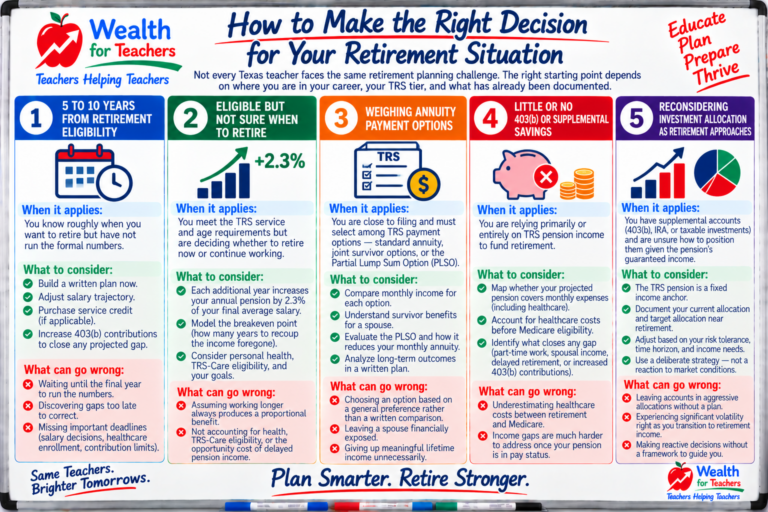
Not every Texas teacher faces the same retirement planning challenge. The right starting point depends on where a teacher is in their career, their TRS tier, and what has already been documented. Below are five common situations and what a written plan should address in each.
When it applies: The teacher knows roughly when they want to retire but has not run the formal numbers.
What to consider: This is the ideal window to build a written plan. There is still time to adjust salary trajectory, purchase service credit if applicable, or increase 403(b) contributions to close any projected income gap.
What can go wrong: Teachers who wait until the final year discover gaps too late to correct them. Salary decisions, healthcare enrollment windows, and contribution limits all have deadlines. Starting the written plan early creates time to act on what the numbers reveal.
When it applies: The teacher meets the TRS service and age requirements but is weighing whether to retire now or continue working.
What to consider: Each additional year of work increases the annual pension by 2.3% of final average salary. A written plan should model the breakeven point — how many years it takes for the higher annuity to recoup the income foregone by working longer.
What can go wrong: Some teachers assume that working longer always produces a proportional benefit. It does in terms of the formula, but it does not account for personal health, TRS-Care eligibility requirements, or the opportunity cost of delayed pension income. A written plan makes the tradeoff visible rather than assumed.
When it applies: The teacher is close to filing and must select among TRS payment options — including standard annuity, joint survivor options, or the Partial Lump Sum Option (PLSO) where eligible.
What to consider: Each option has a different income level and a different risk profile. The standard annuity maximizes monthly income but provides nothing to a surviving spouse after the retiree’s death. Joint and survivor options reduce monthly income but extend payments. The lump sum versus lifetime income decision deserves careful written analysis because it cannot be undone after election.
What can go wrong: A teacher who selects an option based on a general preference rather than a written comparison of outcomes may leave a spouse financially exposed or give up meaningful lifetime income unnecessarily.
When it applies: The teacher is relying primarily or entirely on TRS pension income to fund retirement.
What to consider: A written plan should map whether the projected pension covers estimated monthly expenses, including healthcare premiums before Medicare eligibility. If there is a gap, the plan should identify what closes it — part-time work, spousal income, delayed retirement, or accelerated 403(b) contributions in the remaining working years.
What can go wrong: Without a written plan, teachers often underestimate healthcare costs in the years between TRS retirement and Medicare eligibility. Income gaps that are not identified before retirement begins are far more difficult to address once the pension is in pay status.
When it applies: The teacher has supplemental accounts — 403(b), IRA, or taxable investments — and is uncertain how to position them given the pension’s guaranteed income.
What to consider: The TRS pension functions as a fixed income anchor, which changes how supplemental savings should be allocated. A written plan should document the current allocation, the target allocation near retirement, and the rationale for each. Shifting investments as retirement approaches requires a deliberate strategy, not a reaction to market conditions.
What can go wrong: Teachers who leave supplemental accounts in aggressive allocations without a documented strategy may experience significant volatility at the exact moment they are transitioning into retirement income — and may make reactive decisions without a framework to guide them.
The absence of a written plan does not mean nothing is planned. It means planning is fragmented — spread across informal conversations, HR printouts, TRS estimates, and mental notes that have never been reconciled against each other.
Common problems that emerge without a written plan include:
Each of these problems is avoidable. None of them require a complex financial background to address. They require a written document that forces the assumptions into the open before they become irreversible choices.
Before finalizing any retirement decision, use these five questions to identify gaps in your current planning:
Rather than relying on informal estimates and a general sense of readiness, Texas teachers benefit from treating their written retirement plan as a living document — something that is built, reviewed, and updated as retirement approaches.
A practical written plan does not need to be elaborate. It needs to be specific. Here is what a useful plan structure looks like:
Teachers who want professional support in building this document should consider working with someone who understands TRS-specific rules. Working with a retirement specialist who focuses on teachers can provide structure and catch planning errors that a general financial advisor might miss.
It is also worth reviewing how asset allocation changes for teachers in retirement to ensure supplemental accounts are positioned in a way that supports, rather than complicates, pension income.
One of the most significant risks in teacher retirement planning is not making a wrong decision — it is not knowing that a decision needs to be made at all. Many Texas teachers do not discover gaps in their retirement income projection, their healthcare coverage timeline, or their annuity election strategy until those decisions have already been submitted and confirmed with TRS.
TRS retirement elections are not trial runs. Once an effective retirement date is established and a payment option is elected, the teacher is working within those terms for the duration of retirement. There is no opportunity to re-run the numbers after the fact, no ability to switch from a standard annuity to a joint survivor annuity once income has begun, and no way to recover years of service credit that were within reach but not captured before the retirement date.
This is why written planning before retirement is not about perfectionism — it is about giving each assumption the opportunity to be tested while there is still time to act on what the test reveals. A plan that has been documented, reviewed, and pressure-checked against real numbers is fundamentally different from one that has never been written down. The act of writing it forces clarity. And for Texas teachers, clarity before a final TRS decision is not optional — it is the plan itself.
Use the TRS calculator to estimate your pension and identify potential income gaps.