
The Emotional Side of Retirement for Teachers
Retirement isn’t just financial—it’s emotional too. Here’s what to expect.

Teacher retirement works differently than traditional plans. Here’s what to know.

Most Texas teachers spend decades building toward a retirement that looks very different from what their neighbors, siblings, or private-sector friends will have. The teacher pension vs 401(k) comparison is not simply a question of preference—it is a structural difference in how retirement income is created, when it becomes available, and what happens if you leave before you reach the finish line.
Texas teachers can also run a full pension estimate using the Texas Teacher Retirement Calculator to better understand their retirement outlook.
Understanding that difference is not optional. It is the foundation of every other retirement decision you will face as a Texas educator.
If you are early in your career, this comparison shapes how aggressively you need to save outside of TRS. If you are mid-career and considering leaving public education, it determines whether your pension years count for something significant or nearly nothing. And if you are approaching retirement, it affects when you should retire, how much monthly income you will receive, and whether your income will hold up without a market-driven portfolio to supplement it.
For a broader foundation before diving into the comparison, start with the Texas Teacher Retirement Planning Guide.
Most retirement plans—whether pension-based or market-based—fail not because the math was wrong, but because the plan was never stress-tested under real-world conditions. Life changes. Health changes. Timelines shift. A pension estimate that looked comfortable at age 50 may look very different when you factor in a spouse’s income, healthcare costs before Medicare eligibility, or the income gap between your last workday and your first pension payment.
The Teacher Retirement System of Texas is a defined benefit plan. That means your retirement income is determined by a formula established in Texas law—not by how much you contributed or how your investment account performed during your working years.
Use the TRS calculator to estimate your pension and identify potential income gaps.
The TRS formula is straightforward:
The 2.3% multiplier applies to every year of credited service across membership tiers.
Here is a concrete example. A teacher with 28 years of service and a five-year average salary of $62,000 would calculate their annual pension like this:
That income is guaranteed for life. It does not shrink because the stock market drops. It does not require you to manage withdrawals or worry about outliving a portfolio. Once you begin receiving it, it is there every month.
What it is not, however, is flexible. You cannot take a lump sum from your TRS pension in most circumstances, you cannot accelerate payments in years when you need more income, and you cannot pass the full value of your pension to your heirs the way you could with a retirement account. Those tradeoffs matter enormously depending on your situation.
Eligibility for full, unreduced TRS retirement is tied to your membership tier, your age, and your years of service. Different eligibility rules apply depending on when you first became a TRS member and whether your membership has been continuous. Leaving Texas public education before you qualify for retirement—even after many years of service—can significantly reduce what you ultimately receive.
A traditional 401(k) is a defined contribution plan. The retirement income it generates depends entirely on how much was contributed, how those contributions were invested, how markets performed, and how carefully withdrawals are managed during retirement.
In a 401(k), the employee bears all of the investment risk. A strong decade in the market can leave you with a healthy balance. A poorly timed downturn—particularly one that happens in the years just before or just after you retire—can permanently damage your income.
Teachers in Texas do not have access to a traditional 401(k) through their employer. Texas public school employees contribute to TRS, not to a 401(k). However, many districts offer a 403(b) plan, which functions similarly to a 401(k) and allows teachers to save additional money on a tax-deferred basis alongside their TRS pension.
The 403(b) can be a valuable supplement—but it operates on a completely different logic than the TRS pension. It does not guarantee income. It does not guarantee a monthly payment for life. And if you make poor investment choices, retire too early, or withdraw too aggressively, you can deplete it.
Understanding that TRS and a 403(b) serve different purposes—and that neither one fully replaces the other—is critical to building a retirement plan that actually holds together.
For a deeper look at one of the most consequential choices at retirement, see Should Teachers Take Lump Sum or Lifetime Income?
Many Texas public school teachers do not pay into Social Security through their district employment, which means they do not earn Social Security credits from that work. Whether Social Security becomes part of your retirement income depends on whether you have enough credits from other covered employment—such as a summer job, a second career, or work before or after your teaching years.
For years, teachers who did receive a TRS pension and also qualified for Social Security benefits were subject to federal provisions that reduced those Social Security payments. That changed with the Social Security Fairness Act, signed into law on January 5, 2025. The Act repealed the Windfall Elimination Provision (WEP) and Government Pension Offset (GPO) for benefits payable beginning January 2024. Teachers who were already receiving reduced Social Security benefits as a result of WEP or GPO became eligible for higher monthly payments and retroactive amounts going back to January 2024.
This is a meaningful change for teachers who also qualify for Social Security. If you or your spouse were affected by WEP or GPO, your benefit picture may look different than the calculations you previously ran. Do not rely on old estimates without revisiting them.
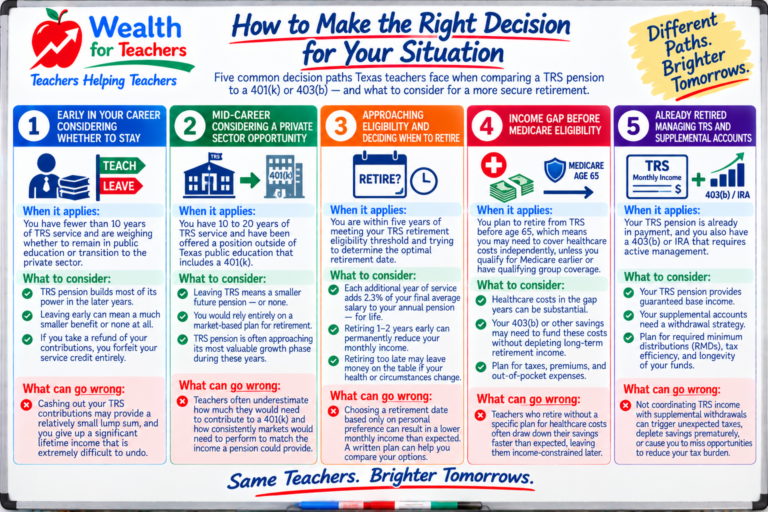
There is no single right answer when comparing pension income to market-based retirement strategies. The right answer depends on where you are in your career, how long you plan to stay in Texas public education, and what your income needs will look like in retirement. Here are five distinct decision paths Texas teachers face.
When it applies: You have fewer than 10 years of TRS service and are weighing whether to remain in public education or transition to the private sector.
What to consider: The TRS pension builds most of its power in the later years of a career. Leaving early—before you meet eligibility requirements—can mean receiving a much smaller benefit or none at all. If you leave and take a refund of your contributions, you forfeit your service credit entirely.
What can go wrong: Teachers who leave early and cash out their TRS contributions often discover years later that they gave up a significant lifetime income in exchange for a relatively small lump sum. That decision is extremely difficult to undo.
When it applies: You have 10 to 20 years of TRS service and have been offered a position outside of Texas public education that includes a 401(k).
What to consider: At this stage, leaving TRS means locking in a smaller future pension—or none—and relying entirely on a market-based plan for retirement. The TRS pension is often approaching its most valuable growth phase during these years.
What can go wrong: Teachers who shift to a 401(k)-based system mid-career frequently underestimate how much they would need to contribute and how consistently markets would need to perform to replicate the income the pension would have provided. The comparison looks closer than it is.
When it applies: You are within five years of meeting your TRS retirement eligibility threshold and trying to determine the optimal retirement date.
What to consider: Each additional year of service adds 2.3% of your final average salary to your annual pension—for life. Retiring one or two years earlier than optimal can reduce your monthly income by hundreds of dollars every month, permanently. Retiring too late means leaving money on the table if your health or personal circumstances change.
What can go wrong: Many teachers retire at what feels like a natural stopping point—end of school year, a round number birthday—without calculating whether that date is actually the optimal one for their income. A written retirement plan that stress-tests your specific date can reveal meaningful differences. See Should Teachers Create a Written Retirement Plan? for guidance on how to structure that analysis.
When it applies: You plan to retire from TRS before age 65, which means you may need to bridge healthcare costs independently before Medicare becomes available, unless you qualify for Medicare earlier or have access to qualifying group health coverage.
What to consider: Healthcare costs in the gap years between TRS retirement and Medicare eligibility can be substantial. Your 403(b) or other savings may need to absorb those costs without depleting your long-term income.
What can go wrong: Teachers who retire without a specific plan for healthcare costs in early retirement often draw down their supplemental savings far faster than expected, leaving them income-constrained later. See How to Adjust Spending in Early Retirement Years for strategies that address this directly.
When it applies: Your TRS pension is already in payment, and you also have a 403(b) or IRA that requires active management.
What to consider: The TRS pension handles your guaranteed base income. Your supplemental accounts need a withdrawal strategy that accounts for required minimum distribution rules, tax efficiency, and the longevity of those funds.
What can go wrong: Retirees who do not coordinate TRS income with their supplemental account withdrawals can trigger unexpected tax consequences, deplete savings prematurely, or miss opportunities to reduce their tax burden. For more on this issue, see How Required Minimum Distributions Affect Retirement Strategy.
Rather than treating the teacher pension vs 401(k) debate as an either/or question, Texas teachers are generally better served by understanding how TRS and supplemental savings work together—and where each one has limits.
Here is a practical framework:
Before making any major decisions about your TRS pension or supplemental savings, answer these five questions honestly:
One of the most consistent patterns in teacher retirement planning is that gaps in the plan remain invisible until a decision has already been made that closes off the options for fixing them. A teacher who retires without modeling the income impact of their payment option election discovers the tradeoff only after it is locked in. A teacher who cashes out TRS contributions after leaving a district does not feel the consequence until decades later, when the pension those contributions represented is gone. A teacher who never builds supplemental savings because the pension feels sufficient may reach retirement and find that the pension alone does not stretch as far as expected once healthcare, inflation, and lifestyle costs are factored in.
The structure of a defined benefit plan like TRS is designed for the long haul—but that same structure means that the decisions surrounding it are largely one-directional. Election choices, refund decisions, and retirement dates all carry consequences that are difficult or impossible to reverse. Testing your assumptions against your actual numbers—before the decisions are final—is the only reliable way to avoid discovering a gap when it is too late to act on it.
Working with someone who understands both TRS and the supplemental savings landscape can help you identify whether what looks like a solid plan actually holds up when the real variables are applied. See Should Teachers Hire a Retirement Specialist? for a practical breakdown of when professional guidance is worth pursuing.
Yes. Many Texas teachers contribute to a district-offered 403(b) alongside their mandatory TRS participation. These are separate accounts with separate rules. TRS provides the defined benefit pension; the 403(b) provides a supplemental market-based account. They complement each other but operate independently.
If you leave Texas public education before meeting retirement eligibility, you can leave your contributions in TRS and potentially collect a reduced benefit later, or you can take a refund of your contributions. Taking a refund permanently forfeits your service credit. That is an irreversible decision with long-term income consequences that is worth careful thought before acting.
Your TRS pension itself is not reduced by Social Security. However, many Texas teachers do not pay into Social Security through their district employment, so they do not automatically earn Social Security credits from that work. If you do qualify for Social Security through other covered employment, the provisions that previously reduced those benefits—WEP and GPO—were repealed for benefits payable beginning January 2024 under the Social Security Fairness Act.
For TRS purposes, yes. The pension formula rewards long, continuous service in Texas public education. Teachers who move out of state, transition to private sector work, or otherwise break their TRS service often find that the pension they would have received does not transfer. Portability is one of the major structural weaknesses of a defined benefit pension compared to a market-based account.
Not necessarily. Early eligibility and optimal retirement timing are different things. Retiring as early as the rules allow may trigger early-age reductions depending on your tier and circumstances, and it permanently fixes your final average salary at a lower point than if you worked additional years. Every individual situation is different, and the right retirement date is the one that has been modeled—not the one that simply arrives first.
The teacher pension vs 401(k) comparison ultimately comes down to this: TRS offers something a market-based account cannot—guaranteed, lifelong income that does not depend on investment returns or withdrawal discipline. But that security comes with structure, timing constraints, and decisions that are difficult to undo. The teachers who navigate this best are the ones who understand both systems clearly, plan proactively around the gaps, and make their major decisions based on actual numbers rather than general assumptions about how it all works out. The transition itself carries its own emotional and logistical dimensions worth preparing for—see The Emotional Side of Retirement for Teachers for a candid look at what that transition often involves.
Use the TRS calculator to estimate your pension and identify potential income gaps.