
What Happens If Inflation Stays High in Retirement?
Inflation can dramatically impact your income over time.

Confidence in retirement comes from a clear plan. Learn how to build one.
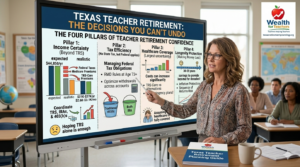
When you retire from teaching in Texas, you get one chance to make decisions that will determine your financial security for the next 20 to 30 years. There are no do-overs for timing mistakes, tax oversights, or income planning errors.
Texas teachers can also run a full pension estimate using the Texas Teacher Retirement Calculator to better understand their retirement outlook.
Teacher retirement confidence doesn’t come from hoping everything works out. It comes from having a tested, complete system that addresses every aspect of your post-teaching life before you need it.
This means understanding exactly how your TRS pension, supplemental savings, healthcare costs, and tax obligations work together. It means knowing what your actual monthly income will be, not just your pension estimate. Most importantly, it means identifying potential problems while you still have time to fix them.
The difference between teachers who retire with confidence and those who struggle isn’t luck. It’s preparation. Our comprehensive Texas Teacher Retirement Planning Guide shows you exactly how to build this foundation, but this article focuses on the critical decisions you must get right.
Most retirement plans fail because they are never stress-tested against real-world conditions like market downturns, unexpected healthcare costs, or changes in tax law. The teachers who succeed build systems that work even when assumptions prove wrong.
Retiring with confidence requires more than knowing your TRS pension amount. You need a complete system built on four pillars:
Use the TRS calculator to estimate your pension and identify potential income gaps.
Each pillar depends on the others. A strong TRS pension means nothing if healthcare costs consume it, or if poor tax planning reduces your take-home income. Teachers who focus on only one or two pillars often discover critical gaps too late to fix them.
The biggest mistake Texas teachers make is treating their TRS pension as their complete retirement plan. While TRS provides a solid foundation, it rarely covers all retirement expenses, especially when you factor in healthcare costs, inflation, and longevity.
A teacher with 30 years of service and a $65,000 final average salary receives approximately $44,850 annually from TRS ($65,000 × 30 × 0.023). This sounds substantial, but after taxes and Medicare premiums, the take-home amount may be significantly less than expected.
Your TRS pension provides the foundation, but most teachers need additional income sources to maintain their standard of living. The key is understanding how these sources work together and when to access each one.
Your gross TRS pension uses the simple formula: Years of Service × 0.023 × Final Average Salary. But your spendable income after taxes, Medicare premiums, and TRS-Care contributions will be lower.
For example, a teacher receiving $44,850 annually from TRS might pay:
This reduces the spendable pension to approximately $31,000-$37,000 annually, or $2,600-$3,100 monthly.
Most teachers need to create retirement income without selling assets by building additional income streams:
The critical decision is how to coordinate TRS, IRAs, and 403(b)s without costly mistakes that increase your tax burden or create unexpected penalties.
Tax planning in retirement isn’t just about minimizing current taxes. It’s about managing your lifetime tax burden while preserving access to your money when you need it.
Texas teachers enjoy significant tax advantages in retirement:
These advantages become more valuable as your retirement income increases, but federal taxes still apply to most retirement income sources.
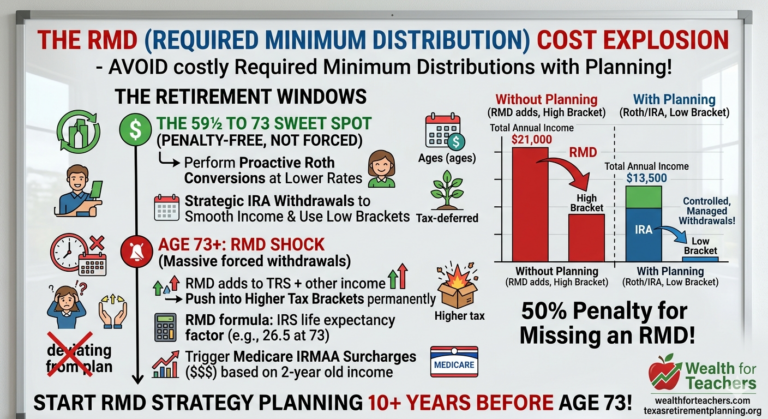
Your federal tax strategy should account for required minimum distributions from traditional retirement accounts starting at age 73. Teachers who accumulate large 403(b) balances may face higher tax rates in retirement than during their teaching careers.
Understanding RMD rules for teachers helps you plan withdrawal strategies that minimize lifetime taxes while ensuring adequate income throughout retirement.
Healthcare represents the largest financial uncertainty in teacher retirement. TRS-Care provides coverage, but costs can increase significantly, and coverage options may change over time.
TRS-Care premiums vary based on your years of service and coverage level. Teachers with fewer than 20 years of service pay higher premiums, while those with 20+ years receive more favorable rates.
However, TRS-Care is not guaranteed to remain unchanged. Premium increases, benefit reductions, or eligibility changes could affect your healthcare costs throughout retirement.
Some teachers explore alternatives to TRS-Care, including:
The key is understanding your options before you need them and having contingency plans if TRS-Care becomes less attractive or affordable.
Teachers often underestimate how long their retirement savings need to last. A teacher retiring at 58 might live another 30-35 years, requiring their savings to provide income for decades.
While TRS pensions receive periodic cost-of-living adjustments, these don’t always keep pace with actual inflation. Your supplemental savings must grow enough to maintain purchasing power over multiple decades.
Market downturns early in retirement can permanently damage your financial security, even if markets recover later. Teachers need strategies that protect against this risk without being overly conservative.
You can retire with full TRS benefits at age 55 with 35 years of service, or at age 65 with 5 years of service. However, retiring at 55 means potentially 10+ years without TRS-Care or Medicare, requiring private health insurance.
This depends on your overall income needs, health status, and longevity expectations. Taking Social Security early reduces benefits permanently, but waiting increases the risk of the Government Pension Offset reducing spousal benefits.
This depends on your TRS pension amount and lifestyle expectations. A common guideline is having 8-12 times your final salary across all retirement accounts, but Texas teachers with strong TRS pensions may need less supplemental savings than private sector workers.
Your TRS pension follows you anywhere, and you avoid state income taxes in states like Florida, Tennessee, or Nevada. However, some states tax out-of-state pensions, so research tax implications before relocating.
You can work for private employers without affecting TRS benefits. However, returning to TRS-covered employment has restrictions and may affect your pension timing and amount.
Rather than hoping your retirement works out, build
Use the TRS calculator to estimate your pension and identify potential income gaps.