

The Healthcare Cost Most Texas Teachers Never See Coming Until It’s Too Late
Healthcare costs for retired teachers are one of the most underestimated threats to a financially secure retirement. A Texas teacher who carefully calculates their TRS pension, builds up savings, and retires on schedule can still find themselves in serious financial trouble — not because their pension math was wrong, but because their healthcare expenses ran far higher than expected.
Texas teachers can also run a full pension estimate using the Texas Teacher Retirement Calculator to better understand their retirement outlook.
This is not a minor budget gap. For many retired Texas teachers, healthcare premiums, out-of-pocket costs, and long-term care expenses can consume $500 to over $1,000 per month in retirement. That is money that has to come from somewhere — and if it was never planned for, it comes out of income that was earmarked for everything else.
Understanding how TRS Care works, what it actually costs, and how to plan around its real limitations is not optional. It is one of the most important financial decisions a Texas teacher will make before they retire.
If you are building your full retirement picture, start with the Texas Teacher Retirement Planning Guide before diving deeper into healthcare specifics.
Most retirement plans are built on assumptions that have never been tested against real-world conditions. A teacher might assume TRS Care will cover the bulk of their medical expenses, only to discover that the premiums are higher than expected, the coverage is thinner than projected, and Medicare eligibility is still years away. Plans that look solid on paper can unravel quickly when they meet actual healthcare costs.
Run Your Free Texas Teacher Retirement Analysis
Use the TRS calculator to estimate your pension and identify potential income gaps.
What TRS Care Actually Is — and What It Is Not
TRS Care is the health insurance program offered by the Teacher Retirement System of Texas to eligible retired members. It is not free, it is not unlimited, and it is not Medicare. Understanding those three facts upfront will save you from some of the most costly misunderstandings in Texas teacher retirement planning.
To be eligible for TRS Care, you generally need to meet one of the following criteria:
- At least 10 years of service credit with TRS
- Retirement under the rule of 80 or age 65 with 5 years of service
- Meet the specific eligibility requirements tied to your hire date and retirement tier
TRS Care is structured as a group health plan, but the state subsidy that supports it has shrunk over time, and premiums have risen steadily. Teachers who retired 15 years ago under different premium structures are in a very different financial position than those retiring today.
Once a retiree reaches age 65 and qualifies for Medicare, they transition to TRS Care Medicare Advantage plans. Before 65, they are covered under non-Medicare TRS Care plans, which carry significantly higher premiums.
The Real Out-of-Pocket Costs of TRS Care
The cost of TRS Care depends on several variables: your years of service, whether you are covering dependents, and whether you are pre-Medicare or Medicare-eligible. What most teachers do not realize until they are close to retirement is how large the monthly premium burden can be, especially in the pre-Medicare window.
A retired teacher under age 65 with 20 years of service who also covers a spouse can face combined monthly premiums that approach or exceed $800 to $1,000 per month depending on the plan tier selected. That figure does not include deductibles, copays, or prescription costs.
Once Medicare kicks in at 65, TRS Care costs drop substantially. But the gap between retirement and Medicare eligibility — which could be five years or more for a teacher who retires at 60 — represents one of the most financially exposed periods in a Texas teacher’s retirement.
Additional out-of-pocket exposure includes:
- Annual deductibles ranging from $500 to $2,000 depending on plan tier
- Coinsurance requirements after deductibles are met
- Prescription drug costs that vary by medication tier
- Specialist visit copays that add up quickly for retirees with chronic conditions
How Retirement Timing Changes Your Healthcare Exposure
When a Texas teacher retires is not just a pension math decision — it is a healthcare cost decision. Retiring at 58 versus 62 versus 65 creates dramatically different healthcare cost scenarios.
Consider a teacher who retires at age 58 with 28 years of service. Their annual TRS pension would be calculated as: 28 × 0.023 × final average salary. If their final average salary is $62,000, the pension equals $39,836 per year — or about $3,320 per month before any deductions.
That pension looks solid until you subtract TRS Care premiums for a pre-Medicare retiree and spouse. At $900 per month in healthcare costs alone, more than 27% of that monthly pension income disappears before a single other bill is paid. That is not a small variable — it is a structural hole in the retirement plan.
Waiting until 65 to retire eliminates most of that gap, but it requires the teacher to work seven more years. Understanding exactly how much that gap costs — and whether it can be covered by savings or other income — is a calculation every teacher should run before choosing a retirement date.
For a fuller picture of how your pension stacks up against your actual income needs, see how much income your TRS pension will actually replace.
The Long-Term Healthcare Risk That Most Teachers Ignore
Even after Medicare begins at 65, healthcare costs do not stop growing. They often accelerate. The long-term healthcare risk that most retired teachers underplan for is not routine medical care — it is the cost of extended care: assisted living, memory care, home health aides, and skilled nursing facilities.
Long-term care costs in Texas can range from $50,000 to over $100,000 per year depending on the level of care required. Neither TRS Care nor Medicare covers most of these expenses. Medicaid can provide coverage, but only after a teacher has spent down most of their assets.
A teacher who retires at 62 and lives to 87 is looking at a 25-year retirement. Even with Medicare in place at 65, the last five to ten years of that retirement may involve elevated care costs that no pension was sized to absorb. This is not a remote risk — it is a statistical reality that affects a significant portion of retirees.
Long-term care planning — whether through dedicated insurance, a dedicated savings bucket, or structured income strategies — needs to be part of the conversation before retirement, not after a health crisis forces the issue.
How Healthcare Costs Affect Your TRS Pension’s Buying Power
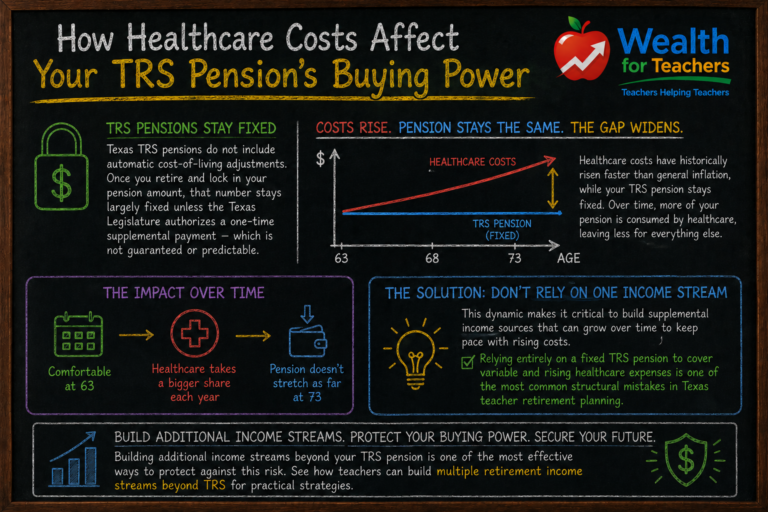
Texas TRS pensions do not include automatic cost-of-living adjustments. Once a teacher retires and locks in their pension amount, that number stays largely fixed unless the Texas Legislature authorizes a one-time supplemental payment, which is not guaranteed or predictable.
Healthcare costs, on the other hand, have historically risen faster than general inflation. That means the gap between what your pension pays and what healthcare costs every year widens over time. A retiree who is comfortable at 63 may find that same pension uncomfortably tight at 73 — not because their lifestyle changed, but because healthcare absorbed an increasing share of a fixed income.
This dynamic makes it critical to build supplemental income sources that can grow over time to keep pace with rising costs. Relying entirely on a fixed TRS pension to cover variable and rising healthcare expenses is one of the most common structural mistakes in Texas teacher retirement planning.
Building additional income streams beyond your TRS pension is one of the most effective ways to protect against this risk. See how teachers can build multiple retirement income streams beyond TRS for practical strategies.
How to Make the Right Decision for Your Situation
Healthcare cost planning is not one-size-fits-all. Where you are in your career, your health status, your dependents, and your savings all shape which decision path makes the most sense.
Path 1: You Plan to Retire Before Age 65
This is the highest-risk scenario from a healthcare cost standpoint. You need to calculate your exact TRS Care premiums for the pre-Medicare period and confirm you have enough income or savings to cover them without hollowing out your pension. What goes wrong: Teachers assume TRS Care will be affordable and do not run the actual numbers until after they retire.
Path 2: You Plan to Retire at 65 or Later
Aligning retirement with Medicare eligibility dramatically lowers your healthcare cost exposure. The tradeoff is additional working years. What to consider: Whether additional working years meaningfully increase your pension or whether you are working longer primarily for the healthcare benefit, which may or may not be worth it depending on your situation.
Path 3: You Have a Spouse or Dependents to Cover
Adding a spouse or dependent to TRS Care significantly increases your monthly premiums. If your spouse is younger and does not yet qualify for Medicare, you may carry elevated premiums longer than expected. What goes wrong: Failing to account for a spouse’s age gap when estimating the length of the pre-Medicare cost window.
Path 4: You Have an Existing Health Condition
If you are managing a chronic condition, your out-of-pocket costs under any insurance plan will be higher than average. This is the time to model worst-case healthcare spending, not average spending. What goes wrong: Using average out-of-pocket estimates when your actual utilization is likely to be above average.
Path 5: You Have Limited Supplemental Savings
If your retirement plan relies almost entirely on your TRS pension with little savings buffer, healthcare cost spikes have nowhere to go except into debt or lifestyle cuts. Building even a modest healthcare reserve before retirement creates critical flexibility. See how building a guaranteed income floor can protect against fixed-expense pressure.
What to Do Instead
The teachers who handle healthcare costs best in retirement are the ones who planned for them explicitly — not as a vague line item, but as a real number tied to their actual TRS Care plan options and Medicare timeline.
- Get your actual TRS Care premium estimates from the TRS website or your HR department at least three years before your target retirement date.
- Model two scenarios: one where you retire before 65, and one where you retire at 65. Compare the pension difference against the healthcare savings.
- Build a dedicated healthcare reserve in your 403(b) or other savings vehicle that is earmarked specifically for pre-Medicare premium costs.
- Plan for long-term care separately. Do not assume Medicare or TRS Care will cover extended care needs. They will not.
- Treat healthcare as a fixed expense in your retirement budget, not a wildcard. Estimate high, and build income that can grow to keep pace.
If your retirement income strategy needs strengthening beyond your TRS pension, explore how guaranteed income strategies can support a more durable retirement.
Quick Self-Check Before You Move Forward
Use these questions to identify gaps in your current healthcare cost planning before you make any final retirement decisions:
- Do you know your exact TRS Care monthly premium for the plan tier you intend to use, including any dependent coverage?
- Have you calculated how many months or years you will be in the pre-Medicare window if you retire before age 65?
- Does your projected TRS pension cover your estimated healthcare premiums and still leave enough for your other living expenses?
- Have you set aside any funds specifically for long-term care costs, separate from your general retirement savings?
- Have you stress-tested your retirement budget assuming healthcare costs rise by 5% per year after you retire?
Most Teachers Don’t Find the Gaps Until It’s Too Late
The most dangerous moment in Texas teacher retirement planning is not when you make a bad decision — it is when you make a decision based on an assumption you never verified. Healthcare costs are the most common source of those unverified assumptions.
Teachers who retire and then discover that TRS Care costs far more than they expected, or that a health event in year three of retirement depletes the savings they thought would last twenty years, do not have easy options. Once you leave active employment with a Texas school district, your access to employer-subsidized coverage ends. The decisions you make before you retire determine the financial boundaries you live within afterward.
Testing your retirement assumptions now — especially around healthcare — is not pessimism. It is the only way to retire with real confidence rather than hope.
If you have not reviewed how your overall retirement income holds up against real expenses, understanding your TRS income replacement rate is a critical starting point.
Common Questions Texas Teachers Ask
Is TRS Care free for retired Texas teachers?
No. TRS Care is subsidized, but not free. Retired teachers pay monthly premiums that vary based on years of service, plan tier, and whether dependents are covered. Premiums are significantly higher for teachers who retire before Medicare eligibility at age 65.
What happens to my TRS Care when I turn 65?
At age 65, if you are eligible for Medicare, you transition from standard TRS Care plans to TRS Care Medicare Advantage plans. These plans generally carry lower premiums than pre-Medicare coverage, but you must enroll in Medicare Part A and Part B to participate.
Does TRS Care cover long-term care?
No. TRS Care does not cover assisted living, nursing home care, or most home health aide services beyond limited skilled nursing care. Long-term care costs must be planned for separately through dedicated insurance, savings, or income strategies.
Can I stay on my school district’s health plan after I retire?
Some Texas school districts allow retiring employees to remain on the active employee plan temporarily under COBRA-like provisions, but this is typically very expensive and time-limited. TRS Care is the primary long-term option for most retired Texas teachers.
What if I retire early and my spouse is still working?
If your spouse has employer-sponsored health coverage, you may be able to defer TRS Care enrollment and remain on your spouse’s plan. This can be a significant cost-saving option during the pre-Medicare window, but eligibility rules and enrollment deadlines for TRS Care need to be reviewed carefully to avoid losing coverage options.
See How Healthcare Costs Fit Into Your Full Retirement Picture
Healthcare is one variable. Your TRS pension amount, retirement date, Social Security eligibility, and supplemental savings are the others. Understanding how they interact is what separates a retirement plan that holds up from one that doesn’t.