
The Hidden Risk of Carrying Debt Into Texas Teacher Retirement
Most Texas teachers spend decades focused on reaching their TRS retirement milestone — the years of service, the age threshold, the final average salary. What many don’t plan for is how debt carried into retirement quietly erodes the income they worked so hard to build.
Texas teachers can also run a full pension estimate using the Texas Teacher Retirement Calculator to better understand their retirement outlook.
Teacher debt before retirement isn’t just a personal finance problem. For Texas teachers, it directly affects whether your TRS pension can cover your essential expenses — or whether you’ll be forced to draw down savings, delay retirement, or make cuts you didn’t expect.
This guide breaks down how to think about debt in the context of your TRS pension, when paying off debt is the right move, when it isn’t, and how to make this decision without gambling your retirement security on the wrong assumption.
For a broader foundation, start with the Texas Teacher Retirement Planning Guide before working through the debt-specific decisions below.
Most retirement plans look fine on paper. The real test is whether they hold up when monthly debt payments, inflation, healthcare costs, and unexpected expenses hit simultaneously. Most plans are never stress-tested against those conditions — and that’s exactly when the gaps show up.
Why Debt Matters More for Texas Teachers Than Most Retirees
Texas teachers don’t participate in Social Security. That means your TRS pension isn’t supplementing another income stream — for most teachers, it is the income stream. That single-source structure makes fixed monthly debt payments far more dangerous than they would be for someone who also draws Social Security.
Run Your Free Texas Teacher Retirement Analysis
Use the TRS calculator to estimate your pension and identify potential income gaps.
When you’re still working, a car payment or credit card balance feels manageable because your paycheck absorbs it. In retirement, your income becomes fixed. Debt payments don’t disappear — they just take a larger percentage of a smaller, less flexible income.
This is why teacher debt before retirement deserves a specific, TRS-aware analysis rather than generic financial advice.
What Your TRS Pension Actually Pays — and What’s Left Over
Texas TRS calculates your pension using a flat 2.3% multiplier per year of service, applied to your final average salary:
Annual Pension = Years of Service × 0.023 × Final Average Salary
Here’s a concrete example. A teacher with 28 years of service and a final average salary of $62,000 would receive:
28 × 0.023 × $62,000 = $39,928 per year, or roughly $3,327 per month.
Now layer in a $450 car payment, $300 in credit card minimums, and a $900 mortgage. That’s $1,650 in fixed monthly debt obligations — nearly half of the monthly pension before groceries, utilities, insurance, or healthcare.
Understanding exactly what percentage of your pension debt consumes is one of the most important calculations a Texas teacher can run before retirement. To see how your pension stacks up against your expected expenses, review how much income your TRS pension will actually replace.
Pay Off Debt vs. Invest: The Real Tradeoff
The classic debate — should I pay off debt or invest that money instead — is usually framed as a math problem. If your debt carries a 6% interest rate and your investments return 8%, the math says invest. But that framing misses something critical for teachers: cash flow certainty.
Investments fluctuate. Debt payments don’t. A teacher who retires with a strong investment balance but $2,000 in monthly debt obligations can still face serious cash flow stress if the market drops in the first two years of retirement — a well-documented phenomenon sometimes called sequence-of-returns risk.
The better question isn’t “which has the higher return?” It’s: “Can my fixed pension income comfortably absorb my fixed debt payments every month, without touching savings?”
If the answer is no — or even “maybe” — that’s a signal that debt reduction deserves priority over additional investment contributions.
Which Types of Debt Should Teachers Prioritize?
Not all debt carries equal weight in retirement planning. Texas teachers should categorize their debt before deciding on a strategy:
High-Priority Debt to Eliminate Before Retirement
- High-interest credit cards: Carrying 18–25% interest into retirement is mathematically destructive. These should be paid off before any other financial move.
- Personal loans with fixed payments: Fixed monthly obligations reduce pension flexibility and should be retired before you leave the classroom.
- Car loans near maturity: If you’re within two or three years of paying off a vehicle, accelerating that payoff before retirement removes a significant monthly burden.
Moderate-Priority Debt to Evaluate Carefully
- Mortgage debt: A low fixed-rate mortgage may be manageable within your pension income. But a large remaining balance can create long-term cash flow pressure, especially if property taxes and insurance rise over time.
- Student loans: Teachers may have remaining loan balances, especially those who pursued graduate degrees. Public Service Loan Forgiveness eligibility should be confirmed before making aggressive payoff decisions.
Lower-Priority Debt to Manage Rather Than Rush
- Low-interest fixed debt below 3–4%: In some cases, maintaining this debt and keeping additional cash invested or accessible may make sense — but only if your pension comfortably covers the payment without stress.
How to Make the Right Decision for Your Situation
There is no single right answer. The correct decision depends on your specific pension income, debt load, savings balance, and proximity to retirement. Here are five decision paths Texas teachers commonly face:
Path 1: You Have High-Interest Debt and Are 5+ Years from Retirement
When it applies: You have credit cards or personal loans above 10% interest and substantial time before your retirement date.
What to do: Prioritize eliminating high-interest debt aggressively before increasing retirement contributions. The guaranteed “return” of eliminating 18% interest typically outperforms speculative investment gains.
What can go wrong: Continuing minimum payments while investing the difference sounds smart — but if you carry that debt into retirement, the compounding interest accelerates while your income becomes fixed.
Path 2: You Are Within 3 Years of Retirement with Manageable Debt
When it applies: Your total monthly debt obligations are under 25% of your expected pension, and interest rates are low.
What to do: Run a detailed monthly cash flow projection using your actual pension number. If the math works comfortably — meaning you have clear margin — maintaining low-rate debt while preserving cash reserves may be appropriate.
What can go wrong: Underestimating healthcare costs or property tax increases can close that margin faster than expected. A plan that “works on paper” often fails under real conditions.
Path 3: You Have a Large Mortgage Balance and a Modest Pension
When it applies: Your pension will replace less than 70% of your pre-retirement income, and a significant mortgage payment is part of your monthly obligations.
What to do: Seriously evaluate downsizing before retirement, accelerating mortgage payoff, or extending your working years to build a larger pension. Carrying a large mortgage on a modest TRS pension creates persistent financial fragility.
What can go wrong: Teachers in this situation often assume they’ll “figure it out” in retirement. Without a concrete plan, they become part of the group that runs out of money in retirement within the first decade.
Path 4: You Have Strong Savings but Significant Debt
When it applies: You have a healthy 403(b) or IRA balance but also carry substantial debt going into retirement.
What to do: Resist the temptation to use savings to pay off debt in one move at retirement. This can trigger a large taxable event. Instead, model a structured payoff strategy in the years before retirement.
What can go wrong: Liquidating retirement accounts to pay debt can push you into a higher tax bracket and reduce the compounding growth those accounts could have provided. Understand how required minimum distributions interact with your overall tax picture before making large withdrawal decisions.
Path 5: You Have Minimal Debt but Limited Savings Beyond TRS
When it applies: Your debt load is small, but your entire retirement plan rests on TRS alone with little supplemental savings.
What to do: Shift focus toward building supplemental income sources rather than debt elimination. A TRS pension alone may not be enough, particularly if you retire before Medicare eligibility or face significant healthcare costs.
What can go wrong: Teachers who are “debt-free but savings-light” often feel financially secure — until an unexpected expense forces them to borrow again. Building multiple retirement income streams beyond TRS is essential for long-term stability.
What to Do Instead of Choosing Blindly
Rather than defaulting to “pay everything off” or “always invest,” Texas teachers should build a decision based on three specific numbers:
- Your projected monthly TRS pension (using the 2.3% formula with your actual service years and salary)
- Your total fixed monthly debt obligations at your planned retirement date
- Your monthly essential expenses beyond debt payments
If your pension covers both categories with clear margin, you have flexibility. If it doesn’t, debt reduction — not investment accumulation — becomes the immediate priority. Knowing where you stand is the starting point for everything else. You may also want to explore how building a guaranteed income floor can protect against the risk of outliving your resources.
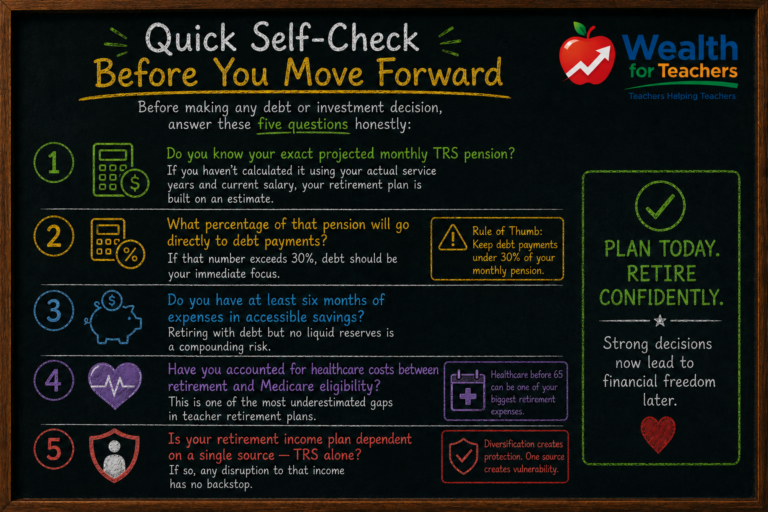
Quick Self-Check Before You Move Forward
Before making any debt or investment decision, answer these five questions honestly:
- 1. Do you know your exact projected monthly TRS pension? If you haven’t calculated it using your actual service years and current salary, your retirement plan is built on an estimate.
- 2. What percentage of that pension will go directly to debt payments? If that number exceeds 30%, debt should be your immediate focus.
- 3. Do you have at least six months of expenses in accessible savings? Retiring with debt but no liquid reserves is a compounding risk.
- 4. Have you accounted for healthcare costs between retirement and Medicare eligibility? This is one of the most underestimated gaps in teacher retirement plans.
- 5. Is your retirement income plan dependent on a single source — TRS alone? If so, any disruption to that income has no backstop.
Most Teachers Don’t Find the Gaps Until It’s Too Late
The teachers who struggle most in retirement aren’t the ones who made obviously bad decisions. They’re the ones who made reasonable-sounding decisions without ever stress-testing them against real numbers.
A debt payoff plan that “should work” and a pension that “should be enough” are not the same as a plan that has been verified to hold up under actual retirement conditions. Healthcare costs rise. Property taxes increase. Emergencies happen. A plan that isn’t tested against those scenarios isn’t a plan — it’s an assumption.
The time to find the gaps in your retirement plan is before you retire, not after your first year on a fixed income when reversing course is far more difficult.
Get Your TRS Analysis
If you’re unsure how your debt load interacts with your projected TRS pension, a personalized analysis can show you exactly where you stand — before you make a decision you can’t undo.
Common Questions Texas Teachers Ask
Should I cash out my 403(b) to pay off debt before retiring?
In most cases, no. Withdrawing from a 403(b) before age 59½ triggers a 10% early withdrawal penalty plus ordinary income taxes. Even after 59½, a large lump-sum withdrawal can push you into a higher tax bracket. A structured payoff strategy in the years before retirement is almost always more efficient.
Does carrying debt affect my TRS pension amount?
Your debt load doesn’t change your pension calculation, but it directly affects how much of your pension you actually get to use. A $3,500 monthly pension with $1,800 in debt obligations functions like a $1,700 pension in terms of real purchasing power.
Is it better to pay off my house or keep the mortgage in retirement?
It depends on your interest rate, remaining balance, and pension income. If your mortgage payment consumes more than 25–30% of your monthly pension, eliminating it before retirement significantly reduces financial stress. If the rate is very low and the payment is small relative to your pension, it may not be the priority.
What if I can’t pay off all my debt before retirement?
Focus on eliminating the highest-cost debt first, then evaluate whether your pension income can absorb remaining payments. If it can’t without strain, delaying retirement by one or two years may build enough additional pension income to offset it — since each additional year adds 2.3% of your final average salary to your annual benefit.
How does debt interact with other retirement income beyond TRS?
If you have supplemental savings or other income streams, debt is less immediately threatening — but it still reduces the margin you have for healthcare, emergencies, or market volatility. Understanding the full picture of your retirement income is essential before deciding how aggressively to pursue debt elimination.