
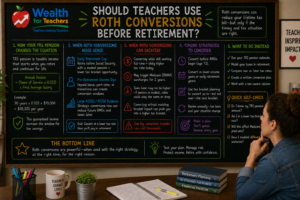
The Roth Conversion Decision That Could Cost Texas Teachers Thousands If They Get It Wrong
Roth conversions are one of the most discussed tax strategies in retirement planning—and one of the most misapplied for teachers. The idea sounds simple: move money from a pre-tax account to a Roth account now, pay tax today, and avoid tax later. But for Texas teachers with a TRS pension, the math and timing are more complicated than most generic financial advice acknowledges.
Texas teachers can also run a full pension estimate using the Texas Teacher Retirement Calculator to better understand their retirement outlook.
Whether a roth conversion for teachers makes sense depends on factors that are specific to how TRS income works, when you retire, and what other income sources you’ll have in retirement. Done right, it can meaningfully reduce your lifetime tax burden. Done wrong, it can push you into a higher bracket, trigger unexpected Medicare surcharges, and cost more than it saves.
This guide breaks down when Roth conversions work, when they don’t, and exactly how Texas teachers should evaluate the decision before acting.
For a broader view of how this fits into your overall financial picture, start with the Texas Teacher Retirement Planning Guide.
Most retirement plans fail not because teachers make bad decisions—but because they never test their assumptions against real numbers. A Roth conversion is one of those decisions that looks good on paper but can quietly undermine a retirement plan that was never stress-tested against actual income projections, tax brackets, and TRS timing.
How Your TRS Pension Changes the Roth Conversion Equation
Texas TRS calculates your pension using a straightforward formula:
Run Your Free Texas Teacher Retirement Analysis
Use the TRS calculator to estimate your pension and identify potential income gaps.
Annual Pension = (Years of Service × 0.023) × Final Average Salary
There are no tiers, no service bands, and no increasing multipliers. Every year of service generates the same 2.3% of your final average salary.
A teacher with 30 years of service and a $70,000 final average salary receives:
30 × 0.023 × $70,000 = $48,300 per year
That pension is taxable income. It starts the moment you retire and continues for life. This matters enormously for Roth conversions because it means your retirement tax bracket is not low by default—it’s anchored by a guaranteed income stream that doesn’t go away.
Unlike a private-sector worker who might retire with zero income before Social Security kicks in, many Texas teachers retire into $40,000 to $60,000 of taxable pension income from day one. That dramatically narrows the tax-rate arbitrage window that makes Roth conversions attractive.
This is a core reason why retirement income planning is fundamentally different for teachers than it is for most other workers.
When a Roth Conversion Actually Makes Sense for Teachers
Roth conversions work best when your current tax rate is lower than what you expect to pay in retirement. For Texas teachers, there are a few situations where this window genuinely exists.
The Early Retirement Gap
Some teachers retire in their late 50s or early 60s. If you retire before Social Security eligibility and your TRS pension is modest—say, 20 years of service at a lower salary—you may land in a relatively low bracket during those early retirement years.
Example: 20 years × 0.023 × $60,000 = $27,600 annual pension. Filing as a single taxpayer, this leaves meaningful room in the 12% federal bracket before hitting the 22% threshold. A targeted conversion in that window could be worthwhile.
Pre-Retirement Working Years With Temporary Income Dips
Teachers who take unpaid leave, reduce hours, or transition between districts sometimes have lower-income years. These windows can create conversion opportunities—but they require planning in advance, not reaction after the fact.
Large 403(b) or 457(b) Balances
Texas teachers who have accumulated significant pre-tax savings in supplemental accounts will face required minimum distributions (RMDs) eventually. If those RMDs would stack on top of TRS pension income and push you into a higher bracket at 73, converting strategically before that point can reduce the total tax paid over your lifetime.
When a Roth Conversion Can Backfire
There are at least as many situations where Roth conversions cost teachers more than they save.
- Converting while still working full-time. If you’re earning a teacher’s salary plus adding conversion income, you’re almost certainly converting at a higher rate than you’ll pay in retirement.
- Ignoring Medicare surcharges. IRMAA surcharges are triggered by income thresholds. A large conversion in a single year can cause a spike that adds hundreds of dollars per month to Medicare Part B and D premiums for two years. This is a real and often overlooked risk for teachers approaching Medicare age. Learn more about how healthcare costs affect retired teachers.
- Assuming taxes will always be higher later. This assumption isn’t guaranteed. If your pension is modest and your spending decreases in late retirement, your actual rate may stay flat or drop.
- Converting without tax-bracket modeling. Many teachers convert a round number—$20,000 or $30,000—without verifying whether it fits cleanly under a bracket ceiling. A small miscalculation can push thousands of extra dollars into a higher rate.
Timing Strategies Worth Considering
If a Roth conversion does make sense for your situation, how you time it matters as much as whether you do it.
The Gap Year Strategy
The period between when you stop teaching and when TRS pension payments begin—or when Social Security starts—can create a brief window of reduced income. Some teachers use this gap strategically to convert in smaller annual amounts rather than one large sum.
Bracket-Filling Conversions
Rather than converting as much as possible, calculate exactly how much room you have inside a given tax bracket and convert only up to that ceiling. This requires knowing your exact taxable income from TRS, Social Security (if applicable), and any other sources.
Multi-Year Spreading
Spreading conversions across three to five years rather than doing one large conversion reduces the risk of bracket creep and IRMAA triggers. It also gives you the ability to adjust if your income or tax situation changes.
Understanding how market conditions interact with your withdrawal timing also matters—especially if your accounts dip before or during conversions. The risks tied to sequence of returns are particularly relevant for retired teachers managing both pension income and investment accounts.
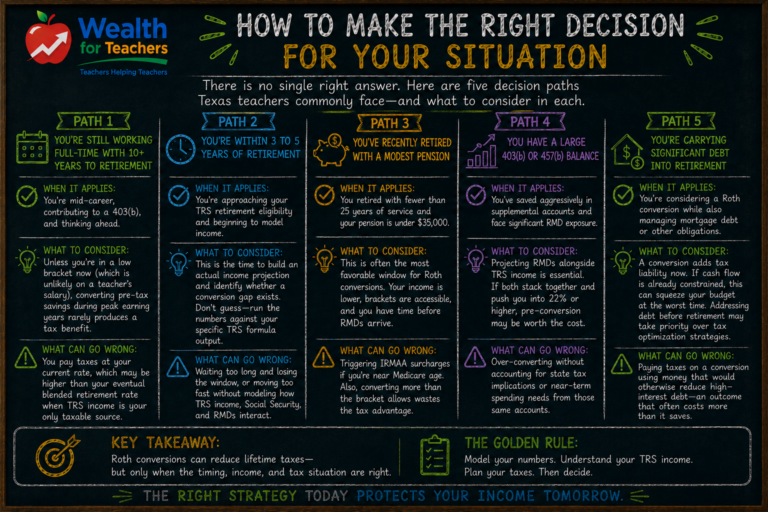
How to Make the Right Decision for Your Situation
There is no single right answer. Here are five decision paths Texas teachers commonly face—and what to consider in each.
Path 1: You’re Still Working Full-Time With 10+ Years to Retirement
When it applies: You’re mid-career, contributing to a 403(b), and thinking ahead.
What to consider: Unless you’re in a low bracket now (which is unlikely on a teacher’s salary), converting pre-tax savings during peak earning years rarely produces a tax benefit.
What can go wrong: You pay taxes at your current rate, which may be higher than your eventual blended retirement rate when TRS income is your only taxable source.
Path 2: You’re Within 3 to 5 Years of Retirement
When it applies: You’re approaching your TRS retirement eligibility and beginning to model income.
What to consider: This is the time to build an actual income projection and identify whether a conversion gap exists. Don’t guess—run the numbers against your specific TRS formula output.
What can go wrong: Waiting too long and losing the window, or moving too fast without modeling how TRS income, Social Security, and RMDs interact.
Path 3: You’ve Recently Retired With a Modest Pension
When it applies: You retired with fewer than 25 years of service and your pension is under $35,000.
What to consider: This is often the most favorable window for Roth conversions. Your income is lower, brackets are accessible, and you have time before RMDs arrive.
What can go wrong: Triggering IRMAA surcharges if you’re near Medicare age. Also, converting more than the bracket allows wastes the tax advantage.
Path 4: You Have a Large 403(b) or 457(b) Balance
When it applies: You’ve saved aggressively in supplemental accounts and face significant RMD exposure.
What to consider: Projecting RMDs alongside TRS income is essential. If both stack together and push you into 22% or higher, pre-conversion may be worth the cost.
What can go wrong: Over-converting without accounting for state tax implications or near-term spending needs from those same accounts.
Path 5: You’re Carrying Significant Debt Into Retirement
When it applies: You’re considering a Roth conversion while also managing mortgage debt or other obligations.
What to consider: A conversion adds tax liability now. If cash flow is already constrained, this can squeeze your budget at the worst time. Addressing debt before retirement may take priority over tax optimization strategies.
What can go wrong: Paying taxes on a conversion using money that would otherwise reduce high-interest debt—an outcome that often costs more than it saves.
What to Do Instead
If you’re not sure whether a Roth conversion is right for you, the better first step is to build a complete retirement income projection. This means knowing:
- Your exact TRS pension amount using the 2.3% formula
- Your expected Social Security benefit and when you’ll claim it
- Your current pre-tax account balances and projected RMD amounts
- Your expected bracket in retirement under realistic spending assumptions
Only after you have this picture can you determine whether converting makes sense, how much to convert, and in which years. Converting without this foundation is guessing—and guessing with your tax liability is expensive.
Quick Self-Check Before You Move Forward
Answer these five questions honestly before making any Roth conversion decision:
- Do you know your exact TRS pension amount? If you haven’t calculated it using your actual years of service and final average salary, you’re working with incomplete information.
- Have you modeled your retirement tax bracket? Not guessed—modeled, with actual numbers including pension, Social Security, and RMDs.
- Do you know your Medicare age and IRMAA thresholds? A conversion that triggers a surcharge can erase the tax benefit entirely.
- Can you pay the conversion taxes without touching retirement accounts? Using IRA or 403(b) money to pay the tax on a conversion often undermines the strategy.
- Have you accounted for how housing and spending decisions affect your income picture? If you’re considering downsizing or relocating, those decisions interact directly with your tax projections. Downsizing decisions for teachers deserve their own analysis before you finalize any tax strategy.
Common Questions Texas Teachers Ask
Does Texas TRS pension income count toward Roth conversion limits?
Your TRS pension is taxable income, and it counts toward your adjusted gross income—which affects your tax bracket during a conversion. It does not, however, reduce your ability to contribute to a Roth IRA if you have earned income from other sources.
Can I do a Roth conversion from my 403(b)?
Yes, if your plan allows in-service distributions or you’ve separated from service. Not all 403(b) plans permit this, so you’ll need to check your specific plan documents before assuming it’s available.
What if I expect tax rates to rise in the future?
This is a legitimate consideration, but it’s speculative. The stronger argument for a Roth conversion is a provable income gap in your specific situation—not a bet on future policy. Build your case on numbers you can verify, not predictions you can’t.
Is a Roth conversion the same as a Roth IRA contribution?
No. A Roth IRA contribution is made with new money you earn. A Roth conversion moves existing pre-tax money into a Roth account, triggering a tax event. They have different rules, limits, and implications for Texas teachers.
Most Teachers Don’t Find the Gaps Until It’s Too Late
The most common scenario isn’t a teacher who made a clearly wrong decision. It’s a teacher who made a reasonable-sounding decision based on incomplete information—and didn’t discover the gap until they were already retired and the window had closed.
A Roth conversion done in the wrong year can cost thousands in unnecessary taxes. An IRMAA trigger can add over $3,000 per year to Medicare costs for two years. A conversion done at the wrong income level can push Social Security benefits into higher taxation. None of these outcomes are obvious in advance unless you test your assumptions with actual numbers before you act.
Retirement planning doesn’t reward good intentions—it rewards correct calculations made at the right time. The best time to find the gaps in your plan is now, not after you’ve already retired.
Get Your TRS Analysis
If you’re not certain whether a Roth conversion fits your TRS retirement picture, the right move is to get a clear analysis based on your actual numbers—your pension formula, your supplemental balances, and your projected tax bracket in retirement.