
What Texas Teachers Get Wrong About Taxes After Retirement — And What It Costs Them
Most Texas teachers spend decades focused on one number: how many years of service they need to retire. Very few spend meaningful time understanding how taxes after retirement for teachers actually work — and that gap can quietly drain thousands of dollars from a fixed pension income that has no room for surprises.
Texas teachers can also run a full pension estimate using the Texas Teacher Retirement Calculator to better understand their retirement outlook.
The tax picture in retirement is not simply a smaller version of your working years. Your income sources change. The way those sources are taxed differs. And decisions you make in the first few years of retirement — about withholding, account withdrawals, and benefit timing — can affect your tax bill for the rest of your life.
For Texas teachers specifically, the combination of a TRS pension, potential Social Security eligibility, and personal savings accounts creates a layered tax situation that rewards planning and punishes assumptions.
For a broader foundation, start with the Texas Teacher Retirement Planning Guide before working through the tax specifics below.
Most retirement plans look reasonable on paper. The problem is that they are built around best-case assumptions — steady inflation, no major health expenses, and a tax rate that stays predictable. Real retirement income rarely behaves that way, and taxes are often the first variable to catch teachers off guard.
How Your TRS Pension Is Taxed
Your TRS monthly annuity is subject to federal income tax. Member contributions are made on a pre-tax basis, which means the amounts accumulated in your member account and your retirement benefits become taxable income in the years in which they are paid to you.
Run Your Free Texas Teacher Retirement Analysis
Use the TRS calculator to estimate your pension and identify potential income gaps.
The IRS requires TRS to withhold federal income tax from your monthly benefit unless you tell TRS in writing that you do not want tax withheld. That withholding election is important and easy to overlook during the paperwork-heavy retirement process.
If you elect not to have withholding applied to your pension payments, or if you do not have enough federal income tax withheld from your pension, you may be responsible for payment of estimated tax. Missing estimated tax payments can trigger IRS penalties — an unpleasant outcome for a teacher in year one of retirement.
You can update your withholding preference at any time through your MyTRS account. MyTRS includes a withholding calculator with your current annuity and income tax withholding preference, allowing you to modify your marital status, the number of exemptions, and other deductions to estimate changes in your withholding.
To illustrate the scale: a Texas teacher with 28 years of service and a final average salary of $62,000 would receive an annual TRS pension of approximately $39,928 (28 × 0.023 × $62,000). That is meaningful taxable income — enough to push some retirees into a higher bracket when combined with other sources.
Social Security and Texas Teachers: What Changed
Texas TRS participation does not automatically disqualify a teacher from Social Security. Many Texas teachers have earned Social Security credits through summer work, second jobs, a spouse’s record, or years in Social Security-covered employment before or after teaching.
For decades, two federal rules — the Windfall Elimination Provision (WEP) and the Government Pension Offset (GPO) — reduced or eliminated Social Security benefits for public employees who also received a government pension. That changed with recent legislation.
The Social Security Fairness Act of 2023 (HR 82), which became law on January 5, 2025, repealed both the Windfall Elimination Provision (WEP) — which in some instances reduced Social Security benefits for individuals who also receive a pension from an employer that did not withhold Social Security — and the Government Pension Offset (GPO), which in various instances reduced Social Security benefits for spouses, widows, and widowers who also receive government pensions of their own.
December 2023 is the last month that WEP and GPO applied. Those rules no longer apply to benefits payable for January 2024 and later.
This change matters for tax planning because Social Security benefits — if you qualify — add another stream of potentially taxable income. Depending on your combined income, a portion of your Social Security benefit may be subject to federal income tax. Adding Social Security on top of a TRS pension can push retirees into a bracket they did not anticipate.
Only people who receive a pension based on work not covered by Social Security may see benefit increases from the repeal. Most state and local public employees — about 72 percent — work in Social Security-covered employment where they pay Social Security taxes and are not affected by WEP or GPO. If you are unsure whether your Texas teaching position was covered by Social Security, your Social Security earnings statement will show which years had covered wages.
Taxes on Supplemental Retirement Accounts
Many Texas teachers saved in 403(b) or 457(b) accounts during their careers. In retirement, withdrawals from traditional (pre-tax) versions of these accounts are taxed as ordinary income — the same as your TRS pension.
If you also hold a Roth account, qualified distributions from a Roth are generally not included in taxable income, which gives you flexibility in managing your total taxable income from year to year.
The sequencing of withdrawals — which account you pull from first — can meaningfully affect your annual tax bill. Pulling from a traditional 403(b) early in retirement while deferring Roth withdrawals is one approach, but the right sequence depends on your total income picture, expected future income changes, and other factors specific to your situation. There is no universal rule that works for every teacher.
Required minimum distributions (RMDs) from pre-tax accounts add another layer of complexity. As a qualified retirement plan under federal tax law, TRS must comply with minimum distribution requirements of Section 401(a)(9) of the Internal Revenue Code, which require that TRS members must begin to receive benefits by a required beginning date. For personal 403(b) or IRA accounts, similar RMD rules apply and force taxable withdrawals whether you need the income or not. Planning for RMDs before they begin gives you more options to manage the tax impact.
For more context on how investment accounts fit into a retirement income plan, see how asset allocation changes for teachers in retirement and consider whether your account structure still matches your income goals.
The Income Stacking Problem
One of the most common tax surprises for retired Texas teachers is income stacking. Each source of income — TRS pension, Social Security, 403(b) withdrawals, part-time work, rental income — is taxed individually but lands on the same tax return. The combined total determines your marginal rate.
A teacher might assume that a $40,000 pension keeps her in a low bracket. But adding $18,000 in annual 403(b) withdrawals and $12,000 in Social Security (of which a portion may be taxable) changes that picture significantly.
Income stacking also affects Medicare premium surcharges. Higher combined income can trigger Income-Related Monthly Adjustment Amounts (IRMAA), increasing what a retiree pays for Medicare Part B and Part D. These surcharges are based on income from two years prior, which means a one-time event — like a large IRA withdrawal or property sale — can increase Medicare costs before a retiree has a chance to react.
Understanding how retirement income failure often begins with overlooked income interactions is critical. Explore why retirement planning fails when income begins for a closer look at common structural problems.
Texas Has No State Income Tax — But Federal Taxes Still Apply
Texas does not impose a state income tax, which means your TRS pension, Social Security benefits, and retirement account withdrawals are not taxed at the state level. That is a real and meaningful advantage for Texas teachers compared to retirees in many other states.
However, it is a mistake to interpret the absence of state income tax as a signal that retirement taxes are simple or minimal. Federal income tax still applies to virtually all of a teacher’s retirement income sources. The federal tax code — brackets, deductions, and income thresholds — governs how much of each dollar you actually keep.
Teachers who move across state lines in retirement, or who have a spouse living or earning income in another state, should also recognize that Texas’s favorable tax treatment does not necessarily extend beyond its borders.
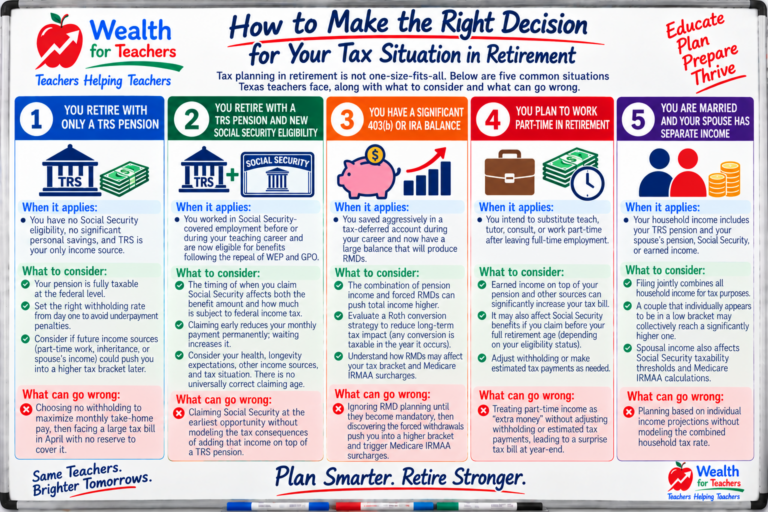
How to Make the Right Decision for Your Situation
Tax planning in retirement is not one-size-fits-all. Below are five common situations Texas teachers face, along with what to consider and what can go wrong without careful planning.
Path 1: You Retire With Only a TRS Pension
When it applies: You have no Social Security eligibility, no significant personal savings, and TRS is your only income source.
What to consider: Your pension is fully taxable at the federal level. Setting the right withholding rate from day one prevents an underpayment penalty at tax time. A teacher in this situation should also consider whether future income sources — part-time work, an inheritance, a spouse’s income — could push them into a higher bracket later.
What can go wrong: Choosing no withholding to maximize monthly take-home pay, then facing a large tax bill in April with no reserve to cover it.
Path 2: You Retire With a TRS Pension and New Social Security Eligibility
When it applies: You worked in Social Security-covered employment before or during your teaching career and are now eligible for benefits following the repeal of WEP and GPO.
What to consider: The timing of when you claim Social Security affects both the benefit amount and how much of it is subject to federal income tax. Claiming early reduces your monthly payment permanently. Waiting increases it — but whether delaying is the right choice depends on your individual health, longevity expectations, other income sources, and tax situation. There is no universally correct claiming age.
What can go wrong: Claiming Social Security at the earliest opportunity without modeling the tax consequences of adding that income on top of a TRS pension.
Path 3: You Have a Significant 403(b) or IRA Balance
When it applies: You saved aggressively in a tax-deferred account during your career and now have a large balance that will produce RMDs.
What to consider: The combination of pension income and forced RMDs can push total income well above what you would otherwise choose to withdraw. Evaluating a Roth conversion strategy — moving some pre-tax dollars to Roth before RMDs begin — may reduce the long-term tax impact, though any conversion is itself taxable in the year it occurs.
What can go wrong: Ignoring RMD planning until they become mandatory, then discovering that the forced withdrawals push you into a higher bracket and trigger Medicare IRMAA surcharges.
Path 4: You Plan to Work Part-Time in Retirement
When it applies: You intend to substitute teach, tutor, consult, or work part-time after leaving full-time employment.
What to consider: Earned income on top of pension and other sources can significantly increase your tax bill. It may also affect Social Security benefits if you claim before your full retirement age — though this depends on your specific Social Security eligibility status.
What can go wrong: Treating part-time income as “extra money” without adjusting withholding or estimated tax payments, leading to a surprise balance due at year-end.
Path 5: You Are Married and Your Spouse Has Separate Income
When it applies: Your household income in retirement includes both your TRS pension and your spouse’s pension, Social Security, or earned income.
What to consider: Filing jointly combines all household income for tax purposes. A couple that individually appears to be in a low bracket may collectively reach a significantly higher one. Spousal income also affects Social Security taxability thresholds and Medicare IRMAA calculations.
What can go wrong: Planning based on individual income projections without modeling the combined household tax rate.
If you are unsure about how any of these paths apply to your situation, working with a retirement specialist familiar with Texas teachers can help you model each scenario with real numbers before committing to a strategy.
What to Do Instead
Rather than making withholding and withdrawal decisions in isolation, treat your retirement tax situation as a single integrated picture.
- Project total income across all sources before retirement begins — pension, Social Security, account withdrawals, and any earned income.
- Set withholding deliberately. Use the MyTRS withholding tool to model different scenarios, and revisit the election whenever your income or tax situation changes.
- Think in brackets, not just rates. Understand which marginal bracket each additional dollar of income reaches, and make withdrawal decisions with that in mind.
- Plan for RMDs before they start. If you have a pre-tax 403(b) or IRA balance, know when distributions will be required and how they interact with your pension income.
- Account for Medicare IRMAA early. A single year of elevated income — even a one-time event — can increase Medicare costs two years later.
- Revisit your plan after major life changes — a spouse’s retirement, a home sale, an inheritance, or a change in part-time income — because each one changes the tax picture.
It is also worth examining whether your investment mix needs to change before or shortly after retirement, since how assets are positioned affects taxable distributions. The article on whether teachers should shift investments before retirement addresses this transition in more detail.
And if you are thinking about how fixed pension income holds up under rising prices, what happens if inflation stays high in retirement examines a risk that interacts directly with tax planning — because your TRS pension is not automatically adjusted for inflation, and over time your monthly annuity purchasing power will decrease.
Quick Self-Check Before You Move Forward
Use these five questions to identify whether you have gaps in your retirement tax plan:
- Do you know your total projected retirement income from all sources? If you can only name your TRS pension amount and nothing else, you are not seeing the full picture.
- Have you set a deliberate federal withholding amount on your TRS annuity — not just accepted the default?
- Do you know whether your Texas teaching position was covered by Social Security and whether you may now be eligible for benefits following the repeal of WEP and GPO?
- If you have a 403(b), IRA, or similar account, do you know when your required minimum distributions begin and how they will interact with your pension income?
- Have you modeled your household tax situation — not just your individual income — if a spouse has separate retirement income?
A “no” or “I’m not sure” on any of these questions points to a gap worth addressing before making final retirement decisions.
Common Questions Texas Teachers Ask
Is my TRS pension taxed by the state of Texas?
No. Texas does not have a state income tax, so your TRS pension is not taxed at the state level. It is, however, subject to federal income tax.
Will Social Security reduce my TRS pension?
Your TRS benefit payments are not affected by Social Security. The two systems operate independently. The concern historically ran the other direction — Social Security benefits being reduced because of a TRS pension — but those reductions no longer apply for benefits payable beginning January 2024 following the repeal of WEP and GPO.
Do I have to pay taxes on my TRS annuity right away?
Yes. Amounts accumulated in your member account or your retirement benefits become taxable income in the years in which they are paid to you. You can manage how much is withheld monthly, but the income itself is taxable when received.
What happens to my 403(b) if I don’t start withdrawing right away?
Pre-tax 403(b) accounts are subject to required minimum distribution rules, which means you will eventually be required to take taxable withdrawals regardless of whether you need the income. The starting age for RMDs has been adjusted under recent federal legislation — consult IRS guidance or a tax professional for your specific required beginning date, since it depends on your date of birth.
Can I reduce my taxes in retirement by converting to a Roth IRA?
A Roth conversion moves pre-tax money into a Roth account, and the converted amount is taxable in the year of conversion. For some teachers, converting a portion of a 403(b) or traditional IRA to Roth in lower-income years — before RMDs begin — can reduce the long-term tax burden. However, the benefit depends on your tax rate today versus your expected rate in the future, and a conversion done without modeling the full income picture can backfire.
The Gap Most Teachers Don’t Find Until It’s Too Late
Retirement tax decisions are not easily reversible. Withholding elections can be changed, but a large underpayment penalty has already occurred. A Social Security claim submitted too early cannot be undone after the initial 12-month window. A Roth conversion executed in the wrong year creates a tax bill that cannot be returned. An RMD missed or mishandled triggers penalties that cannot be negotiated away retroactively.
The pattern that causes the most damage is not a single bad decision. It is a series of small assumptions — that taxes in retirement will roughly mirror what they looked like while working, that the default withholding is probably fine, that Social Security can be figured out later — that compound quietly until the first full tax return of retirement reveals the real picture.
By that point, several of the most consequential decisions have already been made. That is why testing your income assumptions, modeling your total tax exposure across all sources, and understanding the interaction between your TRS pension and every other income stream matters — not after your first full year of retirement, but before you retire.
The teachers who navigate retirement taxes most successfully are not the ones who happened to get lucky. They are the ones who treated tax planning as a required part of retirement preparation — not an afterthought assigned to April of the following year.