
What Happens If You Retire During a Market Downturn?
Retiring during a downturn can impact your income long-term. Learn what to expect.

Downsizing can improve cash flow—but it’s not always the right move.

For many Texas teachers, the family home represents decades of memories, stability, and financial equity. But as retirement approaches, the question surfaces: should you downsize? The answer is rarely as simple as “yes, it saves money.” For teachers relying on a TRS pension, downsizing in retirement involves trade-offs that ripple through your monthly cash flow, tax situation, healthcare access, and long-term quality of life.
Texas teachers can also run a full pension estimate using the Texas Teacher Retirement Calculator to better understand their retirement outlook.
Getting the downsizing decision wrong—moving too soon, too late, or to the wrong location—can quietly erode the retirement you spent 25 or 30 years building.
This guide is written specifically for Texas teachers who are weighing whether downsizing retirement makes sense for their situation. You’ll find concrete financial analysis, honest trade-offs, and a step-by-step framework to make a decision with confidence rather than assumption.
For a broader view of how housing fits into your overall retirement picture, start with the Texas Teacher Retirement Planning Guide.
Most retirement plans fail not because the math was wrong, but because the assumptions were never tested against real conditions. A plan that looks solid on paper—a TRS pension, some savings, a paid-off home—can fracture quickly when taxes, healthcare costs, and lifestyle expenses are added to the equation. Downsizing can either strengthen that plan or introduce new vulnerabilities. The difference lies in how carefully you evaluate the decision before you move.
Downsizing doesn’t just mean moving to a smaller home. It means restructuring a significant portion of your retirement balance sheet. When a teacher sells a larger home and moves to a smaller one, the financial outcomes depend heavily on equity, local real estate markets, carrying costs, and what is done with the proceeds.
Use the TRS calculator to estimate your pension and identify potential income gaps.
Consider a concrete example:
That’s real money for a teacher on a fixed pension income. But the analysis doesn’t stop there. Where does the $140,000 go? If it sits in a low-yield savings account, inflation gradually erodes it. If it funds retirement income through a conservative investment approach, it can meaningfully extend financial security.
The decision only looks simple from the outside.
Texas TRS uses a straightforward formula: multiply your years of service by 2.3%, then multiply that result by your final average salary. A teacher with 30 years of service and a final average salary of $62,000 would receive:
30 × 0.023 × $62,000 = $42,780 per year, or $3,565 per month.
That monthly income is fixed. It does not grow with inflation unless a cost-of-living adjustment is authorized—which TRS does not guarantee. That fixed nature is precisely why housing costs matter so much.
If your mortgage is paid off and your property taxes and maintenance are manageable within your monthly pension, downsizing may not add meaningful financial benefit. But if your home is carrying high costs—large square footage, older systems, a high-tax zip code—your fixed pension income may be working too hard just to maintain the property.
Understanding how much income your TRS pension will actually replace is the right starting point before making any housing decision. Teachers often overestimate their pension’s purchasing power once healthcare, taxes, and housing are factored in.
One cost that surprises many retiring teachers is healthcare. Moving to a lower-cost zip code can sometimes restrict access to preferred providers under TRS-Care or require different plan selections. Healthcare costs for retired teachers deserve serious attention before any relocation decision is finalized.
If you carry significant debt—a HELOC, car loans, or credit balances—the decision to downsize becomes more complicated. Whether to pay off debt before retirement can directly influence whether downsizing is the right financial sequence for your situation.
Financial analysis alone does not determine whether downsizing is the right move. The emotional and practical dimensions matter just as much for long-term retirement satisfaction.
Teachers who have spent careers building routines and community ties often underestimate how disorienting a move can be in the first year of retirement. That transition period, when identity is already shifting after leaving the classroom, can be made significantly harder by a simultaneous relocation.
None of this means staying put is always correct. It means the decision requires honesty about your actual lifestyle priorities, not just the financial projection.
There is no universal right answer for downsizing retirement. Your decision should depend on your pension income, current housing costs, savings, health, and what retirement actually looks like for you day to day. Here are five decision paths Texas teachers commonly face:
When it applies: You have no mortgage, property taxes are manageable, and maintenance is predictable.
What to consider: Downsizing may not meaningfully improve cash flow. The disruption may outweigh the benefit.
What can go wrong: Selling prematurely and losing a stable, low-cost base in exchange for a smaller home in a more expensive market.
When it applies: Large property, high taxes, aging systems, and a TRS pension that feels stretched.
What to consider: Freeing equity and reducing fixed expenses can meaningfully extend retirement security.
What can go wrong: Moving costs, market timing, and reinvestment decisions can consume a large portion of the equity gain.
When it applies: You plan to move regardless of financial optimization.
What to consider: Analyze TRS-Care network coverage in the destination area. Compare total cost of ownership in both locations.
What can go wrong: Moving to a lower cost-of-living area may not deliver expected savings if healthcare access or home prices have shifted.
When it applies: You are carrying a remaining mortgage balance into retirement.
What to consider: Downsizing could eliminate the mortgage entirely, improving monthly cash flow dramatically.
What can go wrong: If the math is tight, you may end up in a smaller home without meaningful savings and reduced flexibility.
When it applies: You are not sure whether to stay or move and are hoping clarity will come later.
What to consider: Delaying is itself a decision. Costs accumulate, health changes, and market conditions shift.
What can go wrong: Waiting too long can reduce your physical capacity for the move or limit your ability to access equity at peak value.
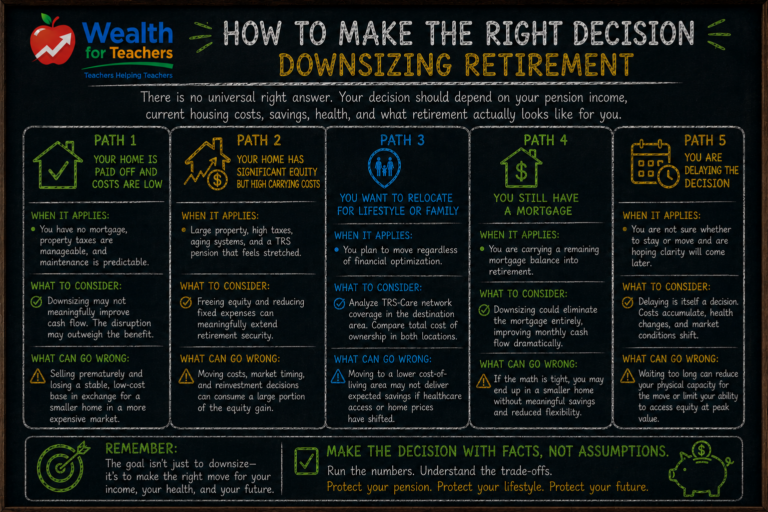
Rather than making the downsizing decision based on assumptions or what worked for a colleague, treat it as a financial planning exercise with a clear framework.
Because teacher retirement is fundamentally different from traditional retirement, strategies that work for private-sector workers often do not translate. Teachers need housing decisions built around the structure and limitations of a TRS pension, not generic financial advice.
No. Your TRS pension is calculated based on your service years and final average salary. Selling your home has no impact on the pension calculation itself. However, it can significantly affect your overall financial security depending on how proceeds are managed.
Both have trade-offs. Downsizing before retirement can reduce financial stress heading into your first year without a paycheck. Downsizing after retirement gives you time to understand your actual spending patterns first. Neither is universally better—it depends on your timeline, health, and local market.
TRS-Care is available to eligible retirees regardless of where they live. However, network access and provider availability may differ significantly depending on your new location. Investigate coverage in your target area before committing to a move.
This is a real risk when equity is not strategically deployed. A lump sum from a home sale can create a false sense of financial abundance. Without a structured plan for those proceeds, they can erode faster than anticipated, leaving you with less flexibility later in retirement.
Before making a final decision about downsizing, answer these five questions honestly:
The most common retirement planning mistake Texas teachers make is not the wrong decision—it is an untested one. A TRS pension provides a reliable base, but it was never designed to cover every expense in retirement without supplementation. Housing costs, healthcare premiums, and inflation all apply pressure to a fixed monthly income over time.
Teachers who discover these gaps after retiring have significantly fewer options to respond. A downsizing decision made under financial pressure is rarely as favorable as one made from a position of clarity and timing. The window to plan well is before retirement, not after the first difficult year reveals what the projection missed.
If you have not yet tested your retirement plan against real-world scenarios—including what happens if healthcare costs rise sharply or if your home takes longer to sell than expected—now is the time to do that work. Retiring with confidence is possible, but only when assumptions have been challenged, not just confirmed.
The downsizing decision is not made in isolation. It connects directly to your pension income, your healthcare coverage, your debt situation, and what your retirement actually needs to look like financially. Getting that full picture before making a move—in either direction—is the difference between a retirement that works and one that surprises you.
Use the TRS calculator to estimate your pension and identify potential income gaps.