
What Happens If Inflation Stays High in Retirement?
Inflation can dramatically impact your income over time.

Confidence in retirement comes from planning, not guessing. Learn how to build a secure plan.

Most Texas teachers spend decades building toward retirement. They track their years of service, watch their TRS statements, and count down to the day they can finally leave the classroom. But counting down is not the same as planning. And planning is not the same as being ready.
Texas teachers can also run a full pension estimate using the Texas Teacher Retirement Calculator to better understand their retirement outlook.
Retiring with confidence means more than knowing your pension amount. It means understanding exactly what your income will cover, what it won’t, and what happens if your assumptions turn out to be wrong. That’s what separates teachers who retire with clarity from those who retire with uncertainty — and discover the gaps too late to fix them.
This guide is built around one goal: helping you retire with confidence (without guessing). Not with rough estimates and hopeful math, but with a real plan grounded in your specific numbers, your timeline, and your life after teaching.
For a full overview of how TRS retirement decisions connect, start with the Texas Teacher Retirement Planning Guide.
Why most retirement plans fail before they start: A retirement plan that has never been stress-tested is not a plan — it’s a guess dressed up in a spreadsheet. Real-world retirement involves healthcare costs, inflation, debt, tax surprises, and income gaps that generic projections routinely miss. Until your plan has been run against those variables, you don’t actually know if it works.
Confidence in retirement is not a feeling. It’s the result of running real numbers and making decisions based on what those numbers show — not what you hope they’ll show.
Use the TRS calculator to estimate your pension and identify potential income gaps.
A complete retirement plan for a Texas teacher answers all of these questions clearly:
If any of those questions feel uncomfortable to answer, that discomfort is important information. It points directly to where your plan needs work before you retire — not after.
Understanding why retirement income planning is different for teachers is the first step toward building a plan that actually fits your situation.
The Texas TRS pension is a defined benefit plan. Your annual pension is calculated using a straightforward formula:
Annual Pension = Years of Service × 2.3% × Final Average Salary
This multiplier is flat. It does not increase at certain service milestones, and it does not work in tiers or bands. Every year of service contributes the same percentage to your final benefit.
Here’s what that looks like for a real teacher:
A teacher with 30 years of service and a final average salary of $62,000 would calculate their pension like this:
30 × 0.023 × $62,000 = $42,780 per year, or roughly $3,565 per month before taxes.
That number may sound solid. But for many Texas teachers, it only replaces 60–70% of pre-retirement income — and that’s before healthcare costs, debt payments, or any irregular expenses are factored in.
To understand how far that pension actually goes, you need to know your TRS income replacement rate — and whether your pension alone can carry the full weight of your retirement lifestyle.
In most cases, it can’t. And that’s not a problem, as long as your plan accounts for it.
There is no single retirement path that fits every Texas teacher. Your decision depends on your years of service, your age, your debt, your income needs, and your health coverage situation. Here are five common decision paths — and what’s at stake with each one.
When it applies: You’re close to hitting the Rule of 80 or age eligibility under TRS.
What to consider: This is the time to run your exact pension number, map out your healthcare plan, and stress-test your income against real monthly expenses.
What can go wrong: Teachers who wait until the last year to build their plan often discover gaps — like insufficient supplemental savings or unexpected healthcare costs — when it’s too late to course-correct before their retirement date.
When it applies: You meet the minimum age requirement but haven’t hit 30+ years of service.
What to consider: Retiring early permanently reduces your pension. Each year you step away before maximizing your service credit costs you 2.3% of your final average salary — every year, for the rest of your life.
What can go wrong: A teacher who retires at 27 years instead of 30 gives up roughly 6.9% of their final salary in annual pension income permanently. That’s not a small number compounded over a 20–25 year retirement.
When it applies: You’re being offered a non-teaching position or considering a career pivot in your late 40s or 50s.
What to consider: Leaving Texas public education may freeze or complicate your TRS benefit depending on timing. A higher salary outside of TRS doesn’t automatically produce a better retirement outcome if you lose pension accrual years.
What can go wrong: Teachers underestimate how much the compounding of additional service years inside TRS is worth. A few extra years of teaching at a higher salary late in your career can dramatically increase your final average salary and lifetime pension value.
When it applies: You’re carrying a mortgage, car payment, or other recurring debt that will follow you beyond your last paycheck.
What to consider: Debt in retirement reduces your effective monthly income. Your pension may look adequate on paper but fall short when debt obligations are subtracted from it each month.
What can go wrong: Teachers who retire with significant monthly obligations discover quickly that a fixed pension provides no flexibility for unexpected costs. Understanding how to approach debt before retirement can determine whether your plan actually holds.
When it applies: Your retirement income plan is almost entirely built around your TRS pension with little or no 403(b), savings, or other income streams.
What to consider: A pension-only retirement plan is vulnerable. It offers no flexibility for large one-time costs, healthcare surprises, or changes in spending needs.
What can go wrong: Without additional income sources, a single unexpected expense — a major health event, home repair, or family need — can destabilize the entire plan. Building multiple retirement income streams beyond TRS is what separates stable retirements from fragile ones.
This is the part that most retirement conversations skip over — and it’s the part that matters most.
The gaps in a retirement plan are rarely obvious. They don’t announce themselves. They hide inside assumptions: “Healthcare won’t cost that much.” “I’ll spend less once I stop working.” “My pension will be enough.”
Those assumptions feel reasonable. But they haven’t been tested.
When the plan finally meets real life — the first healthcare premium, the first year of full retirement spending, the first required minimum distribution — is when the gaps show up. And at that point, the window to fix them has often already closed.
Healthcare is one of the most common and most expensive blind spots. The cost of coverage after leaving active employment regularly surprises teachers who never modeled it in advance. Understanding how healthcare costs impact Texas teacher retirement is a critical step that belongs in every retirement plan — not just the financial ones.
The goal of planning is not to predict the future perfectly. It’s to close every gap you can identify before you retire, so that the ones you can’t predict have less room to damage your outcome.
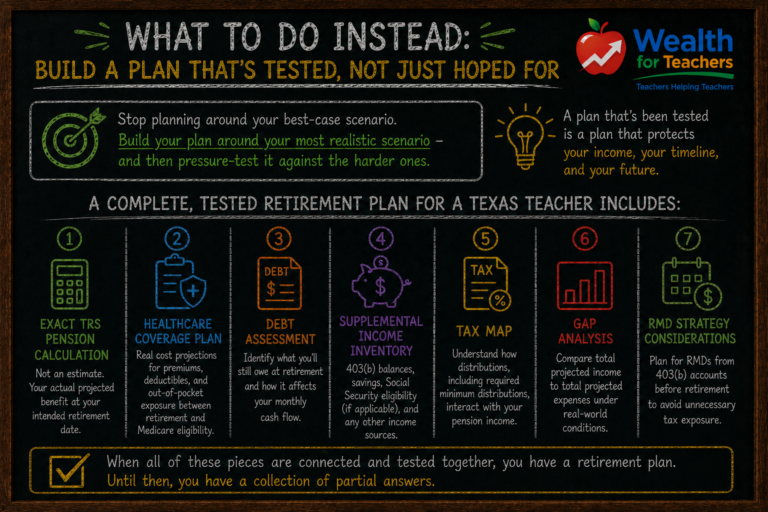
Stop planning around your best-case scenario. Build your plan around your most realistic scenario — and then pressure-test it against the harder ones.
Here’s what a complete, tested retirement plan for a Texas teacher actually includes:
Planning for required minimum distributions is also something teachers with 403(b) accounts must address before retirement. Ignoring this creates unnecessary tax exposure. Learning the RMD strategy considerations for teachers before you retire can protect income you’ve spent decades accumulating.
When all of these pieces are connected and tested together, you have a retirement plan. Until then, you have a collection of partial answers.
Use these five questions to identify where your plan may have gaps:
If any of these questions revealed uncertainty, that’s where to focus your planning energy before you finalize your retirement date.
It depends on your pension amount and your actual monthly expenses. Use the formula — Years of Service × 2.3% × Final Average Salary — to calculate your annual benefit, then compare it to your projected retirement budget including healthcare, debt, and living costs. Many teachers find a meaningful income gap that requires supplemental savings to close.
Eligibility and readiness are different things. You may meet the age and service requirements under TRS and still not be financially ready to retire. Readiness means your total projected income covers your total projected expenses with enough margin to absorb surprises.
Retiring based on pension eligibility rather than financial readiness. Reaching the Rule of 80 means you can retire — it does not mean your plan is complete or that your income will be sufficient.
No. Texas TRS uses a flat 2.3% multiplier for every year of service. There are no tiers, thresholds, or bonus years. Each additional year of service adds the same percentage to your final benefit, which means every year matters equally — and leaving early always has a cost.
Ideally, five or more years before your target retirement date. That window gives you time to identify gaps, make adjustments to savings or debt, model healthcare options, and enter retirement with decisions already made rather than questions still open.
A real retirement plan doesn’t leave room for guessing. If you’re ready to get clarity on your TRS pension, your income gaps, and what your retirement actually looks like on paper — this is where to start.
Use the TRS calculator to estimate your pension and identify potential income gaps.