
Retiring During a Market Crash Can Permanently Damage a Texas Teacher’s Income—Here’s Why It Matters
Most Texas teachers spend decades building toward a retirement number. They count service years, estimate their TRS pension, and assume the finish line is simply a matter of time. What they rarely plan for is the moment the market drops 25% the same year they hand in their resignation.
Texas teachers can also run a full pension estimate using the Texas Teacher Retirement Calculator to better understand their retirement outlook.
The decision to retire during a market crash—or just before one—is one of the most consequential financial mistakes a teacher can make. And unlike other financial errors, this one can compound silently for years before the damage becomes obvious.
If you are thinking about when to retire, or you are already questioning whether now is the right time, this article explains exactly what happens when teachers retire during a market downturn, why the risks are different than most people assume, and what you should do before making a final decision.
For a complete foundation, start with the Texas Teacher Retirement Planning Guide before going deeper into market timing and sequence risk.
Most retirement plans look solid on paper. They fail in real life because they are built on best-case assumptions and never tested against real-world conditions—market drops, healthcare spikes, unexpected expenses, or income gaps in year one. A plan that only works when everything goes right is not a retirement plan. It is a guess.
What Is Sequence of Returns Risk and Why Does It Hit Teachers Hard
Sequence of returns risk is the danger that comes from receiving poor investment returns early in retirement—right when you begin making withdrawals. It is not just about average returns over time. It is about the order those returns arrive.
Run Your Free Texas Teacher Retirement Analysis
Use the TRS calculator to estimate your pension and identify potential income gaps.
Here is a simple way to understand it: Two teachers retire with $300,000 in a 403(b). One retires into a bull market. One retires into a crash where the portfolio drops 30% in year one. Both withdraw $15,000 in year one. The second teacher is now drawing from a portfolio worth $195,000 instead of $285,000. Even if the market fully recovers, that teacher never catches up. The shares sold during the downturn are gone permanently.
This is why teachers who decide to retire during market crash conditions face a structurally different risk than those who retire into stable or rising markets. The damage is not temporary. It is baked into every future year of retirement.
Understanding why retirement income planning is different for teachers helps clarify why this risk matters more for educators than for workers with employer 401(k) matches or Social Security as a primary income source.
How Your TRS Pension Changes the Equation
Texas TRS is a defined benefit pension. That means it pays a fixed monthly amount for life, regardless of what markets do. This is a significant structural advantage over a retirement plan that relies entirely on investment accounts.
The Texas TRS formula is straightforward:
Annual Pension = Years of Service × 0.023 × Final Average Salary
For example, a teacher with 30 years of service and a final average salary of $60,000 would receive:
30 × 0.023 × $60,000 = $41,400 per year, or roughly $3,450 per month.
That income does not shrink when the S&P 500 falls. It does not fluctuate with interest rates. It arrives every month regardless of economic conditions.
This matters enormously when thinking about market timing. If your TRS pension covers most or all of your essential monthly expenses, a market crash creates less pressure to sell investments at a loss. If your pension only covers a fraction of what you need, you may be forced to withdraw from a depleted portfolio to cover the gap—and that is where sequence risk becomes dangerous.
To understand how much of your pre-retirement income your pension will actually replace, review how much income your TRS pension will actually replace. That number is the foundation of every other retirement decision.
What Happens to Withdrawals During a Downturn
When a teacher retires and begins withdrawing from a 403(b) or other investment account during a downturn, three things happen simultaneously:
- The account balance drops due to falling market values
- Withdrawals continue at the same dollar amount (because expenses do not shrink)
- Fewer shares remain to benefit from any future recovery
This triple effect is what makes early-retirement downturns so destructive. The teacher is not just riding out the crash. She is liquidating assets at depressed prices to pay for groceries, utilities, and healthcare.
Healthcare is a particular pressure point. Texas TRS retirees who retire before Medicare eligibility at age 65 face significant out-of-pocket healthcare costs. Those costs do not wait for the market to recover. If you are retiring early and relying on investment accounts to bridge healthcare expenses, a downturn creates compounded financial pressure from two directions at once.
For a closer look at that cost structure, see how healthcare costs impact Texas teacher retirement.
How Market Timing Affects Long-Term Income Stability
Retirement income stability is not just about how much money you have on day one. It is about how long it lasts and whether it keeps pace with your actual expenses over time.
A Texas teacher who retires into a 20% to 30% market decline and has no pension income beyond TRS to cover variable expenses will face one of three outcomes:
- She withdraws more aggressively to maintain her standard of living, depleting the portfolio faster
- She cuts spending sharply, which may work short-term but is unsustainable if the downturn lasts two or three years
- She delays retirement until conditions stabilize, which preserves the portfolio but requires continued classroom service
None of these outcomes are comfortable. The goal is to position yourself before any of them become your only option.
Teachers who have built multiple sources of retirement income outside of TRS are better positioned to handle market volatility without being forced into bad withdrawal decisions. If you have not started thinking about this, how teachers can build multiple retirement income streams is a practical starting point.
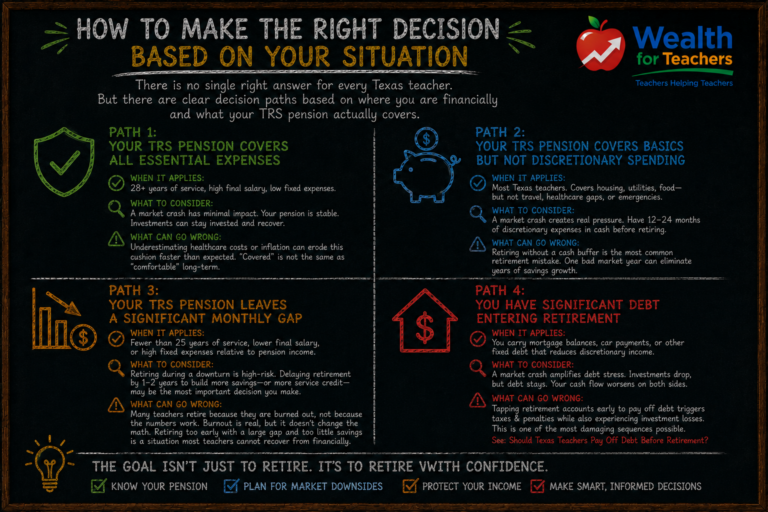
How to Make the Right Decision for Your Situation
There is no single right answer for every Texas teacher. But there are clear decision paths based on where you are financially and what your TRS pension actually covers.
Path 1: Your TRS Pension Covers All Essential Expenses
When it applies: You have 28 or more years of service, a relatively high final salary, and low fixed monthly expenses.
What to consider: A market crash has minimal impact on your retirement security. Your pension is stable. Investment accounts can simply stay invested and recover.
What can go wrong: Underestimating healthcare costs or inflation can erode this cushion faster than expected. Do not assume “covered” means “comfortable” indefinitely.
Path 2: Your TRS Pension Covers Basics but Not Discretionary Spending
When it applies: Most Texas teachers fall here. The pension covers housing, utilities, and food—but not travel, healthcare gaps, or emergencies.
What to consider: A market crash creates real pressure. You need a cash reserve of 12 to 24 months of discretionary expenses before retiring, so you are never forced to sell investments during a decline.
What can go wrong: Retiring without a cash buffer in this scenario is the most common retirement mistake Texas teachers make. One bad market year eliminates years of savings growth.
Path 3: Your TRS Pension Leaves a Significant Monthly Gap
When it applies: Fewer than 25 years of service, a lower final salary, or high fixed expenses relative to pension income.
What to consider: Retiring during a downturn in this scenario is high-risk. Every month of gap coverage is coming from investment accounts that are simultaneously shrinking. Delaying retirement by even one or two years to build more savings—or more service credit—may be the most important decision you make.
What can go wrong: Many teachers in this position retire because they are burned out, not because the numbers work. Burnout is real, but it does not change the math. Retiring too early with too large a gap and too little savings is a situation most teachers cannot recover from financially.
Path 4: You Have Significant Debt Entering Retirement
When it applies: You carry mortgage balances, car payments, or other fixed debt that reduces your monthly discretionary income from the pension.
What to consider: A market crash amplifies the stress of fixed debt payments. If investment accounts drop, the debt does not. Your cash flow position worsens on both sides simultaneously.
What can go wrong: Teachers in this situation sometimes tap retirement accounts early to eliminate debt—triggering taxes and penalties—while simultaneously experiencing investment losses. This is one of the most damaging sequences a pre-retiree can face. For more on this decision, see whether Texas teachers should pay off debt before retirement.
What to Do Instead
If you are concerned about retiring during a market downturn, there are concrete steps that reduce your exposure without requiring you to time the market perfectly.
- Build a cash reserve before you retire. Twelve to twenty-four months of non-pension expenses held in cash or stable short-term accounts means you never have to sell investments at the worst moment.
- Know your actual pension income before you retire. Run the TRS formula with your real service years and real final average salary. Do not estimate. Do not round up. Know the exact number.
- Identify your income gap. Subtract your monthly pension from your monthly expenses. That gap is what your investment accounts must cover. A smaller gap means less vulnerability to a market crash.
- Delay if the gap is large and the market is declining. One additional year of service at $60,000 adds $1,380 per year to your pension permanently. That is guaranteed income that no market crash can take away.
- Diversify your withdrawal sources. If you have multiple income streams—pension, 403(b), Roth IRA, part-time income—you have options during a downturn. Flexibility is protection.
Quick Self-Check Before You Move Forward
Before making any final retirement decision, answer these five questions honestly:
- Does your TRS pension alone cover your essential monthly expenses? If the answer is no, you are dependent on investment withdrawals from day one.
- Do you have at least 12 months of non-pension expenses in cash or stable accounts? If not, a downturn in year one forces you to sell investments at a loss.
- Have you calculated your exact monthly income gap? Guessing is not a plan. The gap number drives every other decision.
- Do you know your TRS pension amount using the actual formula? Many teachers overestimate. Run the math: Years × 0.023 × Final Average Salary.
- Have you stress-tested your plan against a 20% to 30% portfolio drop in year one? If your plan only works when markets cooperate, it has not been tested.
Why Most Teachers Discover Gaps Too Late
The most common retirement planning failure among Texas teachers is not a lack of effort. It is a lack of stress testing. Teachers spend years contributing to their 403(b), accumulating service years, and watching their TRS balance grow—but they rarely model what happens if markets fall 25% the month after they retire.
By the time the gap becomes obvious, the damage is already done. Accounts are smaller. Fixed expenses have not changed. And the options that were available before retirement—delaying, saving more, reducing debt, building income streams—are no longer on the table.
The window to fix a retirement plan closes on the day you retire. Everything after that is damage control.
If you want to retire with actual confidence—not just optimism—start by understanding what your numbers look like under pressure, not just under ideal conditions. The article on how Texas teachers can retire with confidence walks through how to approach that process practically.
Get Your TRS Analysis
Knowing your TRS pension amount is only the first step. Understanding how it holds up during a market downturn—and whether your full retirement plan is built to last—requires a complete picture of your income, expenses, and withdrawal strategy.
Common Questions Texas Teachers Ask
Does a market crash affect my TRS pension payment?
No. Your TRS pension is a defined benefit paid by the Teacher Retirement System of Texas. It is not tied to investment markets. Your monthly payment is calculated using your years of service and final average salary and does not change based on market conditions.
Should I delay retirement if the market is down?
It depends on your income gap. If your TRS pension covers all essential expenses and you have a cash reserve, a market crash has limited impact on your day-to-day retirement. If you are dependent on investment withdrawals to cover monthly expenses, delaying retirement—even by one year—to build additional savings or service credit is often the right move.
How much cash should I have before retiring as a Texas teacher?
A practical target is 12 to 24 months of non-pension monthly expenses held in cash or low-risk accounts. This buffer allows you to avoid selling investments during a downturn in your early retirement years, which is when sequence of returns risk is highest.
Is a 403(b) enough to supplement my TRS pension?
It can be, depending on your balance and your income gap. But a 403(b) exposed to market volatility is not a guaranteed supplement. Its reliability as an income source depends on your withdrawal rate, your account balance at retirement, and what markets do in your first few retirement years.
What if I retired recently and the market is now down—what should I do?
If you recently retired and the market has declined, avoid withdrawing more than necessary from investment accounts. Draw on your TRS pension first, use any cash reserves you have, and give your investment accounts time to recover before resuming withdrawals. Selling at a loss permanently reduces future growth.