What Happens If Inflation Stays High in Retirement?
Inflation can dramatically impact your income over time.

Market timing can impact retirement income. Learn how sequence risk affects teachers.
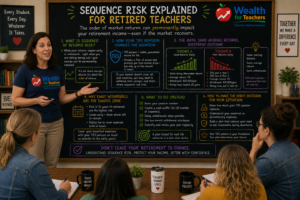
Most Texas teachers spend decades building toward a TRS pension. They calculate the formula, estimate their monthly check, and assume that number is safe. But for teachers who retire with outside savings — a 403(b), a personal investment account, or a supplemental retirement plan — there is a risk that most retirement conversations never address directly: sequence of returns risk.
Texas teachers can also run a full pension estimate using the Texas Teacher Retirement Calculator to better understand their retirement outlook.
Sequence of returns risk is the danger that comes from the order in which investment returns occur, not just the average return over time. A teacher who earns strong market returns late in retirement may end up in a very different position than one who earns those same returns in the first few years after leaving the classroom. When you are drawing down a portfolio to cover living expenses, a bad stretch of returns early on can permanently reduce your income, even if the market fully recovers later.
This is not a theoretical concern. It is one of the most practical and underappreciated risks facing Texas educators who retire with any personal savings to manage.
For a deeper foundation before diving into this topic, start with the Texas Teacher Retirement Planning Guide.
Most retirement plans look solid on paper but have never been tested under real-world conditions. A projected average return of 6% or 7% annually tells you nothing about what happens if the market drops 25% in your first year of retirement and you are already drawing from that same account to pay for groceries, utilities, or healthcare. Plans built on averages frequently fall apart when sequence is the actual variable at work.
Use the TRS calculator to estimate your pension and identify potential income gaps.
Sequence of returns risk describes the impact of return timing on a portfolio that is being actively withdrawn from. It is distinct from average return risk, which is simply whether an investment performs well or poorly over a long period.
For teachers still working and contributing to a 403(b) or IRA, a market downturn is painful but recoverable. Contributions continue, and time allows the portfolio to rebuild. But once a teacher retires and begins making withdrawals, the math flips. Selling shares at depressed prices to cover monthly expenses means fewer shares remain to benefit when the market recovers.
This is especially important for Texas teachers because retirement income planning is fundamentally different for teachers than it is for workers in the private sector. TRS-covered educators do not receive Social Security in most cases, which means supplemental savings often carry more responsibility than they would for a typical retiree.
The good news is that a TRS pension provides a meaningful buffer against sequence risk — but only up to the amount it covers.
Texas TRS uses a flat 2.3% multiplier per year of service applied to your final average salary. The formula is straightforward:
Annual Pension = (Years of Service × 0.023) × Final Average Salary
A teacher with 30 years of service and a final average salary of $58,000 would receive:
30 × 0.023 × $58,000 = $40,020 per year, or about $3,335 per month
That pension arrives every month regardless of what the stock market does. It does not shrink because the S&P 500 dropped. It does not require you to sell assets at the wrong time. In that sense, it provides a floor of guaranteed income that partially insulates a retired teacher from sequence risk.
But here is the problem: for many Texas teachers, that pension does not cover all monthly expenses. The gap between pension income and actual spending must be filled — often by drawing from a 403(b), a deferred compensation account, or personal savings. That gap is exactly where sequence risk lives.
Understanding how much income your TRS pension will actually replace is the critical starting point before assessing how much exposure to sequence risk you truly have.
Consider two teachers who both retire with $300,000 in a 403(b). Both experience the same average annual return of 5% over 20 years. The only difference is the order of returns.
Teacher A experiences strong returns early and poor returns late. Her portfolio survives well past her life expectancy.
Teacher B experiences a 20% loss in year one and a 15% loss in year two before markets recover. She draws $18,000 per year to supplement her pension income. Despite recovering average returns, her portfolio runs out in year 14.
Same starting balance. Same average return. Same withdrawal amount. Different outcome — purely because of sequence.
The early losses forced Teacher B to sell shares at a discount. She had fewer shares left when markets rebounded. Her recovery never fully caught up to her withdrawal rate.
The first five to ten years of retirement represent the highest-risk window for sequence damage. During this period, the portfolio is still large enough that percentage losses translate into significant dollar losses, and the teacher has decades of withdrawals ahead of her.
Several factors compound this risk for Texas teachers specifically:
If a teacher is also carrying debt into retirement, that compounds the problem further. Entering retirement with unresolved debt obligations raises the minimum monthly withdrawal needed and shortens the window for recovery.
Protecting against sequence risk does not require avoiding the market altogether. It requires structuring income so that short-term market downturns do not force you to sell long-term assets at the wrong time.
Here are specific strategies that apply to Texas teachers:
When it applies: Long-service teachers with 30+ years and a relatively modest lifestyle compared to their final salary.
What to consider: Your sequence risk exposure is low. Your primary concern is inflation eroding the real value of your fixed pension over time.
What could go wrong: Assuming you are fine without stress-testing healthcare and inflation scenarios over a 25-to-30-year retirement horizon.
When it applies: Most Texas teachers with 25 to 30 years of service at average salary levels.
What to consider: You have meaningful sequence risk exposure. The gap you fill with savings is large enough that early market losses could force painful adjustments.
What could go wrong: Retiring without a cash buffer or withdrawal strategy, especially if a market downturn hits in years one through three of retirement.
When it applies: Teachers with fewer years of service, those who worked part-time, or those with higher lifestyle costs relative to their salary history.
What to consider: This is the highest-risk category. Your supplemental savings must work harder, and your exposure to sequence damage is significant.
What could go wrong: Running out of savings before age 80 if a bad sequence of returns hits early and withdrawals never decrease to match.
When it applies: Teachers approaching the retirement decision during a period of market uncertainty.
What to consider: This is the highest-stakes window. Decisions made about retirement timing, asset allocation, and withdrawal sequencing in this window have outsized long-term consequences. Read more about what happens if you retire during a market downturn.
What could go wrong: Locking in a retirement date without adjusting your portfolio allocation to reduce near-term volatility exposure.
When it applies: Teachers with paid-off or nearly paid-off homes who have flexibility in how they access capital.
What to consider: Home equity can act as a buffer, either through downsizing or a strategic sale. Exploring whether downsizing in retirement makes sense for your situation could reduce the withdrawal pressure on your investment portfolio during a bad sequence period.
What could go wrong: Over-relying on home equity as a fallback without a concrete plan for accessing it efficiently.

Before finalizing any retirement timeline or income plan, answer these five questions honestly:
If you cannot answer yes to each of these with confidence, there are gaps in your plan that need to be addressed before you finalize your retirement date.
The most common pattern in teacher retirement planning is not catastrophic failure — it is quiet erosion. A teacher retires, feels financially comfortable for the first few years, and then notices that her savings are shrinking faster than expected. By the time the problem is clear, options are limited.
A bad sequence of returns in years two and three can permanently reduce a portfolio’s capacity to generate income. That damage cannot be undone by returning to work at 68 or hoping markets improve at 74. The compounding effect of drawing down a damaged portfolio over decades works against recovery.
The teachers who navigate this well are the ones who tested their assumptions before retiring — not after. They knew their income gap, had a cash buffer in place, and had a plan for what to do if markets dropped in the first few years. The ones who struggle are the ones who projected average returns, assumed the pension would be enough, and never stress-tested the plan under adverse conditions.
Partially. Your TRS pension provides guaranteed income that does not fluctuate with market performance. But if your pension does not cover all your expenses, the portion you must withdraw from savings is still exposed to sequence risk. The larger the income gap, the greater your exposure.
Not necessarily, but timing matters. Retiring during a market downturn with no cash buffer is a higher-risk scenario than retiring during a stable or rising market with reserves in place. The decision should be based on your income gap, buffer size, and overall financial position — not fear alone.
A bad investment year while you are still working is recoverable because you are not withdrawing and you continue contributing. A bad year in early retirement is different because you are selling assets to fund expenses during the downturn. That reduces the shares available to benefit from recovery, which permanently shrinks your portfolio’s long-term capacity.
Sequence risk applies to any account you are actively drawing from. Whether it is a 403(b), a 457(b), an IRA, or a personal brokerage account — if you are making regular withdrawals, the order of returns matters.
Most Texas public school teachers do not receive Social Security due to participation in TRS. If you worked in a Social Security-covered position before or alongside teaching, you may have some benefit, but WEP and GPO rules may reduce it. Confirm your Social Security status with SSA directly before building it into your income plan.
Sequence of returns risk is manageable — but only if you plan for it before you retire, not after you notice your savings shrinking. A TRS analysis that accounts for your income gap, withdrawal timing, and retirement date can show you where your current plan holds up and where it does not.
Use the TRS calculator to estimate your pension and identify potential income gaps.