

What Texas Teachers Get Wrong About Retirement Income—And Why It Costs Them
Most retirement planning advice is built around one assumption: you have a 401(k), you invest over time, and you draw it down in retirement. That model does not describe how most Texas teachers retire.
Texas teachers can also run a full pension estimate using the Texas Teacher Retirement Calculator to better understand their retirement outlook.
When comparing teacher retirement vs traditional retirement, the differences go far beyond having a pension instead of a brokerage account. The structure of your income, the timing of your benefits, how Social Security interacts with your pension, and when your healthcare coverage kicks in—all of these work differently for Texas TRS members than they do for almost any other worker in the country.
If you are relying on generic retirement planning guides or tools designed for corporate employees, you may be making decisions based on information that simply does not apply to your situation.
For a complete overview of how Texas teachers should approach this process, start with the Texas Teacher Retirement Planning Guide.
Most retirement plans—teacher or otherwise—fail not because the math was wrong on paper, but because the assumptions were never tested against real-world conditions. Income projections built in a vacuum rarely survive contact with actual retirement. This article explains what makes teacher retirement planning genuinely different and what to do about it.
Pension-Based Income vs. 401(k)-Based Income: A Structural Difference
In a traditional retirement built around a 401(k), the employee controls everything: how much they contribute, how it is invested, when they withdraw, and how fast they spend it down. The risk sits entirely with the individual. Market performance matters. Withdrawal sequencing matters. Running out of money is a genuine and measurable risk.
Run Your Free Texas Teacher Retirement Analysis
Use the TRS calculator to estimate your pension and identify potential income gaps.
Texas TRS works in the opposite direction. As a teacher, you do not control the investment. You do not choose a withdrawal rate. You receive a defined monthly benefit for life, calculated by a fixed formula, regardless of market conditions.
That is a meaningful advantage—but it also means your planning decisions look nothing like what a traditional retirement guide recommends.
- You cannot “rebalance” your pension the way you would a portfolio.
- Your income floor is fixed, not flexible.
- You cannot withdraw a lump sum in a bad year to avoid market losses.
- Your benefit amount is locked in at retirement and does not automatically adjust for inflation.
Understanding this structure is the starting point for every other retirement decision you will make as a Texas teacher.
How Texas TRS Actually Calculates Your Retirement Income
Texas TRS uses a straightforward formula: multiply your years of service by 2.3%, then multiply that percentage by your final average salary.
Annual Pension = (Years of Service × 0.023) × Final Average Salary
Here is what that looks like in practice. A teacher with 28 years of service and a final average salary of $62,000 would calculate their pension as:
28 × 0.023 = 0.644, or 64.4% of their final average salary.
64.4% × $62,000 = $39,928 per year, or roughly $3,327 per month.
That is a meaningful income—but it is also the ceiling of what TRS alone will provide. It does not grow automatically with inflation. It does not increase based on investment performance. And if you retire with fewer years of service than you planned, the reduction is permanent.
To understand how that number compares to what you actually need to cover your expenses, see How Much Income Will Your TRS Pension Actually Replace?
The Social Security Problem Most Texas Teachers Don’t See Coming
Most Texas public school teachers do not pay into Social Security during their teaching career. That means they do not earn Social Security credits for those years—and they may be surprised to learn that even if they worked in a Social Security-covered job before or after teaching, two federal rules can significantly reduce their benefit.
The Windfall Elimination Provision (WEP) reduces Social Security benefits for workers who receive a pension from a non-covered employer, like Texas TRS. The Government Pension Offset (GPO) can reduce or eliminate spousal and survivor Social Security benefits.
This is one of the sharpest contrasts between teacher retirement vs traditional retirement. A corporate employee who retires with a pension from a private employer typically keeps their full Social Security benefit. A Texas teacher in the same scenario may see their Social Security benefit cut significantly—or eliminated entirely if they rely on a spouse’s record.
Planning around this requires knowing your numbers before you retire, not after.
The Healthcare Gap Between Retirement and Medicare
Texas TRS members can retire before age 65 and often do. But Medicare eligibility does not begin until age 65. That gap—sometimes five to ten years—creates a healthcare cost exposure that traditional retirement planning tools rarely account for.
TRS-Care is available to qualifying retired teachers, but it is not free and it is not the same as active-employee coverage. Premiums, deductibles, and out-of-pocket maximums can take a significant portion of a teacher’s monthly pension income, especially in early retirement.
For a detailed breakdown of what these costs look like and how to plan for them, read How Healthcare Costs Impact Texas Teacher Retirement.
This is an area where many teachers underestimate their expenses by thousands of dollars per year.
Why Retirement Timing Is a Permanent Income Decision
In a 401(k)-based retirement, you can delay withdrawals, work part-time, or adjust the pace of your spending based on your circumstances. Your income is largely variable and within your control.
In a TRS pension, your retirement date determines your benefit amount permanently. If you retire at 55 with 27 years of service instead of waiting until 58 with 30 years of service, that difference in your multiplier and your final average salary is baked in forever.
Three additional years at 2.3% per year adds 6.9 percentage points to your benefit. On a $65,000 salary, that is a difference of $4,485 per year—every year, for the rest of your life.
Teachers who retire one or two years early because they are burned out, pressured, or simply ready often do not realize how much income they are leaving on the table permanently. This is not a recoverable mistake the way an early 401(k) withdrawal might be.
How to Make the Right Decision for Your Situation
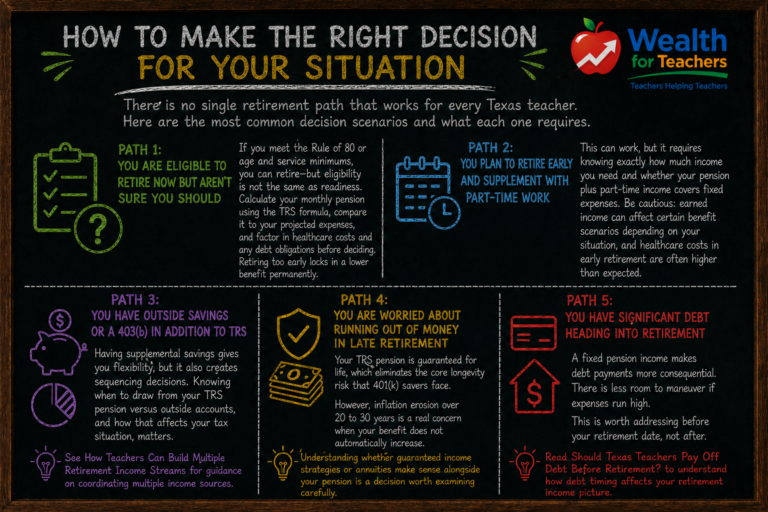
There is no single retirement path that works for every Texas teacher. Here are the most common decision scenarios and what each one requires.
Path 1: You Are Eligible to Retire Now But Aren’t Sure You Should
If you meet the Rule of 80 or age and service minimums, you can retire—but eligibility is not the same as readiness. Calculate your monthly pension using the TRS formula, compare it to your projected expenses, and factor in healthcare costs and any debt obligations before deciding. Retiring too early locks in a lower benefit permanently.
Path 2: You Plan to Retire Early and Supplement With Part-Time Work
This can work, but it requires knowing exactly how much income you need and whether your pension plus part-time income covers fixed expenses. Be cautious: earned income can affect certain benefit scenarios depending on your situation, and healthcare costs in early retirement are often higher than expected.
Path 3: You Have Outside Savings or a 403(b) in Addition to TRS
Having supplemental savings gives you flexibility, but it also creates sequencing decisions. Knowing when to draw from your TRS pension versus outside accounts, and how that affects your tax situation, matters. See How Teachers Can Build Multiple Retirement Income Streams for guidance on coordinating multiple income sources.
Path 4: You Are Worried About Running Out of Money in Late Retirement
Your TRS pension is guaranteed for life, which eliminates the core longevity risk that 401(k) savers face. However, inflation erosion over 20 to 30 years is a real concern when your benefit does not automatically increase. Understanding whether guaranteed income strategies or annuities make sense alongside your pension is a decision worth examining carefully.
Path 5: You Have Significant Debt Heading Into Retirement
A fixed pension income makes debt payments more consequential. There is less room to maneuver if expenses run high. This is worth addressing before your retirement date, not after. Read Should Texas Teachers Pay Off Debt Before Retirement? to understand how debt timing affects your retirement income picture.
What to Do Instead
Rather than applying a generic retirement planning framework to a pension-based situation, Texas teachers should work from their specific TRS numbers outward.
- Start with your TRS benefit estimate. Know what your monthly income will be under different retirement dates. Run the formula yourself so you understand the impact of each additional year.
- Map your actual expenses. Separate fixed expenses from discretionary spending and identify what your pension must cover versus what is flexible.
- Account for healthcare before Medicare. If you retire before 65, price out TRS-Care coverage and factor that into your monthly budget now.
- Understand your Social Security situation before assuming you have one. If WEP or GPO applies to you, your projected Social Security benefit from the SSA website may be inaccurate.
- Coordinate any outside savings intentionally. A 403(b) or IRA creates decisions around tax treatment, withdrawal timing, and Required Minimum Distributions. See What Teachers Need to Know About RMDs before assuming your supplemental accounts are straightforward.
Why Most Teachers Don’t Find the Gaps Until It’s Too Late
The most common scenario is this: a teacher reviews their TRS benefit estimate, decides the monthly amount looks reasonable, and retires without pressure-testing the full picture. Then, six months in, the healthcare costs are higher than expected. Or they realize Social Security will not offset their expenses the way they assumed. Or debt payments consume a larger percentage of their fixed income than they planned for.
These are not rare edge cases. They are the predictable result of planning in isolation without stress-testing assumptions against real numbers. The pension is guaranteed. The rest of your retirement income picture is not. The time to find the gaps is before you submit your retirement paperwork—not after your benefit is locked in.
Quick Self-Check Before You Move Forward
Use these questions to identify where your plan may have gaps before making a final retirement decision.
- Do you know your exact TRS monthly benefit under at least two different retirement dates? If you only know one number, you do not have enough information to make a timing decision.
- Have you confirmed whether WEP or GPO will affect your Social Security benefit? If you have worked in Social Security-covered employment at any point, this needs a direct answer—not an assumption.
- Have you priced out TRS-Care premiums and out-of-pocket costs for the years before Medicare? If not, your monthly budget is incomplete.
- Do you know how much of your pension will go toward fixed expenses like housing, debt, and insurance? If discretionary expenses are not clearly separated, you cannot assess whether your pension is truly sufficient.
- If you have a 403(b) or IRA, do you know when RMDs begin and how they affect your income? Many teachers are surprised to find that required distributions push them into a higher tax bracket in their late 70s.
Common Questions Texas Teachers Ask
Is a teacher pension better than a 401(k)?
A pension provides guaranteed lifetime income, which eliminates longevity risk. A 401(k) provides flexibility and potential growth but puts market and withdrawal risk entirely on you. For most Texas teachers, the TRS pension is the strongest income asset they have—but it works best when it is planned around, not just received.
Can Texas teachers collect Social Security?
Many Texas teachers do not pay into Social Security while teaching and therefore do not earn credits for those years. If you have Social Security from prior employment, the WEP or GPO rules may reduce what you actually receive. This needs to be verified with the SSA directly using your actual earnings record.
What happens to my TRS pension if I retire early?
Your benefit is calculated based on your years of service at the time you retire. If you retire with fewer years, your multiplier is lower and your final average salary may also be lower. Both factors reduce your monthly benefit permanently. There is no mechanism to increase the benefit later based on what you would have earned.
Should I keep contributing to my 403(b) if I have TRS?
TRS alone may not replace 100% of your pre-retirement income, especially in early or mid-career retirement scenarios. A 403(b) or other supplemental savings gives you flexibility for variable expenses, large purchases, or healthcare gaps. The question is not whether to save supplementally, but how to structure withdrawals strategically in retirement.
How is teacher retirement income taxed in Texas?
Texas has no state income tax, which means your TRS pension is not subject to state income tax. Federal income tax still applies to your pension income. If you also draw from a 403(b) or traditional IRA, those distributions are taxable at the federal level as well.
If you are not confident that your current plan accounts for all of these factors—TRS timing, Social Security exposure, healthcare costs, debt, and outside savings—a structured review of your numbers is the most practical next step.