

Why Most Texas Teachers Overestimate How Much Income TRS Will Actually Replace
The assumption is common: teach long enough, retire with TRS, and your income is covered. But when Texas teachers sit down and run the actual numbers, many are surprised by what they find.
Texas teachers can also run a full pension estimate using the Texas Teacher Retirement Calculator to better understand their retirement outlook.
The TRS income replacement rate — the percentage of your working income your pension will actually replace — is often lower than expected. And the gap between what teachers assume they’ll receive and what they actually receive can quietly derail a retirement that looked fine on paper.
Understanding your replacement ratio before you retire isn’t just a math exercise. It’s a decision that shapes when you retire, whether you need supplemental income, and whether your plan holds up when real expenses hit.
For a deeper foundation on how TRS fits into your overall retirement strategy, start with the Texas Teacher Retirement Planning Guide.
Most retirement plans fail not because teachers made bad choices, but because their assumptions were never stress-tested against real-world numbers. A plan that looks solid in the abstract often shows cracks the moment it’s measured against actual monthly income, healthcare costs, and a 20- to 30-year retirement horizon.
What Is a TRS Income Replacement Rate?
A replacement rate is simply the percentage of your pre-retirement income that your pension will provide once you stop working.
Run Your Free Texas Teacher Retirement Analysis
Use the TRS calculator to estimate your pension and identify potential income gaps.
If you earned $70,000 per year as a teacher and your TRS pension pays $49,000 annually, your replacement rate is 70%.
Financial planners often cite 70% to 85% as a common target for retirement income replacement. But that range isn’t a rule — it’s an estimate. Your actual number depends on your lifestyle, whether you carry debt into retirement, your healthcare costs, and whether you have other income sources.
For Texas teachers, the TRS pension is usually the largest income source in retirement. That makes understanding the replacement ratio critical, not optional.
How Texas TRS Calculates Your Pension
Texas TRS uses a straightforward formula:
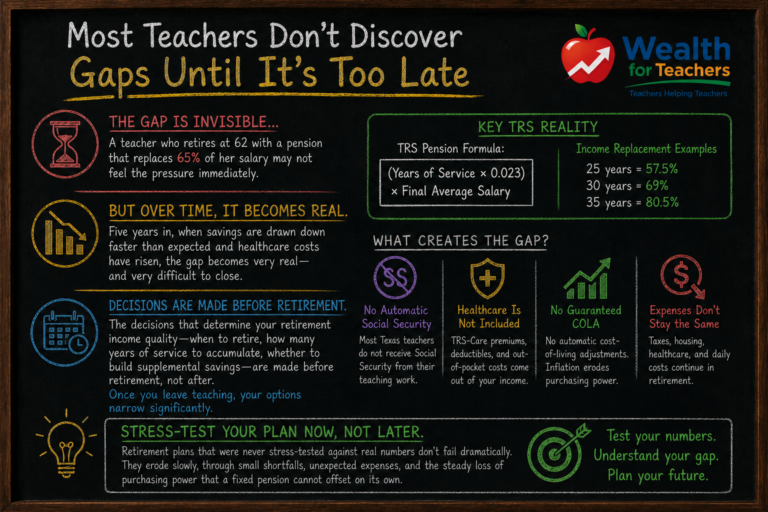
Annual Pension = (Years of Service × 0.023) × Final Average Salary
The multiplier is a flat 2.3% per year of service. It does not increase based on how many years you’ve taught, it does not work in tiers, and it does not accelerate at any point. Every year adds the same 2.3%.
Your final average salary is typically calculated using your highest five consecutive years of earnings.
What the Multiplier Means in Practice
- 25 years of service = 57.5% of your final average salary
- 30 years of service = 69% of your final average salary
- 35 years of service = 80.5% of your final average salary
This means that for most teachers retiring with fewer than 30 years of service, TRS alone will not replace 70% or more of their working income. The pension is real and valuable — but it is not automatically sufficient.
Realistic Replacement Rate Examples
Let’s look at concrete numbers so the replacement rate concept becomes clear.
Example 1: The 28-Year Teacher
A teacher retires after 28 years with a final average salary of $62,000.
Annual Pension = (28 × 0.023) × $62,000 = 0.644 × $62,000 = $39,928 per year
That’s a replacement rate of about 64%. If this teacher’s working expenses were $62,000 per year, she now faces a roughly $22,000 annual gap — before accounting for healthcare, which is not automatically covered by TRS.
Example 2: The 33-Year Teacher
A teacher retires after 33 years with a final average salary of $72,000.
Annual Pension = (33 × 0.023) × $72,000 = 0.759 × $72,000 = $54,648 per year
That’s a replacement rate of about 76%. Much stronger, but still not a complete replacement — especially if retirement lasts 25 or 30 years and expenses increase over time.
These examples aren’t worst-case scenarios. They’re typical. And they illustrate why relying solely on TRS without understanding the gap is a planning risk.
Where the Gaps Come From
The replacement rate gap is real, but it’s not always obvious until you look at what TRS does and doesn’t cover.
No Automatic Social Security for Most Texas Teachers
Most Texas public school teachers do not pay into Social Security and are not eligible to collect it based on their teaching work. This is a critical distinction. In states where teachers do receive Social Security, the combined replacement rate from both sources is often significantly higher.
In Texas, TRS is usually the only institutional income source. That puts more weight on the pension and on any supplemental savings a teacher has built.
Healthcare Is Not Included in the Pension Formula
TRS retirees may access TRS-Care, but premiums, deductibles, and out-of-pocket costs are not covered by the pension calculation. A teacher retiring before Medicare eligibility at 65 faces years of healthcare costs that come directly out of retirement income.
No Cost-of-Living Adjustment Is Guaranteed
Texas TRS does not provide automatic annual cost-of-living adjustments (COLAs). Any increases require action by the Texas Legislature. Over a 20- to 25-year retirement, a fixed pension loses real purchasing power as prices rise. A pension that replaces 70% of income today may only replace 55% to 60% of equivalent expenses a decade into retirement.
Early Retirement Reduces the Multiplier
Leaving before reaching full eligibility under your TRS tier may reduce your benefit or prevent you from receiving the full formula amount. Every year short of a full career is a year the 2.3% multiplier doesn’t run.
How to Make the Right Decision for Your Situation
Not every Texas teacher faces the same retirement picture. Here are five common situations and what each one requires.
Path 1: You Have 30+ Years and a Pension That Comes Close to Replacing Your Income
When it applies: You’re approaching or have passed 30 years of service and your pension will cover most of your working expenses.
What to consider: Even at 69% to 80% replacement, a gap exists. Focus on identifying where the shortfall is and whether savings, a spouse’s income, or part-time work can fill it.
What can go wrong: Assuming the pension is enough without accounting for healthcare costs or inflation eroding purchasing power over 20-plus years.
Path 2: You Have Fewer Than 25 Years and Are Considering Early Retirement
When it applies: Life circumstances are pushing you toward an earlier exit than originally planned.
What to consider: A shorter career means a significantly smaller pension. At 20 years, the formula produces only 46% of your final average salary. You need supplemental savings or income to make this work.
What can go wrong: Retiring early without a clear plan to cover the gap leads to financial stress and potential depletion of savings. Learn more about why some teachers run out of money in retirement and how to avoid it.
Path 3: You Have Savings in a 403(b) or 457(b) and Need to Coordinate Them With TRS
When it applies: You’ve been contributing to a supplemental retirement account and need to understand how to draw from it without creating tax or income problems.
What to consider: Withdrawal sequencing, required minimum distributions, and how additional income affects your overall tax picture. Review what teachers need to know about RMD strategy before distributions become mandatory.
What can go wrong: Drawing down savings too fast in early retirement or triggering avoidable taxes by not planning withdrawal timing carefully.
Path 4: You’re Worried About Running Out of Income Later in Retirement
When it applies: You’re concerned about inflation, longevity, or the risk that your fixed pension won’t be enough 15 or 20 years from now.
What to consider: Strategies that create guaranteed income beyond TRS, including annuities or structured income products. Understand the options teachers have for guaranteed income strategies.
What can go wrong: Relying entirely on a fixed TRS pension without any mechanism to address purchasing power loss over a multi-decade retirement.
Path 5: Your TRS Pension Covers Basics but Leaves Little Flexibility
When it applies: Your pension will cover essential expenses but won’t support discretionary spending, travel, or unexpected costs.
What to consider: Whether building multiple income streams beyond TRS is realistic and how to structure them. Explore how teachers can build multiple retirement income streams to create more flexibility.
What can go wrong: Living in a financially rigid retirement where any unexpected cost — medical, home repair, family need — disrupts the entire budget.
What to Do Instead
Rather than estimating or assuming, treat your TRS income replacement rate as a number that must be calculated and tested.
- Run the actual formula. Use your current years of service and projected final average salary to calculate your real annual pension. Don’t use round numbers or best-case assumptions.
- Identify your actual expenses. What you spend in retirement is often different from what you earn at work. Build a realistic retirement budget that includes healthcare, housing, and inflation adjustments.
- Calculate the gap. Subtract your projected TRS pension from your projected retirement expenses. That gap is what your savings, part-time work, or other income must cover.
- Stress-test your plan. What happens if healthcare costs rise faster than expected? What happens if you live to 90? What happens if the Legislature doesn’t approve a COLA for a decade?
- Build an income floor. Understand how to build a guaranteed income floor so your essential expenses are covered regardless of what the market or your savings do.
Quick Self-Check Before You Move Forward
Answer these five questions honestly. If you can’t answer them clearly, your retirement plan has gaps that need attention before you make any major decisions.
- Do you know your exact projected TRS annual pension based on your current years of service and salary? If you’re estimating, you’re planning on assumptions, not facts.
- Have you calculated how much your monthly retirement expenses will actually be, including healthcare? If not, you don’t yet know whether your pension covers them.
- Do you have a plan to cover the gap between your TRS pension and your real expenses? If TRS replaces 65%, what covers the other 35%?
- Have you accounted for the fact that TRS does not include automatic inflation adjustments? What will your pension’s purchasing power look like 20 years into retirement?
- If you retire before Medicare eligibility at 65, do you know what your healthcare will cost and where that money will come from? This is one of the most underestimated expenses in teacher retirement planning.
Most Teachers Don’t Discover Gaps Until It’s Too Late
The problem with retirement planning gaps is that they’re invisible until they aren’t. A teacher who retires at 62 with a pension that replaces 65% of her salary may not feel the pressure immediately. But five years in, when savings are drawn down faster than expected and healthcare costs have risen, the gap becomes very real — and very difficult to close.
The decisions that determine your retirement income quality — when to retire, how many years of service to accumulate, whether to build supplemental savings — are made before retirement, not after. Once you leave teaching, your options narrow significantly. The time to test your assumptions is now, not after you’ve submitted your retirement paperwork.
Retirement plans that were never stress-tested against real numbers don’t fail dramatically. They erode slowly, through small shortfalls, unexpected expenses, and the steady loss of purchasing power that a fixed pension cannot offset on its own.
Common Questions Texas Teachers Ask
Is a 70% replacement rate enough to retire comfortably?
It depends entirely on your actual expenses. For teachers who retire with a paid-off home, no debt, and modest lifestyle expectations, 70% can work. For teachers with ongoing housing costs, healthcare expenses, or family financial obligations, 70% may fall short. The percentage only matters in relation to your real spending needs.
Does TRS income replace Social Security for Texas teachers?
For most Texas public school teachers, yes — TRS is the primary retirement income because they do not pay into Social Security and are not eligible for benefits based on their teaching employment. Some teachers who worked in Social Security-covered jobs before or after teaching may have partial Social Security eligibility, but it is often reduced by the Windfall Elimination Provision or Government Pension Offset.
What if I only taught for 15 or 20 years?
At 20 years, the TRS formula produces a replacement rate of 46% of your final average salary. At 15 years, it’s 34.5%. These are pension income levels that require substantial supplemental savings or other income sources to support a full retirement. Short-career teachers face the most significant replacement rate gaps.
Can I increase my TRS pension after retirement?
No. Once your pension is set at retirement, the formula is locked in based on your service years and final average salary. The only mechanism for an increase is a COLA approved by the Texas Legislature, which is not guaranteed and has not been consistently provided.
Should I work part-time in retirement to close the income gap?
For some teachers, part-time work is a practical and satisfying solution for filling a replacement rate gap, especially in the early years of retirement. Understanding whether this is worth it — financially and practically — depends on your pension amount, your expenses, and your retirement goals. Review the considerations around part-time work for retired teachers before counting on it as a strategy.
Get a Clear Picture of Your TRS Replacement Rate
Understanding your TRS income replacement rate is the first step. The next is building a plan that accounts for the gap, protects your purchasing power, and doesn’t leave your retirement exposed to risks you haven’t tested.