Understanding Safe Withdrawal Rates for Teachers
Withdrawal strategy determines how long your money lasts.

Part-time work can boost income—but is it the right choice?

The promise of retirement feels simple: stop working, start collecting your pension, and enjoy the freedom you’ve earned. But for many Texas teachers, that first month of retirement brings an uncomfortable reality check. Your TRS pension covers the basics, but the extras that made life enjoyable during your teaching years suddenly feel out of reach.
Texas teachers can also run a full pension estimate using the Texas Teacher Retirement Calculator to better understand their retirement outlook.
Part-time work seems like the obvious solution. Extra income, flexible schedule, and a chance to stay active without the full-time stress you left behind. But this decision carries hidden consequences that can impact your financial security, tax situation, and long-term retirement success in ways most teachers never consider.
Understanding whether part-time work fits your retirement strategy requires looking beyond the immediate income boost. You need to examine how it affects your overall financial picture, your lifestyle goals, and the sustainability of your retirement plan. Getting this decision right can enhance your retirement years. Getting it wrong can create new problems while failing to solve the original income gap that drove you to consider working in the first place.
Your Texas Teacher Retirement Planning Guide should address this decision before you retire, but many teachers find themselves making this choice reactively rather than strategically.
Most retirement plans fail because they look perfect on paper but fall apart when tested against real-world conditions like inflation, unexpected expenses, and changing lifestyle needs. Part-time work decisions made without understanding these broader implications often create short-term relief but long-term complications.
Part-time work sounds straightforward until you calculate the actual financial benefit. The gross income number that initially attracts you tells only part of the story.
Use the TRS calculator to estimate your pension and identify potential income gaps.
Consider a retired Texas teacher earning a $3,200 monthly TRS pension. Taking a part-time job earning $1,500 per month seems like a 47% income increase. But the reality involves taxes, expenses, and opportunity costs that reduce that benefit significantly.
Your TRS pension may have been partially or fully tax-free at your current income level. Adding part-time income can push you into higher tax brackets and make more of your pension taxable. A $1,500 monthly part-time job might only net you $900-$1,100 after taxes and work-related expenses.
Work-related expenses add up faster than most retirees expect. Transportation, work clothes, meals, and the general cost of being away from home can easily consume 15-20% of part-time earnings.
Part-time work consumes time and energy you could use for other activities. If you’re working to afford travel, entertainment, or hobbies, but the job prevents you from enjoying these activities, you’ve created a counterproductive cycle.
The physical and mental energy required for work, even part-time, can impact your health and enjoyment of retirement. Some teachers find that working part-time makes them feel like they never truly retired.
Texas teachers often underestimate the tax implications of adding income to their retirement picture. Your TRS pension, Social Security benefits, and part-time earnings create a complex tax situation that requires careful planning.
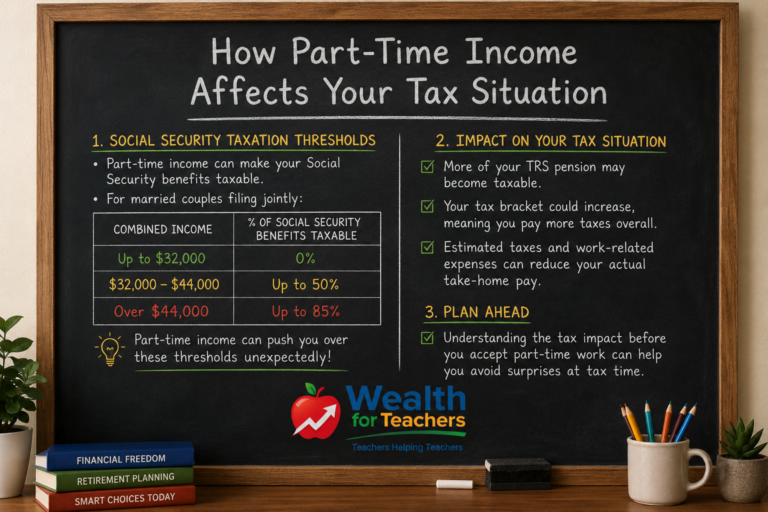
If you’re receiving Social Security, part-time income can trigger taxation on benefits that were previously tax-free. The combined income thresholds are lower than many teachers realize, and crossing them can create a sudden tax burden.
For married couples filing jointly, combined income over $32,000 can make 50% of Social Security benefits taxable. Over $44,000, up to 85% becomes taxable. Part-time income often pushes retirees over these thresholds unexpectedly.
While Texas doesn’t have state income tax, this can create complications if you work remotely for an out-of-state employer or take seasonal work in other states. Understanding the tax implications before accepting work prevents surprises at tax time.
The decision to work part-time in retirement involves lifestyle considerations that extend beyond immediate financial needs. These factors often determine long-term satisfaction more than the extra income.
One of retirement’s greatest benefits is control over your time. Part-time work, even with flexible scheduling, introduces constraints and obligations that can diminish this freedom.
Many teachers discover that even “flexible” part-time work comes with expectations, deadlines, and responsibilities that create stress they thought they’d left behind.
Retirement often involves spending more time with family, pursuing hobbies, volunteering, or traveling. Part-time work can interfere with these relationships and goals, particularly if your spouse has also retired and expected to share this time with you.
The social aspect of retirement changes when you’re still working. You may find yourself out of step with retired friends who have full flexibility, while not quite fitting in with working colleagues who are at different life stages.
Part-time work becomes a strategic choice rather than a financial necessity in specific situations. Understanding when it truly benefits your overall retirement plan helps you make this decision deliberately rather than reactively.
If you retired earlier than originally planned or before Social Security eligibility, part-time work can bridge the income gap until your full retirement benefits begin. This strategy works best with a clear end date and specific financial target.
For example, a teacher who retires at 60 might work part-time until age 62 when Social Security becomes available, then reassess whether continued work serves their goals.
Part-time work targeted at specific goals—like funding grandchildren’s education, major travel plans, or home improvements—can be more psychologically satisfying than working to cover general living expenses.
This approach works because it has clear parameters and end points. You’re not working indefinitely to make ends meet; you’re working temporarily to achieve something specific.
Some teachers miss the professional identity and sense of purpose that came with their career. Part-time work in education or related fields can provide this satisfaction while generating income.
Substitute teaching, tutoring, or consulting work allows you to use your professional skills without the full-time commitment and stress of classroom management.
Part-time work becomes counterproductive when it masks underlying retirement planning problems or creates new complications without addressing the root cause of financial stress.
If you need part-time income to pay for basic living expenses like housing, utilities, or groceries, the problem isn’t solved by working—it’s postponed. This situation indicates a fundamental gap in your retirement planning that requires more comprehensive solutions.
Working to cover basic expenses in early retirement often becomes unsustainable as you age and your ability or desire to work diminishes. The underlying income gap will eventually resurface, possibly when you have fewer options to address it.
Sometimes teachers use part-time work to avoid making necessary lifestyle adjustments. If your retirement income doesn’t support your current expenses, working part-time might delay the inevitable need to downsize, reduce discretionary spending, or make other difficult changes.
These delayed decisions often become more challenging and expensive the longer you wait to address them.
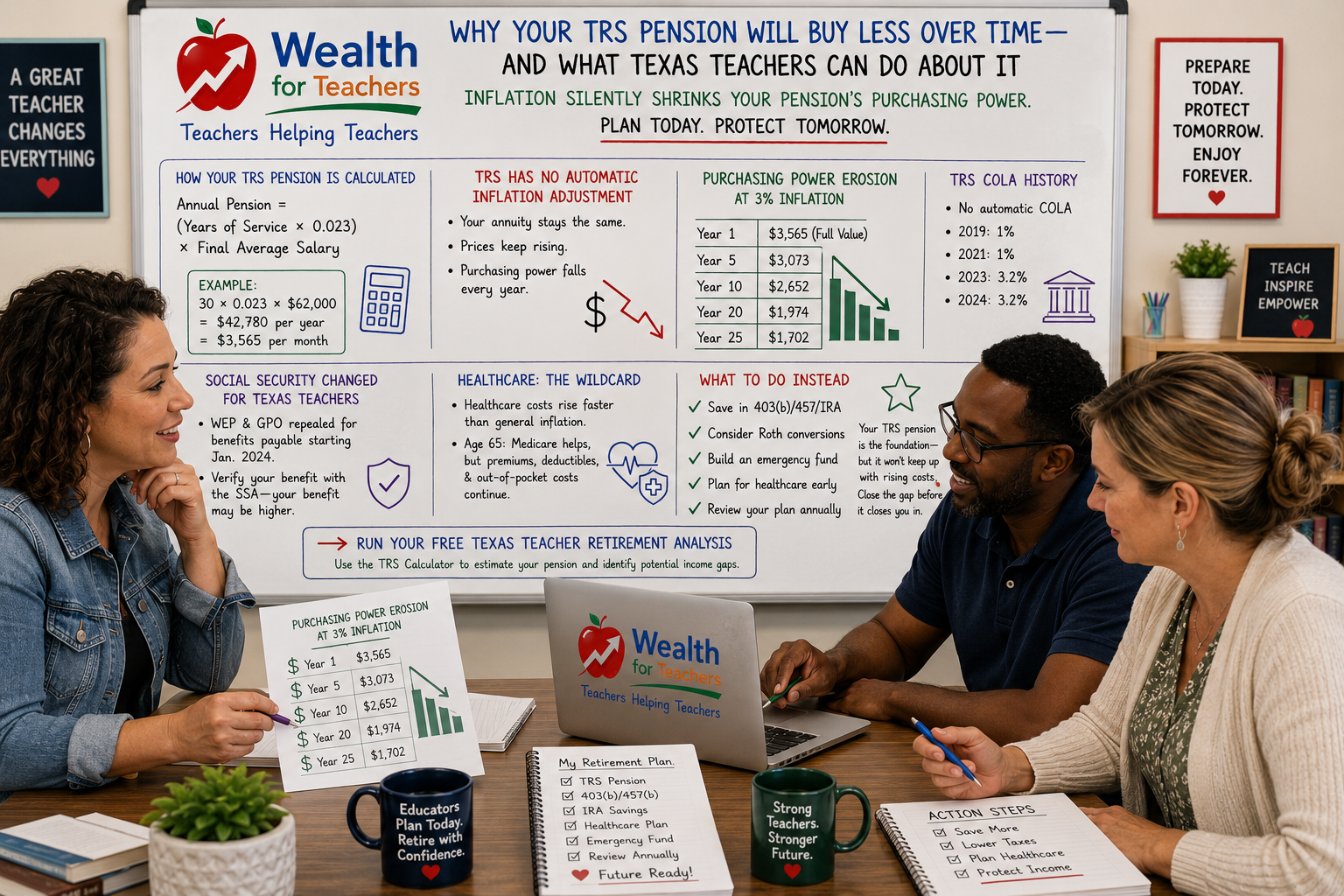
Part-time income that seems sufficient today may not keep pace with inflation over time. Inflation quietly reduces your TRS pension’s purchasing power, and relying on part-time work to fill the gap becomes increasingly difficult as prices rise.
Your ability to earn part-time income will likely decrease as you age, while your expenses may increase due to healthcare needs and other factors.
Before defaulting to part-time work as your retirement income solution, examine whether other strategies might better address your underlying financial needs.
Determine whether your income pressure stems from temporary adjustment issues, permanent lifestyle misalignment, or gaps in your retirement planning. Each cause requires different solutions.
Temporary adjustment issues might resolve as you adapt to retirement and find lower-cost ways to enjoy your time. Permanent misalignment requires lifestyle changes or strategic income planning. Planning gaps need comprehensive financial review and adjustment.
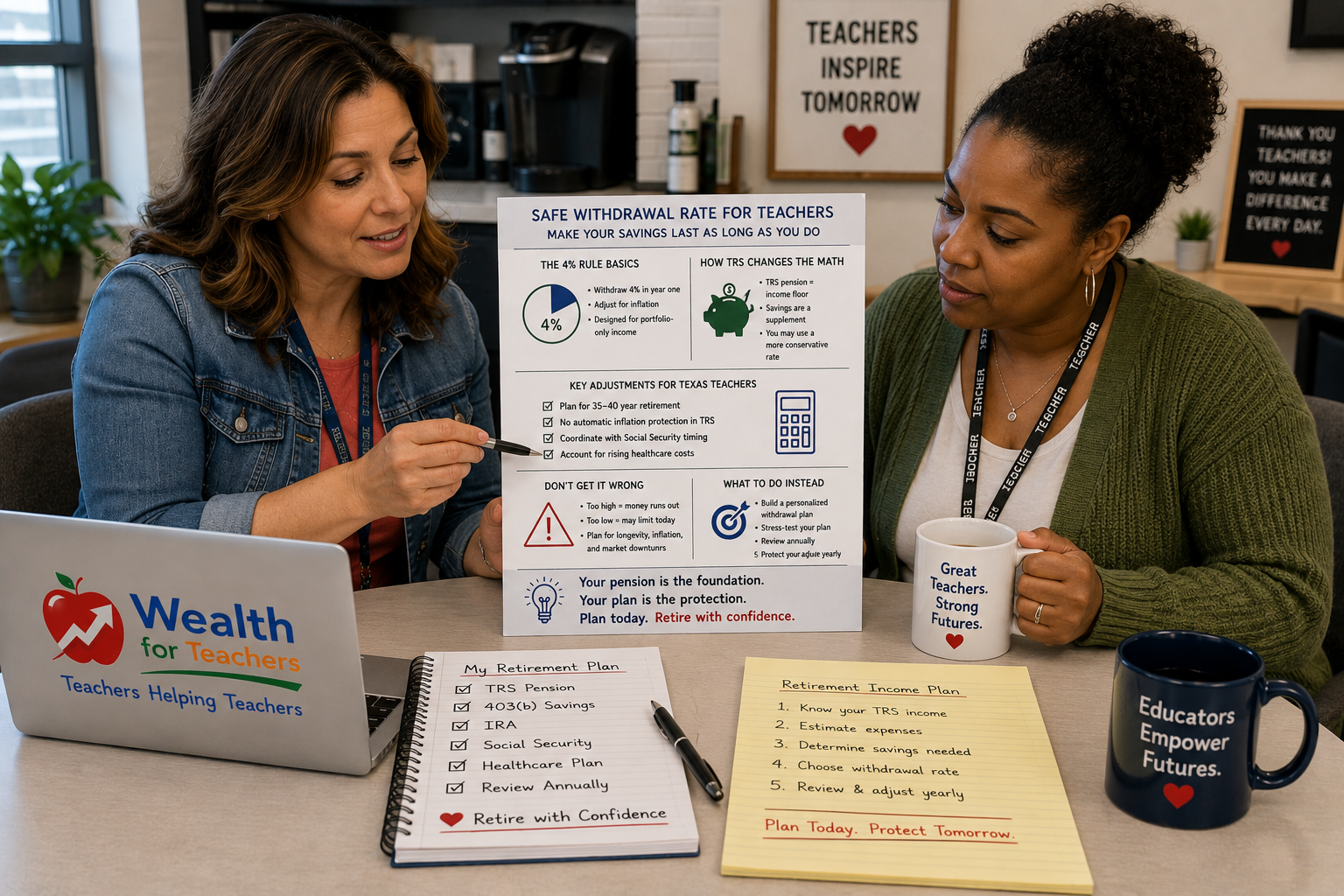
Examine whether you’re maximizing your current retirement income. This includes optimizing your Social Security claiming strategy, understanding your safe withdrawal rate from personal savings, and ensuring you’re not missing any available benefits or income sources.
Many teachers experience lifestyle inflation in the years leading up to retirement. Higher income in final working years can create spending habits that don’t align with retirement income. Addressing these habits may eliminate the need for part-time work.
Review your spending patterns and identify areas where you can reduce expenses without significantly impacting your quality of life.
The right choice depends on your specific financial situation, health, family circumstances, and retirement goals. Here are the key decision paths Texas teachers face:
If your TRS pension and other retirement income cover your basic needs but you want extra money for travel, hobbies, or gifts, part-time work can be a reasonable choice.
Consider the trade-offs carefully. Calculate the actual net benefit after taxes and expenses. Ensure the work schedule allows time for the activities you’re funding. Set clear boundaries about how much and how long you’re willing to work.
What can go wrong: Part-time work becomes a habit that continues longer than originally intended, consuming retirement years without proportional benefit.
If you retired earlier than planned or are waiting for other income sources to begin, part-time work can bridge the gap effectively.
Create a specific timeline and financial target. Know exactly when you plan to stop working and what will replace that income. Monitor your plan regularly to ensure you stay on track.
What can go wrong: The “temporary” gap becomes permanent if underlying retirement planning issues aren’t addressed.
If part-time income is necessary to cover essential expenses like housing, utilities, or healthcare, this indicates a more serious retirement planning issue.
Working part-time may be necessary short-term, but focus on developing a sustainable long-term solution. This might involve downsizing, relocating, or making significant lifestyle adjustments.
What can go wrong: Relying on part-time work for basic expenses becomes unsustainable as you age, creating a crisis when you can no longer work.
If part-time work allows you to maintain a lifestyle your retirement income can’t support, you’re postponing rather than solving the problem.
Make the necessary adjustments now while you have time to adapt and find alternatives. This might mean downsizing your home, reducing discretionary spending, or finding more cost-effective ways to meet your needs.
What can go wrong: Delayed lifestyle adjustments become forced adjustments later, often under less favorable circumstances.
If you’re considering part-time work because you miss the structure, social interaction, or sense of purpose from your teaching career, examine whether work is the best solution.
Consider volunteering, consulting, or other activities that provide similar benefits without the income pressure and tax complications. If you do choose part-time work, prioritize roles that provide the professional satisfaction you’re seeking.
What can go wrong: Taking any available work for income rather than finding meaningful activity that truly addresses your need for purpose and engagement.
Before making your decision about part-time work in retirement, honestly assess your situation with these diagnostic questions:
Can you cover your basic living expenses with your TRS pension and other guaranteed retirement income? If not, part-time work is a temporary solution to a permanent problem that needs comprehensive addressing.
Have you calculated the actual net benefit of part-time income after taxes, expenses, and opportunity costs? Many teachers overestimate the financial benefit because they focus on gross income rather than net impact.
Do you have a clear timeline and exit strategy for part-time work? Open-ended work commitments often continue longer than beneficial and can consume your retirement years.
Are you using part-time work to avoid making necessary lifestyle adjustments? If your retirement income doesn’t support your current lifestyle, working longer delays but doesn’t solve the underlying misalignment.
Will part-time work interfere with your primary retirement goals and relationships? The income benefit may not justify the lifestyle trade-offs if it prevents you from enjoying the retirement you’ve earned.
Most teachers don’t discover the gaps in their retirement income plan until they’re already retired and living with the consequences. By then, your options for addressing income gaps become more limited and expensive.
The part-time work decision feels urgent when you’re facing immediate income pressure, but it’s actually one piece of a larger retirement puzzle that should be solved comprehensively rather than piecemeal.
Testing your retirement plan before you need to live on it gives you time to make strategic adjustments rather than reactive decisions. It allows you to address the root causes of income gaps rather than just treating the symptoms.
Your TRS pension continues unchanged regardless of part-time work after retirement. However, if you return to work for a TRS employer, specific rules about earnings limits and benefit suspension may apply.
If you’re receiving Social Security retirement benefits, there are no earnings limits once you reach full retirement age. Before full retirement age, earnings limits apply that can temporarily reduce your benefits.
Health insurance can be a valuable benefit, but evaluate the total compensation package. Sometimes lower-paying work with health benefits provides better net value than higher-paying work where you pay for individual coverage.
Work expense deductions are more limited than they were in the past. Most employees can no longer deduct unreimbursed work expenses, though specific situations may qualify for other deductions.
If you need part-time income for basic living expenses rather than discretionary spending, this suggests your retirement income may be insufficient for long-term financial security. Consider whether your fixed pension creates hidden risks that need addressing.
Use the TRS calculator to estimate your pension and identify potential income gaps.