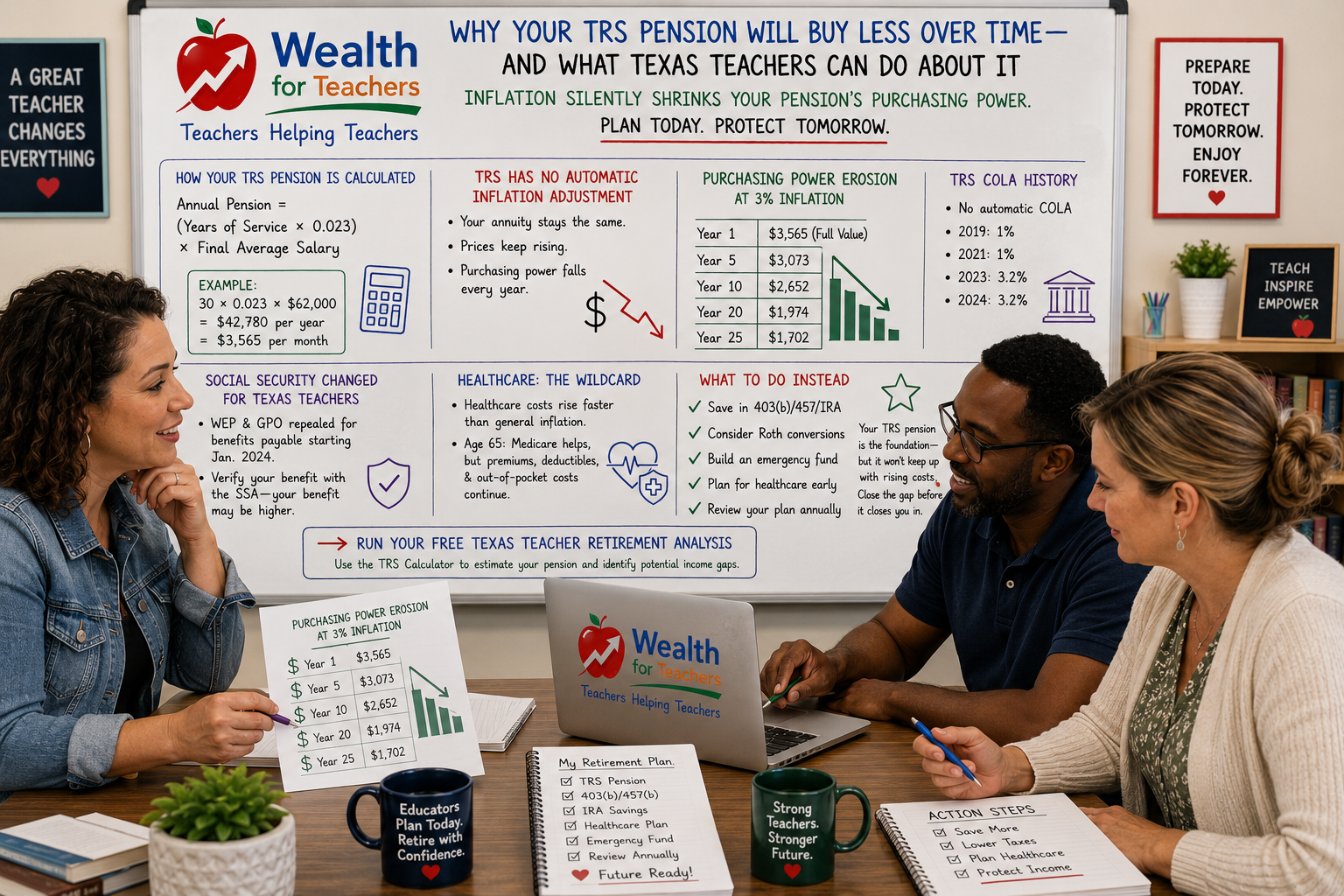

The Teacher Retirement Regrets That Are Entirely Avoidable — If You Plan Ahead
Retirement should feel like a reward. For many Texas teachers, it starts that way. Then the income gaps show up. The healthcare premiums arrive. The pension check that looked sufficient on paper doesn’t stretch the way they expected.
Texas teachers can also run a full pension estimate using the Texas Teacher Retirement Calculator to better understand their retirement outlook.
Teacher retirement regrets are more common than most educators realize — not because teachers made reckless decisions, but because they made reasonable assumptions that were never stress-tested against real retirement conditions.
This article breaks down the most frequently reported regrets from retired teachers, what caused them, and what you can do differently before you hand in your badge.
For a complete overview of how Texas TRS works and how to plan around it effectively, start with the Texas Teacher Retirement Planning Guide.
Most retirement plans fail not because they were reckless, but because they were never tested under real-world conditions. A pension estimate on a spreadsheet behaves very differently than actual monthly income when healthcare costs, inflation, and unexpected expenses enter the picture. The gap between what teachers plan for and what they actually experience is where regret lives.
Regret #1: Not Understanding the Income Gap
The Texas TRS pension formula is straightforward: your annual benefit equals your years of service multiplied by 2.3%, multiplied by your final average salary.
Run Your Free Texas Teacher Retirement Analysis
Use the TRS calculator to estimate your pension and identify potential income gaps.
Annual Pension = (Years of Service × 0.023) × Final Average Salary
A teacher with 28 years of service and a final average salary of $58,000 would receive:
28 × 0.023 × $58,000 = $37,352 per year, or about $3,113 per month.
That number can look reassuring during the planning phase. But many retired teachers didn’t account for what that pension replaces — or more importantly, what it doesn’t replace.
- Most Texas teachers do not receive Social Security benefits due to the Windfall Elimination Provision and Government Pension Offset
- The pension is fixed — it does not automatically increase with inflation
- Supplemental savings through 403(b) plans are often underfunded or not touched strategically
The regret isn’t that the pension is small. It’s that the total income picture was never fully assembled before retirement.
Understanding why retirement income planning is different for teachers is one of the most important steps you can take before your final year in the classroom.
Regret #2: Underestimating Healthcare Costs
Healthcare is consistently the most underestimated retirement expense for Texas teachers — and one of the most painful to correct after the fact.
Teachers who retire before age 65 face a coverage gap before Medicare eligibility. TRS-Care, the state’s retiree health plan, provides options, but premiums and out-of-pocket costs can be significantly higher than what active employees paid while working.
Teachers who retire without a spouse’s employer coverage and without sufficient savings to absorb premium increases often find themselves spending far more than projected on healthcare in the first decade of retirement.
Common mistakes include:
- Assuming TRS-Care premiums will stay flat after enrollment
- Not factoring in dental and vision costs, which TRS-Care does not fully cover
- Retiring early without calculating the monthly cost of coverage until Medicare kicks in
- Ignoring how chronic health conditions can shift out-of-pocket costs dramatically
A full breakdown of what this looks like in dollar terms is covered in the article on how healthcare costs impact Texas teacher retirement.
Regret #3: Retiring at the Wrong Time
Timing matters more in teacher retirement than most educators recognize — and the consequences of getting it wrong are permanent.
Texas TRS does not allow you to revise your retirement date or undo a benefit election once payments begin. That means a rushed or emotionally driven exit from the classroom can lock in a lower benefit for life.
Leaving Too Early
Because the TRS formula applies a flat 2.3% per year of service, each additional year you work meaningfully increases your benefit. A teacher who retires at 27 years instead of 30 years of service gives up 3 × 2.3% = 6.9% of their final average salary — permanently.
On a $60,000 final salary, that’s roughly $4,140 per year in lost pension income, every year, for life.
Ignoring the Rule of 80
Texas TRS uses the Rule of 80 to determine when a teacher can retire without an age-based reduction. If your age plus years of service total less than 80, and you are under age 60, your benefit may be reduced. Many teachers don’t calculate this carefully and retire with a permanently reduced benefit they didn’t expect.
Retiring During a Market Downturn
Teachers with 403(b) or 457(b) accounts often retire without considering what happens to those accounts during a market decline. If you begin withdrawing from supplemental accounts while they’re down significantly, the long-term damage compounds quickly. This is covered in detail in the article on what happens if you retire during a market downturn.
Regret #4: Retiring Without a Real Financial Plan
The most common teacher retirement regret of all is deceptively simple: not having a written, tested plan before leaving the classroom.
A TRS benefit estimate is not a retirement plan. It is one piece of a much larger income picture that must account for taxes, healthcare, debt, housing, supplemental savings, and longevity.
Teachers who carry significant debt into retirement often find the pension income insufficient to cover both living expenses and debt payments simultaneously. Addressing debt before retirement, rather than after, gives the pension far more flexibility to do its job. The article on whether Texas teachers should pay off debt before retirement walks through how to prioritize this decision.
Similarly, teachers who never explored Roth conversion strategies during their working years often face higher tax bills in retirement than expected, especially when required minimum distributions from 403(b) accounts begin. A Roth conversion executed during low-income years before retirement can reduce that burden significantly. The article on whether teachers should use Roth conversions before retirement explains how and when this applies.
What to Do Instead
Avoiding teacher retirement regrets doesn’t require predicting the future. It requires building a plan that holds up when conditions don’t go exactly as expected.
- Calculate your exact TRS benefit at multiple retirement ages — not just your target date. Know the dollar difference between retiring at 27, 28, 29, and 30 years.
- Model your healthcare costs from day one of retirement, not just once you reach Medicare eligibility. Know your TRS-Care options and their realistic total annual cost.
- Audit your supplemental accounts. What are they invested in? How much monthly income can they realistically generate without depleting too quickly?
- Resolve high-interest debt before your retirement date. Fixed income leaves little margin for debt service.
- Build a written income plan that covers year one through year fifteen, with realistic assumptions for inflation and healthcare cost increases.
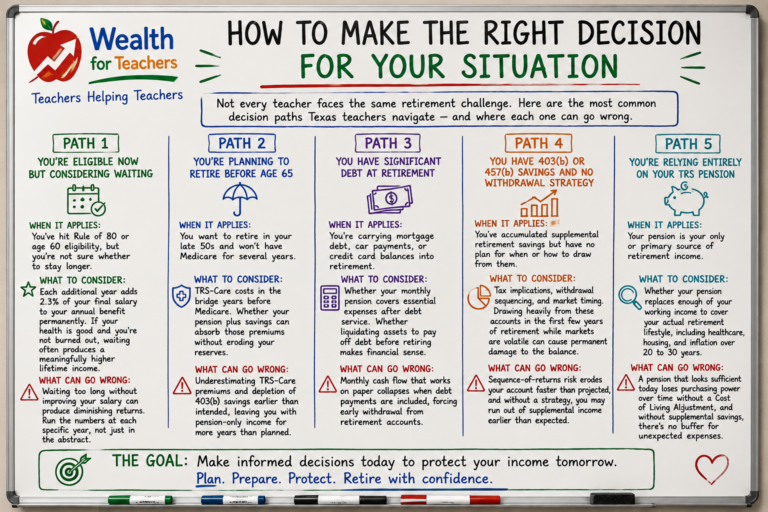
How to Make the Right Decision for Your Situation
Not every teacher faces the same retirement challenge. Here are the most common decision paths Texas teachers navigate — and where each one can go wrong.
Path 1: You’re Eligible Now But Considering Waiting
When it applies: You’ve hit Rule of 80 or age 60 eligibility, but you’re not sure whether to stay longer.
What to consider: Each additional year adds 2.3% of your final salary to your annual benefit permanently. If your health is good and you’re not burned out, waiting often produces a meaningfully higher lifetime income.
What can go wrong: Waiting too long without improving your salary can produce diminishing returns. Run the numbers at each specific year, not just in the abstract.
Path 2: You’re Planning to Retire Before Age 65
When it applies: You want to retire in your late 50s and won’t have Medicare for several years.
What to consider: TRS-Care costs in the bridge years before Medicare. Whether your pension plus savings can absorb those premiums without eroding your reserves.
What can go wrong: Underestimating TRS-Care premiums and depletion of 403(b) savings earlier than intended, leaving you with pension-only income for more years than planned.
Path 3: You Have Significant Debt at Retirement
When it applies: You’re carrying mortgage debt, car payments, or credit card balances into retirement.
What to consider: Whether your monthly pension covers essential expenses after debt service. Whether liquidating assets to pay off debt before retiring makes financial sense.
What can go wrong: Monthly cash flow that works on paper collapses when debt payments are included, forcing early withdrawal from retirement accounts.
Path 4: You Have 403(b) or 457(b) Savings and No Withdrawal Strategy
When it applies: You’ve accumulated supplemental retirement savings but have no plan for when or how to draw from them.
What to consider: Tax implications, withdrawal sequencing, and market timing. Drawing heavily from these accounts in the first few years of retirement while markets are volatile can cause permanent damage to the balance.
What can go wrong: Sequence-of-returns risk erodes your account faster than projected, and without a strategy, you may run out of supplemental income earlier than expected.
Path 5: You’re Relying Entirely on Your TRS Pension
When it applies: Your pension is your only or primary source of retirement income.
What to consider: Whether your pension replaces enough of your working income to cover your actual retirement lifestyle, including healthcare, housing, and inflation over 20 to 30 years.
What can go wrong: A pension that looks sufficient today loses purchasing power over time without a Cost of Living Adjustment, and without supplemental savings, there’s no buffer for unexpected expenses.
Quick Self-Check Before You Move Forward
Use these five questions to identify gaps in your retirement plan before they become regrets.
- Do you know your exact monthly TRS benefit at your current planned retirement date — and at one year later? If not, you may be leaving significant income on the table without realizing it.
- Have you calculated your monthly healthcare cost from retirement to age 65? If you’ve only looked at TRS-Care plan names without modeling the total annual premium and out-of-pocket exposure, this is an open gap.
- Does your pension alone cover your essential monthly expenses? If the answer is “mostly” or “I think so,” that’s a sign your income plan needs more precision.
- Do you have a plan for when to begin drawing from your 403(b) or 457(b)? Drawing too soon or without a strategy can deplete these accounts years ahead of schedule.
- Have you accounted for inflation over 20 or 30 years on a fixed pension? Purchasing power erosion is invisible in the first few years and damaging by the second decade.
Why Most Teachers Don’t Find the Gaps Until It’s Too Late
The difficult truth about teacher retirement regrets is that most of them were preventable. But they weren’t prevented because the gaps were invisible during the planning phase.
A pension estimate doesn’t show you what healthcare inflation looks like in year eight. A 403(b) balance doesn’t tell you what happens to your withdrawal plan if markets drop 25% in your first two years of retirement. A salary projection doesn’t reveal whether your income will hold up against a major home repair, a health event, or twenty-five years of fixed income with no cost-of-living adjustment.
The assumptions that feel safe today are the ones that cause regret tomorrow. Testing those assumptions — before you submit your retirement paperwork — is the only way to know whether your plan will hold.
Ready to Test Your Retirement Plan?
A TRS pension estimate is a starting point, not a complete plan. Before you make a final decision, make sure your income, healthcare, timing, and savings strategy have all been reviewed together.
Common Questions Texas Teachers Ask
Can I change my TRS retirement date after I’ve submitted paperwork?
Once your TRS retirement begins and your first payment is issued, the decision is generally final. This is why calculating your benefit at multiple retirement ages — before submitting anything — matters so much. Even a one-year difference can produce a meaningful change in lifetime income.
Does Texas TRS have a cost-of-living adjustment?
Texas TRS benefits are not automatically adjusted for inflation. Ad hoc increases require legislative action and are not guaranteed. This means your pension will likely buy less in year twenty than it does in year one, making supplemental savings and income planning more critical over a long retirement.
What is the biggest financial mistake Texas teachers make before retiring?
Retiring without knowing the full monthly cost of healthcare from retirement to age 65 is one of the most common and most costly mistakes. The second is not knowing the dollar difference in lifetime pension income between their current retirement date and one to two years later. Both are fixable before retirement — and nearly impossible to fix after.
Should I be worried about retiring during a down market if I have a 403(b)?
Yes. If you plan to draw from supplemental accounts alongside your pension, retiring into a declining market can accelerate account depletion through a combination of withdrawals and reduced account value. Having a withdrawal sequencing strategy — including when to draw from which account — is essential for protecting those savings in the early years of retirement.
Does downsizing my home make sense as part of a teacher retirement plan?
For some teachers it does, particularly those with a paid-off home who want to reduce maintenance costs or access equity to supplement fixed pension income. The decision depends on your local housing market, your remaining mortgage, and your overall income picture. The article on downsizing in retirement as a teacher covers when this strategy makes sense and when it doesn’t.