

The Wrong Withdrawal Order Can Cost Texas Teachers Thousands in Avoidable Taxes
Most Texas teachers spend decades building retirement income from multiple sources — a TRS pension, a 403(b), maybe a Roth IRA or traditional IRA on the side. What rarely gets discussed is that the order in which you tap those accounts has a direct impact on how much of that income the IRS keeps.
Texas teachers can also run a full pension estimate using the Texas Teacher Retirement Calculator to better understand their retirement outlook.
Getting the withdrawal strategy taxes teachers face exactly right is not a minor detail. It determines your effective tax rate in retirement, how long your savings last, and whether a single decision early in retirement quietly drains your portfolio over the next two decades.
This guide explains how to sequence withdrawals across a TRS pension, tax-deferred accounts, and Roth accounts — and what goes wrong when teachers treat those accounts as interchangeable.
For a broader foundation, start with the Texas Teacher Retirement Planning Guide before working through the sequencing decisions below.
Most retirement plans look fine on paper. They fall apart when tested against real tax brackets, Social Security offsets, healthcare premiums, and required minimum distributions all arriving at the same time. A plan that was never stress-tested under real-world conditions is not a retirement plan — it is a guess.
Why Withdrawal Order Matters for Texas Teachers
Texas teachers are not typical retirees. You likely do not receive Social Security, which changes how your taxable income stacks in retirement. Your TRS pension starts the moment you retire and never stops — it is not optional income you can defer or skip in a given year.
Run Your Free Texas Teacher Retirement Analysis
Use the TRS calculator to estimate your pension and identify potential income gaps.
That fixed pension creates a permanent income floor. Every dollar you pull from a 403(b) or traditional IRA on top of that floor pushes you higher into your marginal tax bracket. If you also trigger required minimum distributions (RMDs) from a 403(b) later in retirement, you could be forced to take taxable income you do not need — and pay taxes you did not have to pay.
This is why sequencing matters. It is not about which account earns the best return. It is about which account you draw from, when, and in what combination — to keep your annual taxable income as low and as controlled as possible.
Understanding why retirement income planning is different for teachers is the starting point for building a sequencing strategy that actually fits your situation.
Understanding Your Three Tax Buckets
Retirement assets fall into three categories based on how they are taxed when withdrawn:
- Taxable now: TRS pension income, traditional 403(b) distributions, traditional IRA withdrawals. Every dollar counts as ordinary income in the year you receive it.
- Tax-deferred: Money still sitting inside a traditional 403(b) or IRA. You owe taxes when you withdraw, not before. RMDs force withdrawals starting at age 73.
- Tax-free: Roth IRA and Roth 403(b) contributions and earnings, once the account is at least five years old and you are 59½ or older. Withdrawals here add nothing to your taxable income.
The goal of a tax-efficient withdrawal strategy is to manage how much income lands in each tax bucket each year — keeping you out of higher brackets and preserving tax-free assets for when they produce the most benefit.
TRS Pension as the Tax Foundation
Your TRS pension is permanent, predictable, and fully taxable as ordinary income. It does not respond to market conditions, and you cannot reduce it or defer it once payments begin.
Texas TRS calculates your pension using a flat 2.3% multiplier per year of service applied to your final average salary:
Annual Pension = (Years of Service × 0.023) × Final Average Salary
For example, a teacher with 28 years of service and a final average salary of $62,000 receives:
28 × 0.023 × $62,000 = $39,928 per year
That $39,928 is taxable income before you touch a single retirement account. It sets your baseline tax bracket for every year of retirement. Every additional withdrawal — from a 403(b), IRA, or any other source — layers on top of it.
This is why many Texas teachers are surprised when they retire and realize that withdrawing even $15,000 to $20,000 from a traditional 403(b) pushes them meaningfully higher in their marginal bracket. The pension left less room than they expected.
A Practical Sequencing Strategy
There is no single correct sequence for every teacher. But a commonly effective approach follows this general logic:
Phase 1: Early Retirement — Fill the Bracket Intentionally
In the years immediately after you retire — before RMDs begin at 73 — your taxable income may be lower than it will be later. This is the window to draw strategically from tax-deferred accounts or execute Roth conversions up to the top of your current bracket without overpaying.
Phase 2: Mid-Retirement — Preserve Tax-Free Assets
Once RMDs begin, your taxable income rises automatically. If you have already reduced your traditional 403(b) or IRA balance through conversions or distributions in Phase 1, the RMD calculation produces a smaller forced withdrawal — and a smaller tax bill.
Phase 3: Late Retirement — Use Roth Last
Roth accounts are most valuable late in retirement because they carry no RMDs and pass to heirs tax-free. Using them last maximizes the compounding and keeps options open for estate planning or unexpected expenses.
The Roth Conversion Window Before RMDs Hit
If you retired in your late 50s or early 60s and have a significant traditional 403(b) balance, the years between retirement and age 73 represent a narrow tax planning window.
During this period, your income may be lower than it will be once RMDs kick in. Converting a portion of your traditional 403(b) to a Roth each year — up to the top of the 22% or 24% bracket — can reduce future forced income while locking in a known tax rate today.
This is one of the most powerful levers available to teachers who do not receive Social Security. Without that income source, there is more room in the lower brackets to execute conversions without crossing into higher territory.
Learn more about whether Roth conversions make sense for teachers before making this decision, because the math depends heavily on your specific pension amount, bracket situation, and account balances.
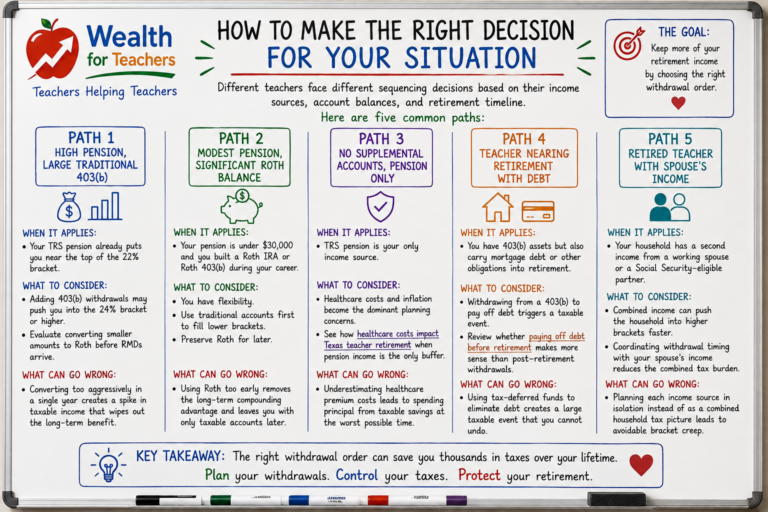
How to Make the Right Decision for Your Situation
Different teachers face different sequencing decisions based on their income sources, account balances, and retirement timeline. Here are five common paths:
Path 1: High Pension, Large Traditional 403(b)
When it applies: Your TRS pension already puts you near the top of the 22% bracket.
What to consider: Adding 403(b) withdrawals may push you into the 24% bracket or higher. Evaluate converting smaller amounts to Roth before RMDs arrive.
What can go wrong: Converting too aggressively in a single year creates a spike in taxable income that wipes out the long-term benefit.
Path 2: Modest Pension, Significant Roth Balance
When it applies: Your pension is under $30,000 and you built a Roth IRA or Roth 403(b) during your career.
What to consider: You have flexibility. Use traditional accounts first to fill lower brackets, preserve Roth for later.
What can go wrong: Using Roth too early removes the long-term compounding advantage and leaves you with only taxable accounts later.
Path 3: No Supplemental Accounts, Pension Only
When it applies: TRS pension is your only income source.
What to consider: Healthcare costs and inflation become the dominant planning concerns. See how healthcare costs impact Texas teacher retirement when pension income is the only buffer.
What can go wrong: Underestimating healthcare premium costs leads to spending principal from taxable savings at the worst possible time.
Path 4: Teacher Nearing Retirement With Debt
When it applies: You have 403(b) assets but also carry mortgage debt or other obligations into retirement.
What to consider: Withdrawing from a 403(b) to pay off debt triggers a taxable event. Review whether paying off debt before retirement makes more sense than post-retirement withdrawals.
What can go wrong: Using tax-deferred funds to eliminate debt creates a large taxable event that you cannot undo.
Path 5: Retired Teacher With Spouse’s Income
When it applies: Your household has a second income from a working spouse or a Social Security-eligible partner.
What to consider: Combined income can push the household into higher brackets faster. Coordinating withdrawal timing with your spouse’s income reduces the combined tax burden.
What can go wrong: Planning each income source in isolation instead of as a combined household tax picture leads to avoidable bracket creep.
What to Do Instead
Instead of drawing from accounts reactively — pulling from whatever feels available — build a written annual income plan before retirement begins. That plan should:
- Start with your TRS pension as fixed income and calculate your baseline taxable income
- Identify how much room remains in your current marginal bracket before hitting the next level
- Determine whether converting traditional 403(b) funds to Roth in the early retirement window makes mathematical sense given your bracket
- Set a target annual withdrawal amount from each account type that keeps total income within a defined range
- Revisit the plan every year as your balance, bracket, and expenses change
This is not a one-time calculation. Tax brackets adjust, account balances shift after market performance, and healthcare costs change. A withdrawal strategy that was correct at 62 may be wrong at 68.
If you are also weighing major expenses like housing in retirement, review whether downsizing makes financial sense for teachers before locking in a withdrawal plan built around current expenses.
Quick Self-Check Before You Move Forward
Before finalizing any withdrawal approach, answer these five questions honestly:
- Do you know exactly what tax bracket your TRS pension alone puts you in? If not, you cannot accurately plan any additional withdrawal without risking an unexpected tax increase.
- Have you calculated when your RMDs begin and how large they will be? A large 403(b) balance at 73 may force withdrawals you do not need, at a tax rate higher than you anticipated.
- Do you have a Roth account, and do you know when it becomes fully tax-free? The five-year rule and age requirements still apply to Roth accounts opened later in your career.
- Does your withdrawal plan account for healthcare premiums before Medicare begins? Retiring before 65 often creates a gap where healthcare costs are high and entirely out of pocket.
- Have you modeled what your annual taxable income looks like at age 75 versus age 65? Most teachers focus on the first few years of retirement, not the decade when RMDs, inflation, and rising expenses converge.
Most Teachers Don’t Find the Gaps Until It’s Too Late
The most common pattern in teacher retirement planning is not catastrophic failure. It is a slow erosion — decisions that looked reasonable in isolation but were never tested together under real conditions.
A teacher withdraws from her 403(b) earlier than needed. Another holds off on Roth conversions waiting for the right moment, and the window closes when RMDs arrive. A third retires during a down market and liquidates at the worst possible price to cover expenses.
None of these situations announce themselves in advance. They emerge from assumptions that were never pressure-tested — assumptions about tax brackets, about account balances, about how expenses actually behave in retirement.
Understanding what happens when you retire during a market downturn is one example of how assumptions can collapse quickly when real conditions arrive. Withdrawal sequencing works the same way. The plan that looked efficient in a spreadsheet may not hold when three income sources, two tax brackets, and an unexpected expense appear in the same year.
The only way to close those gaps is to test the plan before you commit to it — not after.
Common Questions Texas Teachers Ask
Does my TRS pension affect how I should draw from my 403(b)?
Yes, directly. Your pension establishes your baseline taxable income each year. Every 403(b) withdrawal adds to that total. Teachers with higher pensions have less room in lower brackets before their marginal rate rises, which changes the math on both withdrawal timing and Roth conversion decisions.
Should I take 403(b) withdrawals before or after Medicare begins?
This depends on your total income picture. Medicare premiums are income-tested through the IRMAA surcharge — higher income in a given year can raise your Medicare Part B and Part D premiums the following year. Large 403(b) withdrawals can trigger those surcharges, which is a hidden cost most teachers do not anticipate.
Is it ever smart to withdraw from a Roth account early in retirement?
In rare situations, yes — particularly if you face a large unexpected expense and pulling from a Roth avoids pushing you into a higher bracket. But as a default sequencing rule, preserving Roth assets for late retirement and estate purposes provides the strongest long-term outcome for most Texas teachers.
What happens if I ignore withdrawal sequencing entirely?
You will likely pay more in taxes than necessary over the course of retirement. You may also trigger larger RMDs later that force you to take income you do not need, potentially causing Medicare surcharges and pushing you into a higher bracket. The cost compounds quietly across years, which is why it is easy to underestimate.
Does it matter that Texas teachers often do not receive Social Security?
It matters significantly. Without Social Security income, Texas teachers have more control over their taxable income in retirement. That creates real opportunities to execute Roth conversions at lower rates and manage bracket exposure more precisely than retirees who receive fixed Social Security income on top of their pension.
Ready to Test Your Withdrawal Strategy?
A withdrawal plan that works on paper is very different from one that holds under real tax conditions. If you have a TRS pension, a 403(b), and retirement approaching, the sequencing decisions you make now have lasting tax consequences.
Get a clear picture of what your retirement income actually looks like — and where the gaps are before they cost you.